

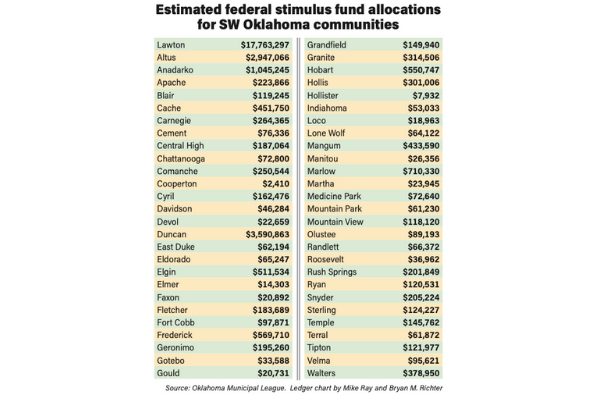
OKLAHOMA CITY – Southwest Oklahoma cities, towns and counties expect to receive allocations ranging from a few thousand dollars to several million from the $1.9 trillion federal stimulus package approved by Congress and signed by President Biden.
The “American Rescue Plan Act of 2021” includes $1.87 billion in additional relief for Oklahoma to address the continued impact of COVID-19 on the economy, public health, state and local governments, individuals and businesses.
That total includes $540,746,888 in stimulus aid to Oklahoma cities and town, and an estimated $768,600,000 in federal aid to Oklahoma’s 77 counties.
Lawton, for example, is in line for $17.7 million; Altus, $2.9 million; Cache, more than $450,000; Duncan, $3.59 million; Elgin, Frederick and Hobart, more than $500,000 each; and Walters, more than $375,000. In addition, 10 counties in Southwest Oklahoma are expected to receive a collective total of $49 million. (See accompanying charts.)
The funding formula for the states started with $500 million for every state and additional funds (in Oklahoma’s case, $1.37 billion) based on average unemployment rates. Connecticut, for example, has approximately 400,000 fewer residents than Oklahoma but received $940 million more in federal aid because it has a higher average unemployment rate.
The first tranches of federal funds were slated to be distributed Tuesday. How the funds will be spent locally remained unclear this week.
Lawton municipal officials have not yet decided how to spend their allocation.
“Since the portal to apply just opened Tuesday,” City Manager Michael Cleghorn and city staff “will be working on recommendations to present to the City Council on ways to spend potential funding to improve the community,” Community Relations Director Tiffany Vrska said Wednesday. “The document they need to review is about 150 pages long, so they are still studying that. No decisions have been made yet. They will be mulling different ideas for a bit.”
“From what I understand, it is complicated and has to be looked at very carefully,” Comanche County Central District Commissioner Johnny Owens said Tuesday. “It is being studied to determine exactly what we can use it for,” he said.
Comanche County is slated to receive more than $23 million in federal stimulus aid from the American Rescue Plan. The Board of County Commissioners voted Monday to establish a new account exclusively for the federal stimulus disbursement.
The President signed the bill, H.R. 1319, on March 11 and local officials were notified soon after.
Every member of Oklahoma’s all-Republican congressional delegation voted against H.R. 1319. “Nay” votes were cast by Representatives Tom Cole, Frank Lucas, Stephanie Bice, Markwayne Mullin and Kevin Hern, and by Senators Jim Inhofe and James Lankford.
CATEGORIES OF FUNDING
Specifically, H.R. 1319 provides funding for:
• agriculture and nutrition programs, including the Supplemental Nutrition Assistance Program (SNAP, formerly known as the food stamp program);
• schools and institutions of higher education;
• child care and programs for older Americans and their families;
• COVID-19 vaccinations, testing, treatment, and prevention;
• mental health and substance-use disorder services;
• emergency rental assistance, homeowner assistance, and other housing programs;
• payments to state, local, tribal, and territorial governments for economic relief;
• small business assistance, including specific programs for restaurants and live venues;
• programs for health care workers, transportation workers, federal employees, veterans, and other targeted populations;
• tribal government services;
• state, territorial, and tribal capital projects that enable work, education, and health monitoring in response to COVID-19;
• health care providers in rural areas;
• scientific research and development;
• international and humanitarian responses.
OTHER PROVISIONS
The bill also includes provisions that:
• extend unemployment benefits and related services;
• make tax-free the first $10,200 per taxpayer of 2020 unemployment benefits received in 2020, for taxpayers who have a modified federal adjusted gross income of less than $150,000;
• make student loan forgiveness tax-free through 2025;
• provide a maximum recovery rebate of $1,400 per eligible individual;
• expand and otherwise modify certain tax credits, including the child tax credit and the earned income tax credit;
• provide premium assistance for certain health insurance coverage; and
• require coverage, without cost-sharing, of COVID-19 vaccines and treatment under Medicaid and the Children's Health Insurance Program (CHIP).
OKLA. CITIES, TOWNS TO GET $500+M
According to the Oklahoma Municipal League (OML), passage of the American Rescue Plan ensures that Oklahoma municipalities will be eligible for more than $500 million in federal aid.
Following are details known and unknown so far about the program, OML Executive Director Mike Fina said.
WHAT IS KNOWN
• Entitlement cities (more than 50,000 population) will receive funding directly from the Treasury.
• The bill clearly says that the States cannot interfere with the funding.
• Treasury has no data for non-entitled municipalities, so it will depend on states to verify the amounts.
• A community’s allocation cannot exceed 75% of the municipality’s pre-COVID budget.
• Funds will come in two tranches: one at 30 days and the second 12 months after the first appropriation.
• The federal relief funds can be allocated until the end of 2024.
• Unused funds, if any, will go back to Treasury at the end of 2024 and cannot be utilized for other projects in other states.
UNKNOWNS
• Treasury is being urged to make clear in its rules that states cannot put any additional limitations on the funds.
• Since the funds are a pass-through to municipalities, who will be responsible for verifying appropriate use of the money? Will this be different from the CARES Act?
• Make clear the rules on use of funds with an emphasis on the two areas below:
--Water, wastewater and broadband.
--Clarity on how to evaluate the 75%: Are municipal authorities considered in the 75%?
--Will Treasury create rules protecting against states requiring certain uses of the funds to leverage state projects? This has already been attempted in other states, in an effort to pull money from the municipal allocations.
--Will municipal authorities’ income be considered in budget calculations?
U.S. COUNTIES TO RECEIVE $65B
The federal stimulus program allocates $65.1 billion in direct federal aid to all counties in the U.S. based on their share of the American population.
The National Association of Counties reports that allowable uses outlined in the bill include, but are not limited to:
• Responding to or mitigating the public health crisis with respect to the COVID-19 emergency or its negative economic impacts;
• Providing government services to the extent of the reduction in revenue;
• Making necessary investments in water, sewer, or broadband infrastructure; and
• Responding to workers performing essential work during the COVID-19 public health emergency by providing premium pay to eligible workers of the county who are performing such essential work, or by providing grants to eligible employers that have eligible workers who perform essential work.
The bill classifies ‘eligible workers’ as those who are needed to maintain continuity of operations of essential critical infrastructure sectors and additional sectors, as each chief executive officer of a metropolitan city, non-entitlement unit of local government, or county may designate as critical to protect the health and well-being of their residents.
REPORTING REQUIREMENTS
Local governments, including counties, must provide “periodic reports” that include a detailed accounting of the use of funds.
If a state, county or municipality does not comply with any provision of this bill, it will be required to repay the U.S. Treasury an amount equal to the funds used in violation.
States are required to report how funds are used and how their tax revenue was modified during the time that funds were spent during the covered period (which begins on March 3, 2021, and ends on the last day of the fiscal year a state or local government has expended or returned all of its funds to the U.S. Treasury).
States are not allowed to use the funds to either directly or indirectly offset a reduction in the net tax revenue that results from a change in law, regulation or administrative interpretation during the covered period.