

OKLAHOMA CITY – It might be a tightrope to walk, but state leaders in both legislative chambers are willing to try and bring Gov. Kevin Stitt’s vision for an income tax cut to reality.
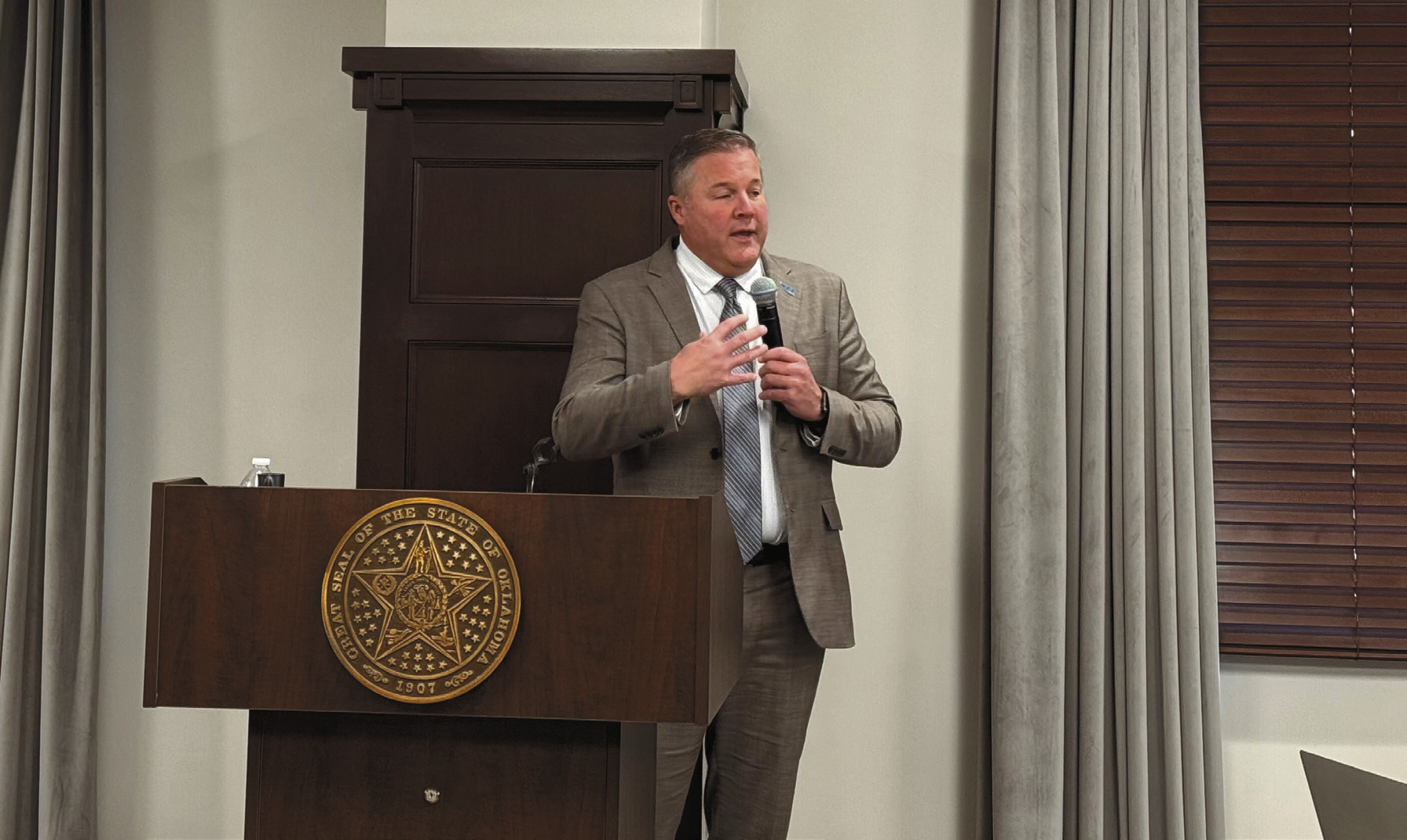
House Speaker Kyle Hilbert (R-Bristow) and Senate President Pro Tem Lonnie Paxton (R-Tuttle) spoke Feb. 6 to state media at the Oklahoma Press Association’s Annual Legislative Summit held at the Capitol. Both lawmakers said they are waiting on final budget numbers from the Board of Equalization to be released this week to see if the .5% desired cut to the top end 4.75% state income tax is feasible.
Stitt proposed a “half-anda- path” plan to implement income tax relief for Oklahomans in his Feb. 3 State of the State address. His speech opened Oklahoma’s 60th Legislative Session and he challenged lawmakers to build on recent progress to make the state “the very best state to live, to work and to raise our families.”
The governor noted significant strides made over the last several years.
“We’ve gotten so much done in the last six years together,” Stitt said. “We’ve built the largest savings account our state has ever seen. We passed the largest tax cut in history. Our economy is the strongest it’s ever been.
“We have become a top 10 state for business. We are number four for GDP growth. We are number two in lowest cost of doing business. We are number eight in net migration to our state. We have 3,500 fewer kids in foster care than we did when I took office.
“The state of our state is the strongest it’s ever been. And we are not done yet.”
Stitt’s reference to the “largest savings account our state has ever seen” is outlined in his Executive Budget Summary presented to the legislators. Under a section detailing the state’s financial condition, it’s noted that the state’s revenue position has fully recovered since a revenue failure was declared in Fiscal Year 2020.
State tax collections reached a record $14,176,086,118 in FY 2023, as reported in the Oklahoma Tax Commission’s annual report. This was a 5.78% increase over FY 2022. In FY 2024 state tax collections totaled $13,555,381,421, a decrease of 4.4% from FY 2023.
The healthy savings account and record tax collections prompted the governor to become passionate about giving Oklahomans tax relief. Out of the 2024 legislative session starting gate, leaders agreed on eliminating the state portion of the grocery tax, which, at the time, was the largest tax cut in state history.
Before the cut, Oklahoma was one of only 13 states that imposed a grocery tax. However, House Bill 1955 was approved by Stitt on Feb. 27, 2024, and became effective in August. It eliminated the 4.5% state sales tax on groceries and the action was projected to save Oklahoma families an expected average of $700 per year.
Last Thursday, Paxton said the elimination of the state sales tax on groceries has contributed to the current state budget’s projected deficit. The Oklahoma Tax Commission’s December projections and estimates show that collections are expected to decline slightly in FY 2025 with slight growth expected in FY 2026.
Even with the hefty savings account, Stitt nor state leaders want to dip into it for recurring expenses.
“I want to set a savings floor of $4 billion to ensure we can weather any financial storm,” Stitt said in his State of the State address. “Let’s not go back to 2018.”
Documents from the Oklahoma Council of Public Affairs (OCPA) show that during the statewide recession that began in 2015, the state’s savings account was severely depleted.
“The account was so depleted it was one of the factors cited by Standard & Poor’s (S&P) for downgrading Oklahoma’s credit in 2017. This S&P rating was used by tax advocates to push for large tax increases. From 2015 until 2018 the Legislature passed an estimated $1.1 billion in increased tax and revenue measures,” the OCPA report said.
Paxton and Hilbert remember this painful scenario well, as they both began legislative service in 2016. Neither want to take any actions with taxpayers’ money to cause a repeat crisis.
“If I leave the Legislature and three to four years after I’m gone, the Legislature has inherited major budget deficits with no savings because of some action that I took, that I will feel like my entire 12 years here was a complete failure, so I don’t want to do that,” Paxton said.
The Senate President Pro Tem also echoed Stitt’s concern that states surrounding Oklahoma – Nebraska, Missouri, Arkansas, Colorado and Louisiana – are cutting their income taxes and have lower rates. State leaders do not want Oklahoma to be considered a high tax state.
“I like to remind the naysayers when we cut taxes, the money doesn’t disappear. It simply stays in Oklahomans’ pockets and gets reinvested in our economy. In times of excess revenue, Oklahomans should keep more of their hard-earned money. That is how we keep pace with our competition and protect Oklahoma taxpayers,” Stitt said.
The lingering question is how much of an excess revenue is actually available to work with this session.
According to the Board of Equalization’s December meeting, revenues from certified and authorized funds for appropriation are expected to decrease from $10,828,038,037 in FY 2025 to $10,745,362,316 in FY 2026. The state’s largest appropriated fund, the General Revenue Fund, is currently projected in FY 2025 to collect $8,404,243,593, a decrease of $62 million, or -0.73%, from FY 2024 actual collections.
Revenue available for appropriation is determined by the Board of Equalization in December and re-estimated in February. These estimates do not include federal funds, off-thetop apportionments, and most fees and fines collected by state agencies.
State lawmakers are waiting for the re-estimation to come out around Feb. 15, basically in just a few days. Leaders have committed to “trying” to make the income tax cut work.