

Greater paternal connection benefits inmates, children, and public safety
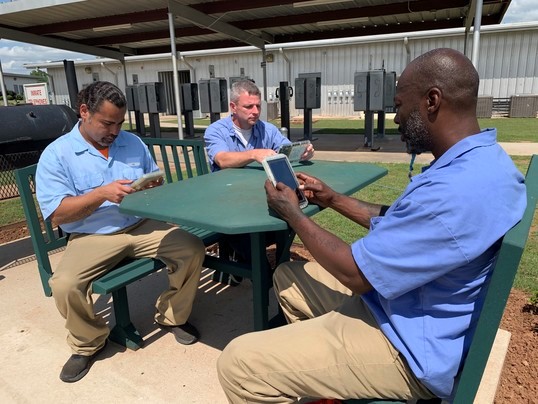
UNION CITY – Navigating holidays is an emotional journey for Robert Rivard.
“Holidays are tough,” said Rivard, who is confined at the Union City Community Corrections Center. “I miss my family so desperately.”
Among the 1.2 million people in federal and state prisons, 92% are fathers. This Father’s Day, Oklahoma’s incarcerated got reconnected.
One year ago, Securus Technologies and the Oklahoma Department of Corrections began distributing free digital tablets to 22,000 inmates, men and women alike.
Josh Ward, the DOC’s public information manager, said the tablets were provided at no charge to the Corrections Department through Securus, which operates inmate telephone services.
The tablets represent a critical update to communications and technology.
“I can go to my cell and be able to talk to them, be able to hear them a lot better than out there,” said inmate Leo Day. As the father of a toddler, he enjoys receiving video grams, e-messaging, and the freedom of talking to family.
“I’ll be able to talk to him and hear his little munchkin voice,” Day said. “He’s just learning how to talk and all of that.”
As beneficial as it is for the inmates to be able to connect with family, the impacts on the lives of children are even greater. “There is nothing better than the love a child has for their parents,” said Matthew Craig, the Corrections Department’s chief of technical services. “Giving that access is huge for the children in the way they see life.”
The tablets also include access to approved television shows, movies and music, along with educational and employment resources. But it’s access to loved ones that these incarcerated parents appreciate most of all.
“I have tons of messages from my wife and my kids,” Rivard said. “It almost brings me to tears. This tablet is a blessing.”
Said inmate John Kepler, “You can still be in prison and if your family wants to say something to you, that’s worth a lot. Or just to say, ‘Dad, I love you.’”
One year after introducing the tablets, ODOC has seen improved morale and more motivated male and female inmates, Ward said. It has strengthened bonds between incarcerated parents and their children.
To promote successful reintegration into the community, the Corrections Department and Securus provide approved inmates with the opportunity to utilize automated wireless devices to access secure content approved by the agency and the company. “Use of the wireless device by inmates is a privilege, not a right,” the DOC emphasizes.
The service provided by Securus is “highly restricted and heavily monitored,” Ward said. Use of the wireless devices is subject to monitoring and recording.
Securus provides wireless access that enables DOC staff to have direct, real-time oversight of the tablets. The facility head or designee can deactivate wireless devices through the command-and-control tablet during emergencies, periods of inclement weather, “and as dictated by the safety and security needs of the facility.”
The devices are available for use by inmates who are housed in general population. Inmates in a special management unit may have availability to limited applications. Inmates in a special management unit for disciplinary housing, suicide watch, mental health observation, violent behavior or other aggravating factors are not authorized use of an electronic tablet.
If an inmate deliberately damages a tablet, he/she must pay a $200 restitution fee to replace the device.
The tablets remain the property of Securus “and will be surrendered by the inmate upon discharge from an ODOC facility,” the agency’s official policy for administration of the program decrees.