

OKLAHOMA CITY – Union Pacific Railroad has announced its intention to cut its greenhouse gas emissions 26% by 2030 compared to its 2018 levels. UP also declared its commitment to achieve net zero carbon emissions by 2050.
“This effort comes with significant challenges,” said Kristen South, UP’s senior director of corporate communications and media relations.
For example, the Omaha, Neb.-based company said it plans to increase the percentage of low-carbon fuels it uses to 10% of total diesel consumption by 2025 and to 20% by 2030.
“Increasing our use of renewable diesel and biodiesel fuels represents the most promising avenue to help Union Pacific meet its science-based target,” Ms. South said.
In August of this year Union Pacific announced that Progress Rail approved the use of up to 20% biodiesel blend in the vast majority of ElectroMotive Diesel (EMD®) locomotives operated by UP, she said. Previously the locomotives were authorized to operate using a biodiesel blend of up to 5%, she said. Progress Rail and Union Pacific “are working together to test the higher biodiesel blend in the remaining EMD® fleet,” she continued.
“This is only the initial step. EMD® locomotives represent approximately 40% of our existing locomotive fleet. To reach our goals related to the consumption of low-carbon fuels, we must reach a critical mass of our locomotive fleet compatible with higher blends of low-carbon fuels.” In addition, she said, additional infrastructure investments may be required to facilitate the storage and use of higher-blend fuels.
“Our next steps include seeking similar approvals for use of a 20% biodiesel blend from the other primary locomotive original equipment manufacturer (OEM) and securing adequate supplies of low-carbon fuels,” Ms. South said. “We are having conversations with current and potential biodiesel supply chain parties to determine what infrastructure requirements will be needed to help us achieve our goals.”
UP said it has spent billions of dollars to improve operational efficiency and minimize fuel consumption with a more advanced locomotive fleet and energy management technology.
The company said it will continue to expand its use of an “energy management system” (EMS) that “acts like cruise control” to “help identify fuel-saving opportunities” on its trains. The EMS has been implemented in approximately two-thirds of UP’s active road fleet.
RR UPGRADING ITS LOCOMOTIVE FLEET
In a related matter, UP is engaged in a fleet modernization program, Ms. South said.
UP has invested roughly $3.4 billion to buy more than 1,300 new locomotives since 2010, while retiring approximately 2,500 older, less fuel-efficient locomotives, the company reported.
Nearly 175 high- and low-horsepower locomotives were overhauled last year, “meaning they were completely rebuilt to meet more stringent emissions standards,” Ms. South said. “Each modernization results in an approximate 53% reduction in emissions through better fuel efficiency, and an additional 5% reduction in fuel consumption per engine.”
The overhauls “improved the reliability of our fleet, which resulted in a 14% increase in locomotive productivity compared to 2019,” she said.
UP expects to complete “around 100 modernizations” this year and plans for “around 120 or so” next year,” Ms. South said, adding, “We anticipate continuing this pace of modernizations in future years.”
Union Pacific officials said the railroad also intends to collaborate with manufacturers to develop battery-powered locomotives that could be used in some of its railyards. However, it probably will be several years before those are available, the company said.
“We are leveraging our experience with low-emission switcher locomotive technology to develop specifications for a battery-electric locomotive that could be deployed in selected yard operations,” Ms. South said. A battery-electric low-horsepower locomotive prototype exists “and we are in preliminary discussions with our locomotive OEMs about this technology.”
Switching operations in yards are “an ideal starting ground to apply this technology, compared to over-the-road operations,” because of the range of operation required, she said. Localized operations “should improve air quality around these yards, which would improve the environment for neighboring communities.”
As for over-the-road operations, battery-electric locomotive technology “currently is not sufficient to be practical for our network,” Ms. South said. “We believe that investment by us and others in the rail industry is required to develop this technology.” Consequently, “We are exploring collaborative efforts with others in our industry to advance this promising technology.”
UP HAS 1,240 MILES OF TRACK IN OKLA.
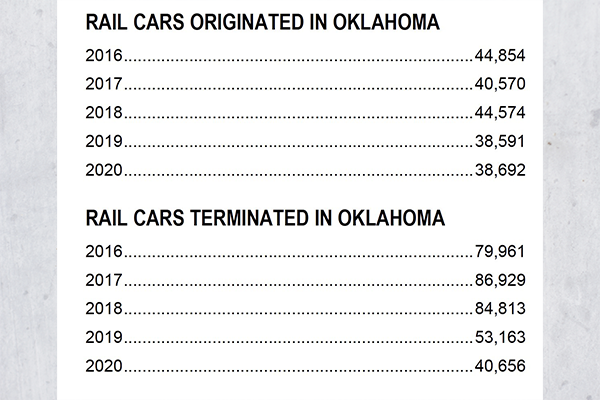
UP spent more than $262 million on tracks, structures and facilities in Oklahoma from 2016 through 2020, the company reported. Union Pacific says it has an annual payroll in this state of $30.1 million.
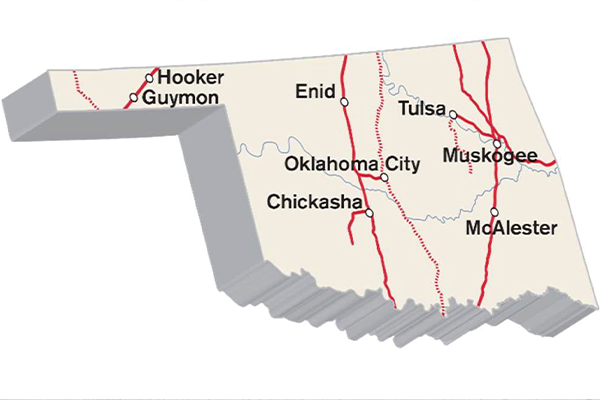
The railroad operates in 23 states and has 1,240 miles of track in Oklahoma. One of its main lines enters Oklahoma south of Terral and proceeds north to Waurika, where it splits at a wye.
UP operates on the northbound line through Comanche, Duncan, Marlow, Rush Springs, Chickasha, Kingfisher, Enid, Medford, and on to the Kansas state line.
The rail line from the Waurika wye extending northwest to Walters is owned by the Union Pacific but is leased to the Wichita, Tillman & Jackson Railroad, according to Brent Payne, manager of the Oklahoma Corporation Commission’s Railroad Department.
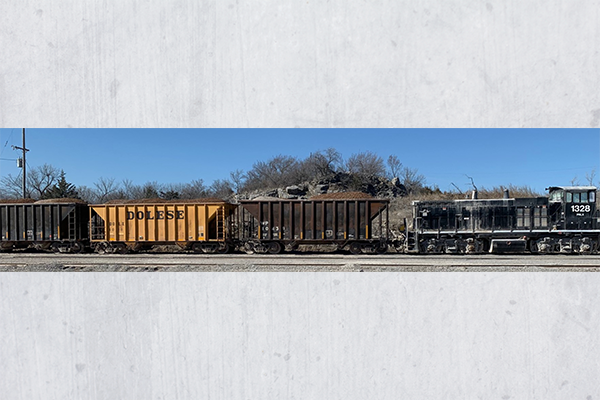
Another leg of the UP extends from the Dolese quarry at Richards Spur north of Lawton and proceeds north to Apache and intersects the main line at Chickasha.
UP ships coal and grain through Oklahoma. The top five commodities UP exported from Oklahoma in 2020, by volume, were )1 cement, roofing materials and miscellaneous minerals, )2 fertilizer, )3 paperboard and printing paper, )4 stone and gravel, and )5 wheat and flour. The drilling industry in western Oklahoma receives pipe and “fracking” sand on UP trains.
Also, Union Pacific supports nonprofit organizations. Last year UP donated $234,000 to local organizations in the Sooner State, including Girl Scouts Western Oklahoma, Tulsa Children’s Museum and the Muskogee Area Arts Council, according to Ms. South.