

SPECIAL REPORT: Ledger looks at broadband
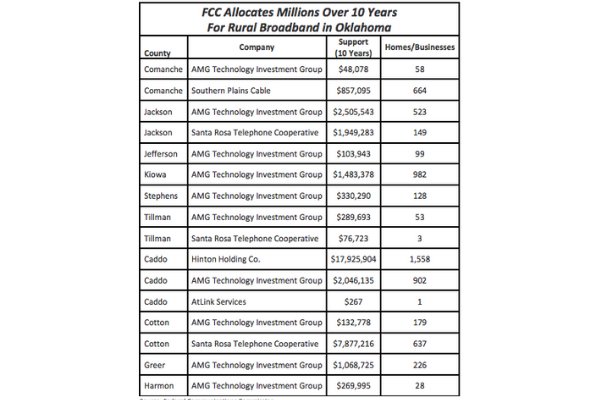
OKLAHOMA CITY – Executives of rural telecommunication companies contend that state and federal subsidies are critical to their survival and to the areas they serve.
“There might be only two in rural Oklahoma, said Tom Karalis, executive vice president of the Oklahoma Telephone Association. “The majors ignore those areas,” so small, rural telephone companies step up to provide them with telecommunication services.
The local telephone company at Terral, in southern Jefferson County two miles north of the Red River, serves an area that encompasses 86 square miles. Terral Telephone Co. has installed 254 miles of copper and fiber facilities that pass 309 structures - 100% of the homes and businesses within town and throughout the surrounding area – said Dick Segress, CEO of the company. That’s equivalent to 3.59 structures per square mile. In comparison, the Northaven residential addition in northwest Oklahoma City has approximately 800 houses in a two-square-mile area.
“We have to provide service to every home and business in our market area, not just the populated part of town,” Segress said. “I might have to install 10 miles of cable to serve just two customers. Unlike the big guys, I can’t provide service only to customer clusters.”
UNIVERSAL SERVICE FUND
The Federal Communications Commission established the Universal Service Fund in 1997 “to support the provision of basic telephone and broadband service to rural areas of America,” he related. “Typically, in a rural area there just aren’t enough customers for a telco to afford to put in modern technology that’s necessary to provide basic telecommunications service. It’s just not economically feasible” without subsidies.
“The whole concept” of the USF “is to provide support to small companies that are serving sparsely populated areas that the big companies don’t want to serve,” Segress said. Terral Telephone Co. is a “carrier of last resort,” he said. “We serve the customers that nobody else wants.”
The U.S. Census Bureau defines a rural area as any place which is located outside a community that has a population greater than 2,500. Approximately two-thirds of the population of Oklahoma lives in the Oklahoma City and Tulsa metropolitan areas, but most of the landmass in this state is rural.
“Honestly and pragmatically, the only option for rural areas is telecommunication companies that receive subsidies,” Segress said. “We absolutely could not survive without it.”
Farmers and ranchers, businesses and residents in Oklahoma’s rural areas depend on high-speed broadband telecommunications service that independent telcos provide. Demographic analysts predict that the movement to rural areas by retiring “baby boomers” (the generation born in the aftermath of World War II) is likely to continue as aging Americans seek out communities that offer affordable housing, small-town quality of life and desirable natural amenities.
“Our customers have to drive 50 miles to a Walmart in Duncan or Wichita Falls, or shop online,” Segress said. “We have built fiber optic cable to the homes and businesses in our rural market area, and they have unlimited bandwidth, essentially,” he said.
Terral has two watermelon processors who previously had to drive to area towns and meet face-to-face with store owners/managers in order to market their produce, Segress said. Their operations are “much more efficient now” with internet service. Another Terral telco customer builds toy boxes and sells them online from her home, he said. Terral Telephone Co. also serves a rancher who lives in
AT&T’s service territory but subscribes to a broadband connection from Terral Telco, Segress said. The rancher raises and sells prize bulls. Previously when he wanted to participate in livestock auctions in California, he had to put two or three of the animals on a train and send them to the Golden State via railroad, Segress said.
But now with broadband access, the rancher can market all his bulls remotely by video transmission via the internet. Telecommunication access is just as important to economic development as roads, water, and sewer lines, Jerry Whisenhunt, general manager and part-owner of Pine Telephone Co. in McCurtain County, told a State Capitol reporter recently.