


OKLAHOMA CITY – Prayer in public schools has been a controversial subject in legislative circles at local, state, and national levels for at least 64 years, when the question of its constitutionality made it to the United States Supreme Court.
In a landmark ruling, Engel v. Vitale (1962), judges ruled 6-1 that statesponsored, nondenominational prayer in public schools is unconstitutional, according to uscourts.gov. At issue then was the New York Board of Regents promoting a designated prayer for staff and students to recite each day, explained constitutioncenter.org. A group of parents challenged the “government-sponsored” prayer as a violation of the First Amendment’s Establishment Clause, which assured a separation of church and state.
Voluntary prayer in schools is another subject and still is a topic consistently challenged. As recent as Feb. 5, 2026, the U.S. Department of Education released a statement offering further guidance on voluntary prayer.
In part, the document states: “Under current Supreme Court precedent interpreting the First Amendment’s Free Speech, Free Exercise, and Establishment Clauses, all members of a public school community have a constitutional right to religious expression in public schools, including a right to engage in prayer, so long as the school does not compel others to participate in or otherwise affirm that religious expression, and so long as the individuals in question do not engage in such religious expression as part of the official activity of the school itself. It follows that public schools, school officials, and teachers may not suppress such religious expression, but also may not coerce it.”
The entire document can be read at 2026-guidanceconstitutionally- protectedprayer- and-religiousexpression- public-elementaryand- secondary-schools-113182. pdf.
Oklahoma legislation
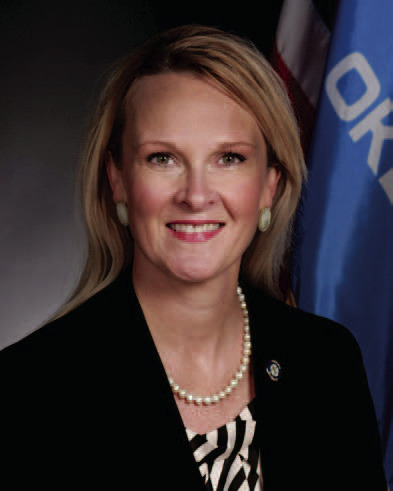
Rep. Toni Hasenbeck, R-Elgin, introduced House Bill 3240, during the current legislative session, aimed at safeguarding voluntary religious expression in Oklahoma public schools. If the bill advances to the governor’s desk and is signed into law, school districts and charter schools would be required to adopt a policy providing students and school employees the opportunity to participate in a voluntary period of prayer or reading of religious texts during noninstructional time.
Hasenbeck said, in a press release, that she filed the bill to provide clarity for school districts who may fear litigation following the 2022 U.S. Supreme Court case
Kennedy v. Bremerton School District.
Information at constitutioncenter.org states that Joseph A. Kennedy, a football coach at a public high school, prayed at the 50-yard line immediately after games.
“Fearing potential lawsuits, the school district asked the coach to stop and eventually refused to renew his contract. Kennedy sued the district for violating his First Amendment rights. In a 6-3 decision, the Court ruled that the coach’s conduct was protected by the First Amendment. The Court concluded that the school’s efforts to prevent the prayer violated the coach’s free exercise rights. In particular, by treating his religious expression less favorably than post-game secular activities by other school employees. The Court also abandoned Lemon v. Kurtzman (1971), a decadesold precedent addressing the Establishment Clause.”
Hasenbeck said that HB 3240 is structured carefully to create a clear, constitutional framework for Oklahoma schools while protecting the rights of those who choose not to participate. Under the bill, written consent from a parent or guardian is required before participation, and consent may be revoked at any time. The legislation also prohibits prayer or readings over public address systems
__________________ and ensures the designated period does not replace instructional time.
As of April 1, the measure is progressing through the legislative chambers, as it received a second reading in the state Senate and was referred to the Rules Committee.
Initially, the bill passed by a narrow margin through the House Appropriations and Budget Education Subcommittee by a vote of 6-4. It passed the House Appropriations and Budget Committee, 17-10, before clearing a third reading in the House, 61-30, and passing over to the Senate.
If enacted, the measure would apply beginning with the 2026-2027 school year.
Debi DeSilver is an awardwinning, third-generation Oklahoma journalist whose writing career now spans 50 years. She can be reached at silvercitypublishing@gmail.com.