

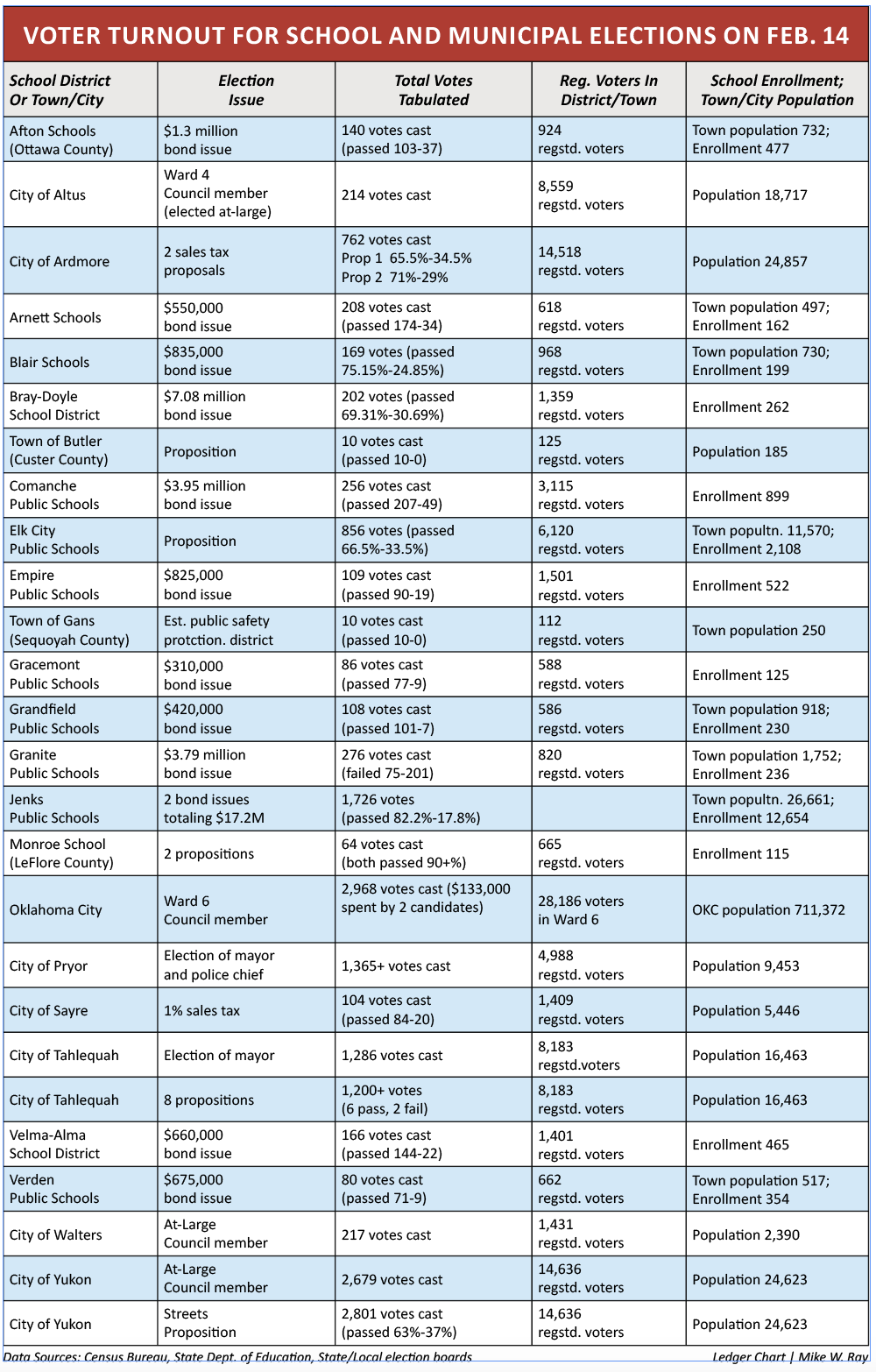
OKLAHOMA CITY — Voter turnout Feb. 14 for municipal and school elections across the state was, as expected, abysmal.
Take Altus, for example. In a city of 18,700 residents, of whom 8,559 are registered voters, the election of a city council member running at large drew just 214 voters – 2.5% of the electorate.
In the Bray-Doyle School District, a $7 million bond issue was approved by 140 of the 1,359 registered voters in the district. A school bond issue must receive the endorsement of at least 60% of the voters; the 140 “yes” votes constituted 69.31% of the 202 total votes cast in that election.
Similarly, a $3.95 million school bond issue in Comanche attracted 256 of the 3,115 registered voters in the district – a little over 8% of the electorate.
Only 10 of the 125 registered voters in the town of Butler bothered to vote on a proposition there Feb. 14.
In Beckham County, officials in Sayre, a city of 5,446 residents, scheduled an election on a 1% city sales tax. Of the 1,409 registered voters in the community, 104 of them – 7.4% – showed up to cast ballots.
Just 80 of the 662 registered voters in the Verden school district – 12% of them – voted on a $675,000 bond issue Feb. 14.
Small towns and school districts aren’t the only ones afflicted with voter apathy.
In Oklahoma City, two candidates for the Ward 6 City Council seat expended $133,000 on their campaigns, yet only 2,968 of the 28,186 voters in that ward – 10.5% of them – went to the polls on Election Day. The candidates spent $44.81 for each of those votes.
It remains a mystery why Oklahoma voters flock to the polls en masse to cast a ballot in a presidential election, when their votes are diluted by tens of millions of other Americans. Yet Oklahomans demonstrate little interest when asked to vote on pocketbook issues such as sales taxes, property taxes and bond issues, and on their local leaders.