

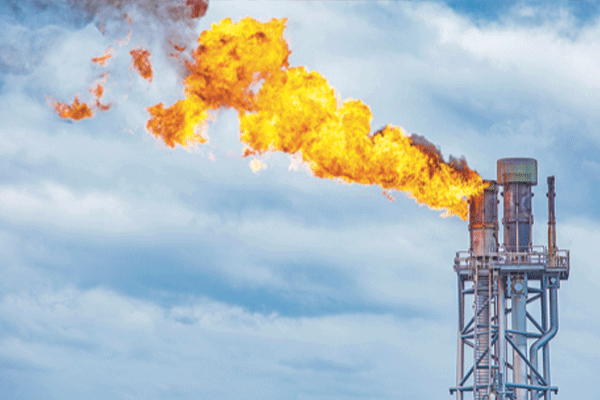
Ten environmental organizations have filed a lawsuit charging the Environmental Protection Agency (EPA) and its administrator with failure to reduce toxic air pollution from industrial flares at oil and natural gas production and processing facilities, municipal solid-waste landfills, and petrochemical plants.
The complainants contend the EPA has not updated two sets of air pollution control standards for industrial flares in decades.
Based on reviews of publicly available records, the plaintiffs argue, “it is apparent” that EPA Administrator Andrew Wheeler “has not conducted the statutorily mandated review” of general flare requirements under New Source Performance Standards (NSPS) since their initial promulgation in 1986 –34 years ago–or of the National Emission Standards for Hazardous Air Pollutants (NESHAP) since they were adopted in 1994 – 26 years ago.
The federal Clean Air Act requires the EPA to update those standards at least once every eight years.
Title 42 of the U.S. Code provides that the Clean Air Act was established “to protect and enhance the quality of the nation’s air resources so as to promote the public health and welfare and the productive capacity of its population.” A “primary goal” of the act is pollution prevention, the Code specifies.
Flares are pollution control devices designed to destroy organic pollutants in waste gases via the combustion process. The NSPS and NESHAP General Flare Requirements “establish certain work practices to maximize combustion efficiency and the corresponding destruction of organics in flare gas,” the plaintiffs write in their lawsuit.
Because of Wheeler’s “ongoing failures to take the actions required” by law, the
NSPS and NESHAP General Flare Requirements “remain outdated, and flares subject to these standards do not operate at the expected destruction efficiency, releasing excess harmful, toxic, and smog-forming pollutants into the air,” the lawsuit alleges.
“It’s been far too long since EPA updated these industrial flare standards, and EPA is well aware of the problem,” said Adam Kron, senior attorney for the Environmental Integrity Project. “Time and time again over the past decade, EPA has admitted that flares operating under these outdated standards can release many times more toxic air pollutants into local communities than estimated. This can cause serious harm to public health.”
Thousands of industrial flares burn across the country, eliminating excess waste gases but at the same time releasing smog-forming volatile organic compounds, hazardous pollutants and others that the environmental groups contend threaten the health of people who live downwind, the Clean Air Council reported.
Using outdated standards, industrial flares can release large amounts of air pollution at the local level. The Clean Air Council pointed to Texas’s Permian Basin, where flares from a gas processing plant owned by Oxy USA LLC in Gaines County reported emissions of 136 tons of volatile organic compounds in 2017, according to the Texas Commission on Environmental Quality.
The lawsuit plaintiffs allege their members “have encountered harmful, toxic, and smog-forming pollutants emitted from facilities subject to the NSPS ... and NESHAP General Flare Requirements in the past and/ or reasonably fear that they will encounter these emissions in the future.”
They also “have a reasonable concern about suffering harm to their health, aesthetic, recreational, and other interests due to exposure to harmful, toxic, and smog-forming pollutants emitted by facilities subject to the NSPS ... and NESHAP General Flare Requirements.”
Plaintiffs in the lawsuit, which was filed October 29 in the U.S. District Court for the District of Columbia, are:
The Environmental Integrity Project, based in Washington, D.C.; the Clean Air Council and PennEnvironment, both based in Philadelphia, Pa.; Air Alliance Houston; Chesapeake Climate Action Network, based in Maryland; Earthworks, based in Washington, D.C.; Environment America, of Denver, Colo.; Environment Texas, of Austin; Hoosier Environmental Council, of Indianapolis, Ind.; and Texas Campaign for the Environment, also of Austin.