

OKLAHOMA CITY – The state Conservation Commission is seeking to boost its appropriation from the Legislature in order to secure matching federal funds for a dam repair program, Executive Director Trey Lam told state budget writers recently.
The agency requested a Fiscal Year 2022 appropriation equal to what it received in FY 2021 – $12,846,525 – plus $536,000 to pay the state Office of Management and Enterprise Services for computer storage space for the commission’s Office of Geographic Information, and $1 million in matching funds for a watershed dam repair pilot project.
Oklahoma has 2,107 up-stream flood control dams that protect farms and ranches, homes, businesses, roads and bridges and other infrastructure.
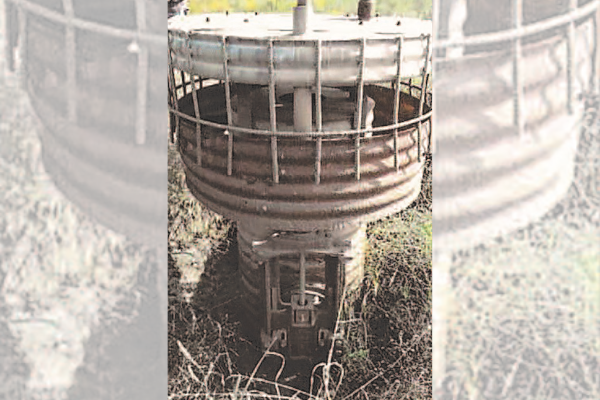
Nearly 20% of those dams – 438 of them, built between 1949 and 1978 – were constructed with corrugated metal pipe components (the material commonly used in county road “tinhorns”) as part of their principal spillways. “There are concerns that deteriorating metal components will affect the integrity of the dams,” Lam said.
Last year the Oklahoma Conservation Commission (OCC), in partnership with the U.S. Department of Agriculture’s Natural Resources Conservation Service (NRCS), launched an initial evaluation of 50 of those dams. The dams have several design/ construction variations that include full metal conduits, metal tailpipe sections, filter house extensions, and a metal tower, Lam said.
The goal of the evaluation is to develop design alternatives, such as slip-lining, interior lining, relocation of outlets, or complete replacement.
The Conservation Commission received $3 million in federal funds that were coupled with $1 million in state matching funds the Legislature appropriated last year for the pilot project.
If repairs to those dams required replacement of an average of two corrugated metal pipe components per dam, such as a tower or tailpipe, the total cost would be “around $20 million,” Lam said. “If we can provide state matching funds, the federal government will pay $14 million of that cost – and that’s more than our entire budget.”
DAM SAFETY
Last year was “a challenging year” in large measure because of the coronavirus pandemic, Lam acknowledged. Nevertheless, the health crisis “didn’t prevent our flood control people from getting out and doing their work” on those 2,107 dams, he said.
“We have already put more than $905,000 into 816 flood control dams in 39 conservation districts” across the state, Lam said. “We’ve repaired or replaced towers and pipes, stopped erosion, fixed fences, removed beavers, and replaced deteriorated components.” Those repairs were financed with funds the Legislature appropriated last year, he said.
In addition, the Legislature passed, and Governor Stitt signed, a measure that authorizes the Capitol Improvement Authority to issue $17.5 million in bonds on behalf of the Conservation Commission.
Those proceeds will help to secure a 2-to-1 match in federal funds and will be used for repair and rehabilitation of high-hazard dams. Those dams are identified as constituting a high hazard “not because there’s anything wrong with them, but because people live below them,” Lam said.
Officials have identified 260 dams in 42 counties as high-hazard. To date, 37 of those structures have been rehabilitated, another will go to construction in February, and a dozen others are in the design or planning stage, said Bryan Painter, the Conservation Commission’s public information officer.
STREAM ‘HEALTH’
Another of the OCC’s duties is collecting data on the health of streams in Oklahoma, Lam said. The commission joined hands with the U.S. Environmental Protection Agency (EPA) and the NRCS to reclaim some of the streams that were impaired or polluted.
Most of the Conservation Commission’s programs are “partnerships with the federal government,” Lam told the legislators.
“We have 88 streams, previously identified by the EPA as polluted or impaired,” whose quality has been improved significantly, Lam told members of the House and Senate appropriation committees. Oklahoma “leads the nation in this effort to restore water quality,” he said.
Fish are an indicator of water quality, Lam noted. “Healthy streams have a wide variety of fish.”
ERADICATION OF WILD PIGS
Another major project of the Conservation Commission is eradication of wild hogs. Creation of a “feral swine free zone” along the Red River is one goal of a three-year pilot project administered by the Oklahoma Conservation Commission (OCC) with a $1.04 million grant from the U.S. Department of Agriculture (USDA).
The Feral Swine Eradication and Control Pilot Program, which began last year, initially focused on two areas of the state – Cotton, Tillman, Jackson and Harmon counties in the Western Red River area, plus Kay County – but recently expanded to include Beckham, Roger Mills, Osage and Pawnee counties, too.
The Western Red River watershed is targeted in a multi-state effort of the Oklahoma Conservation Commission and Texas conservation partners in an effort to “significantly reduce the feral swine population where the invasive species has created substantial economic losses,” commission public information
The goal in Kay County is “to keep the feral swine population in check and reduce the chances of feral swine from migrating into Kansas,” Painter said.
Wild hogs have been detected in at least 70 of the state’s 77 counties, but they are most prevalent across the southern parts of Oklahoma, according to the Oklahoma Department of Wildlife Conservation. “They don’t have a home range,” said Scott Alls, state director of Wildlife Services in the U.S. Department of Agriculture’s Animal and Plant Health Inspection Service (USDA-APHIS).
Based on sightings, habitat disturbance, and current control efforts, feral swine remain a substantial concern in the Wichita Mountains Wildlife Refuge.
Feral pigs destroy yards and gardens and farmland, transmit diseases, pollute water sources, destroy habitat, and compete with native wildlife for food that supports deer, raccoons, black bears and opossums, Lam related.
Wild hogs in Oklahoma have no natural predators. Coyotes “may take some of the little ones,” Alls said, but aren’t inclined to challenge an adult because wild pigs are so aggressive and have a tough hide. The only natural enemies facing wild pigs are humans and weather, particularly drought, Alls said.
ABANDONED MINES
The Conservation Commission also administers the Abandoned Mine Land Reclamation Program, which has been underway for several years and will take decades to complete and at great expense.
In 16 eastern counties, the Conservation Commission has identified more than 32,000 acres of abandoned surface coal mines and approximately 40,000 acres of abandoned underground coal mines, said Robert Toole, director of the OCC’s Abandoned Mine Land (AML) Reclamation Program.
One project alone cost $997,480 and another cost $672,977, Toole related. One project underway in Rogers County entails reclamation of a strip pit on approximately 100 acres, at a cost of about $1 million, he said.
“We have more than $120 million of unreclaimed abandoned mine land still on inventory,” Toole said.
Despite the magnitude of the problem, Oklahoma is making headway. The Conservation Commission’s AML program has completed 190 projects and has restored almost 5,500 acres, records indicate. In addition, 89 emergencies have been remediated, 223 sites of subsidence from abandoned underground mines have been reclaimed, 397 openings to abandoned mines have been closed, and 257 hazardous water bodies have been reclaimed. The commission has negotiated construction contracts on four new projects and will let a contract for construction on another site starting in August, Toole said.
The OCC received $2,823,000 in federal funds to finance reclamation projects at abandoned coal mine sites in the current FFY 2021, Toole said. The agency hopes to receive $3 million for FFY 2022, but the federal legislative initiative to provide funding for the AML program has not been reauthorized yet, he said.
The Abandoned Mine Land Reclamation program is financed entirely with federal funds, and that money “can’t be used for anything else,”
Lam informed the state budget writers.
McGIRT MIGHT AFFECT OCC’S AML PROGRAM
The Conservation Commission director was asked whether the U.S. Supreme Court’s ruling last summer in McGirt v. Oklahoma will affect the OCC. That decision decreed that the Muscogee (Creek) Nation reservation, which encompasses all or parts of 11 eastern Oklahoma counties, was never dissolved by Congress.
The OCC’s Abandoned Mine Land Reclamation Program might be affected, Lam said, because many of those sites “are in their area.” Potentially some of the responsibilities in the AML program “could shift over to the tribe,” he said.