

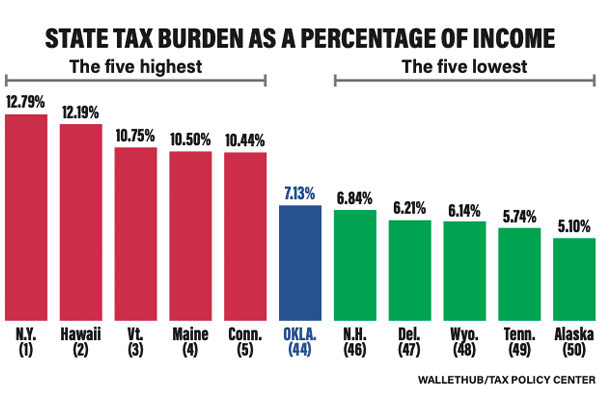
Oklahomans enjoy one of the lowest tax burdens in the nation, according to a report released by WalletHub, a personal finance website.
Utilizing data collected from the Tax Policy Center, the report focuses on tax burden, which measures the proportion of total personal income residents pay toward state and local taxes. This is a good tool for comparing taxes from state to state as it provides a better understanding of how taxes affect people on a more local scale. To arrive at the numbers, WalletHub utilized three components of state taxes: property taxes, individual income taxes, and sales and excise taxes.
Oklahoma ranks near the lowest of any state, with just Florida, New Hampshire, Delaware, Wyoming, Tennessee, and Alaska with lower overall tax burdens. At 7.13%, Oklahoma is nearly half the tax burden of the highest state, New York, at 12.79%. Alaska, the lowest for state level tax burden, comes in at only 5.10% of personal income annually.
When broken into individual components, Oklahoma is the 49th lowest state for property tax burden at just
1.67%. Regarding individual income tax burden, we rank 36th at 1.92%. Seven states have no individual income tax, and New York again leads in this category at 4.96%. Much of the difference is made up with sales and excise taxes, where Oklahoma ranks in the top 20 at 3.54% of personal income. Hawaii has the highest sales and excise tax burden, at 6.65%.
Based on how states voted in the 2020 Presidential Election, it is no surprise that states that voted for Democratic President Joe Biden ranked higher with overall state level tax burden compared to states carried by former Republican President Donald Trump.
As the economy roars back following the recession caused by the COVID-19 pandemic, many states will be re-evaluating their tax bases. It is likely that a number of states that struggled to weather the economic downturn will look at opportunities to increase state revenue to be better prepared for the future.
According to Annette Nellen, Director of the MST Program at San Jose State University, “Most states have a mix of taxes to alleviate this impact and provide a tax base that can best weather economic downturns and pandemic and other disasters. States need to have rainy day funds to help even out ups and downs and have an effective system for maintaining and restoring these funds too.”
Oklahoma established a rainy day fund in 1985 in response to the dramatic revenue shortfall that accompanied the oil bust in the early 1980s. According to the Oklahoma Policy Institute, it is designed to collect extra funds when times are good and to spend those funds when revenues cannot support ongoing state operations. Lessons learned from the economic recession of 2008-2009 encouraged the state to increase the rainy day fund, with the fund up 40% between FY2012 and FY2020.
By law, 37.5% of the fund can be used to cover shortfalls for the current fiscal year, 37.5% for the upcoming fiscal year, and the remaining 25% is reserved for emergencies and can be accessed by emergency declaration by the Governor. The fund is available to cover general revenue appropriations, which represents around one-third of all state spending. Last April the rainy day fund was tapped to cover a revenue shortfall for FY2020, withdrawing $503.9 million ($302.3 million to cover the current shortfall and an additional $201.6 million available after the governor declared an emergency), and leaving a balance forward of $349.7 million.
The 58th Legislative Session may have an opportunity to overhaul the fund, with Rep. Andy Fugate, D-Del City, filing legislation to allow the funds to include all state spending, not just general revenue appropriations.