

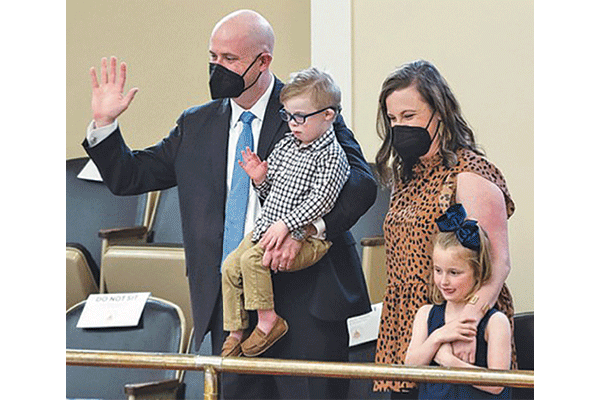
OKLAHOMA CITY – Parents of a son with Down Syndrome are “humbled and excited” that a new state law will prohibit discrimination against a potential organ transplant recipient based solely on the person’s physical or mental disability.
Rhys and Neely Gay, of Edmond, lobbied state Sen. Paul Rosino, R-Oklahoma City, requesting that he push Senate Bill 378 so their son Everett will never have to face that type of discrimination should a transplant need arises. SB 378, otherwise known as Everett’s Law, passed the Senate and House and was signed by Gov. Kevin Stitt on April 20.
“We’re excited not only for ourselves but for everyone with disabilities,” Rhys Gay said. “We know what a lot of families have gone through with the transplant process, and this new law closes loopholes in the system.”
Gay said Everett’s Law stops transplant centers from using a disability as a disqualifying factor when deciding about who gets organs.
In addition, health care providers cannot deny medical services connected to organ transplantation, including diagnostic services, evaluation, surgery, counseling, post-operative treatment and service. The health care providers also must refer the disabled individual to a transplant center so they can be evaluated for the purpose of receiving an organ transplant.
The new law also states health care providers cannot refuse to accept health insurance coverage for any procedure associated with an organ transplant of a disabled person. In addition, a disabled person cannot be placed on a waiting list at a lower priority than the individual would have been placed if they did not have a disability.
The new Oklahoma law also specifies that a parent or legal guardian can accept the organ or gift on behalf of the disabled person.
“We were doing backflips,” Gay said of the day when Gov. Stitt signed the bill into law. “This is a big day for families who have reached out to us. It covers all disabilities, and the impact will be broad.”
The measure passed the House and Senate without opposition. Everett was diagnosed with Down Syndrome shortly after birth and has a congenital heart defect. The 3-year- old is healthy after undergoing five surgeries. But during one of their medical-related trips to Missouri, Everett’s parents learned that individuals with mental or physical challenges could be denied a lifesaving transplant based on a disability. As a result, the Gays reached out to Rosino who serves as vice chairman of the Senate Health and Human Services Committee and the Appropriations Subcommittee on
Health and Human Services. The senator said he’s certain the bill will help others in the future, but was unsure how many people have been discriminated against in the past.
“The Gays came to me because they wanted to be proactive instead of reactive in case Everett needed a transplant later in life and possibly face being denied because of his Down Syndrome,” Rosino said. “This is a phenomenal bill and protects the rights of people.”
The new law also prohibits health insurance carriers from:
• Denying coverage solely on the basis of the disability
• Denying a patient eligibility or continued eligibility for a health benefit plan to circumvent the requirements of the new law.
• Reducing provider reimbursement or providing incentives to induce the provider to provide care in a manner inconsistent with the new law.
• Limiting coverage benefits to a patient for services related to organ transplantation.
California was the first state to pass similar legislation in 1996. Fifteen other states have passed the antidiscrimination laws since that time. There is pending legislation in 12 other states, according to the National Down Syndrome Society.