

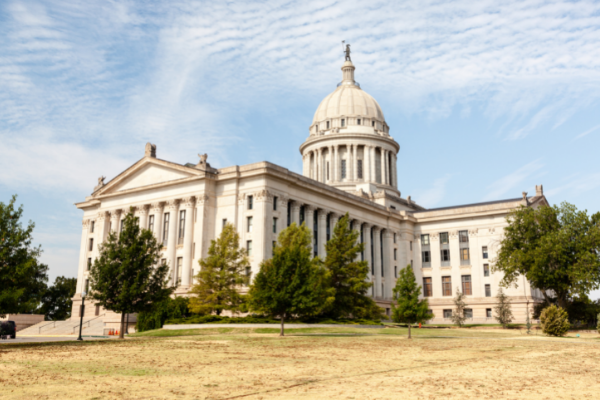
OKLAHOMA CITY – Oklahoma’s Republican lawmakers believe the 2021 legislative session was the most productive in recent memory since they were able to reduce the personal and corporate income tax rate, provided a substantial boost in public education funding and put $800 million into the Rainy Day Fund.
GOP leadership also touted increased funding for a scholarship program, $15.5 million for rural infrastructure projects and $30 million for a film tax incentive to spur more projects and investment. Lawmakers gave special attention to education by including an additional $210 million for public schools and $42 million in incentives for the expansion of broadband service in underserved and unserved areas statewide.
The personal income tax rate dropped from 5% to 4.75% and the corporate rate dropped from 6% to 4%.
“We had a really successful session,” said state Sen. Jessica Garvin (R-Duncan). “Senator Treat made the comment that this was the most successful session in his time even when he was working for the Senate. This was a great state budget with education getting more money than ever, which is a big deal.”
Garvin also pointed to new laws that crack down on ownership of medical marijuana businesses, particularly grow operations, and a plethora of pro-life bills including one she authored that requires only board-certified obstetricians or gynecologists to perform abortions. Garvin also mentioned passage of a bill that makes Oklahoma a Second Amendment Sanctuary state, approved money for a 10th Amendment Fund that protects against federal overreach and funds for legal work connected to the controversial McGirt decision that returned a substantial amount of Oklahoma land back to five Native American tribes.
“We’ve had a session full of big wins,” Garvin said. “We’ve done a lot of really good things.”
State Sen. John Michael Montgomery (R-Lawton) said lawmakers provided Oklahomans with investments in health care and education during the 2021 legislative session. Montgomery pointed specifically to Senate Bill 229, also known as the Redbud School Funding Act, which details how the tax on medical marijuana sales will be distributed for fiscal year 2022. According to the new law, 59.23% of the first $65 million in taxes from medical marijuana sales will be allocated to the public common school building equalization fund, 34.62% to the Oklahoma Medical Marijuana Authority and 6.15% to the Oklahoma State Department of Health. The money that goes to the health department is earmarked for drug and alcohol rehabilitation. Any surplus collections will be placed in the state’s general fund.
The Redbud School Funding Act also allows the state board of education to disburse Redbud grants annually from the equalization fund to public schools and eligible charter schools, which is a significant move to help rural districts such as Indiahoma, Montgomery said.
“This (Redbud grants) is a huge positive for about 300 school districts,” he said.
Funding additional broadband services for rural Oklahoma is a “huge investment to move the state forward,” Montgomery said.
Meanwhile, state Rep. Daniel Pae (R-Lawton) said the session should be considered “extremely productive” considering the 2020 session was cut short by the COVID-19 pandemic.
“A lot of what we did was playing catch-up from the year before,” he said. “I think we put together the most comprehensive budget in history with $3.2 billion allotted to education and another $800 million into a savings account.”
Pae was disappointed an anti-bullying measure was vetoed by Gov. Kevin Stitt. The bill, SB 222, will likely be reintroduced during the 2022 session. Apparently, the governor was concerned about the new definition Pae proposed in the anti-bullying legislation, said Pae. The new definition included “unwanted, aggressive behavior committed in person or by electronic communication.” Previously, the law defined bullying as “any pattern of harassment, intimidation, threatening behavior, physical acts, verbal or electronic communication directed toward a student or group of students.
Pae’s bill included language that defined bullying as actions that are “repeated or is highly likely to be repeated.” The measure also included bullying as actions that include “harassment, intimidation, threatening behavior, spreading rumors, attacking someone physically or verbally and excluding someone from a group as a means of causing harm.”
Pae said he hopes to meet with the governor’s staff to ensure “we are on the same page” when the 2022 legislative session begins.
In other legislative action, lawmakers updated the Oklahoma Religious Freedom Act to ensure religious institutions cannot be deemed “nonessential, passed a bill to prohibit the teaching of critical race theory in Oklahoma schools and protected Oklahoma utility ratepayers by securitizing $4.5 billion in unexpected utility bills after the February winter storm.
Lawmakers also updated the Education Open Transfer Act, which gives parents the ability to move their children from one district to another. In a similar bill, lawmakers ensured education dollars follow the student if they transfer to another district. School districts were also given more flexibility in using carryover funding from the previous fiscal year.
Legislators allocated $9.9 million for the creation of a children’s mental health unit at OU Health, authorized the use of $35 million in economic development funding to recruit new jobs and restored the Earned Income Tax Credit refundability, which provides tax relief to low- and moderate-income working families.
“I think this has been one of the most successful sessions in my legislative career,” said Senate Majority Floor Leader Kim David (R-Porter). “Senate Republicans enacted common-sense, conservative policies to protect and expand the rights of our citizens, and we passed meaningful education reforms that will benefit students and families across Oklahoma. I’m proud of how the Senate led the way in successfully navigating session through pandemic protocols.”