

OKLAHOMA CITY – In energy-producing states such as Oklahoma, Texas, New Mexico and North Dakota, a major concern is plugging oil and natural gas wells that are no longer productive and the responsible operator went bankrupt or cannot be found.
The number of idled oil/gas wells in the U.S. varies widely. The U.S. Environmental Protection Agency, for example, believes the number of abandoned wells across the nation exceeds three million.
Oil and gas exploration and production in Oklahoma have been conducted for 136 years, since before statehood.
The first oil well was drilled near Wapanucka in the Choctaw Nation, Indian Territory, in 1885, but the well was not completed until 1888. Only a small amount of oil and gas was produced before the site was abandoned after the financier fell ill and died.
The first commercially productive well in Indian Territory was the Nellie Johnstone No. 1 drilled in 1897 near Bartlesville, at that time in the Cherokee Nation.
Since then, tens of thousands of oil/gas wells have been drilled throughout the state.
Nobody knows with any precision how many oil and gas wells have been drilled in Oklahoma, but the Corporation Commission’s estimate is perhaps 500,000, said Matt Skinner, the agency’s public information manager.
Literally thousands of the wells drilled in Oklahoma were simply abandoned after production ceased, leaving behind open wells, unsightly structures and polluted acreage.
The Corporation Commission was not designated as the official regulator of the energy industry in Oklahoma until 1914.
ABANDONED WELLS IN OTHER STATES NUMBER IN THOUSANDS
A Texas Railroad Commissioner estimated in 2019 that the Lone Star State had approximately 130,000 orphaned wells.
However, Carbon Tracker Initiative, a nonprofit think tank that researches the impact of climate change on financial markets, estimated about 780,000 unplugged oil wells scattered throughout Texas were abandoned by their owners. The potential cost of remediation of those sites was estimated at tens of billions of dollars.
The growing number of abandoned crude oil and natural gas wells in New Mexico concerns not only environmentalists but some state officials as well. A year ago, one state official contended nearly 70% of New Mexico’s 57,000 active wells were at risk of being shut-in or orphaned.
It has been estimated that hundreds of thousands of oil and gas wells have been drilled in Pennsylvania since the first commercial well was spudded at Titusville in 1859.
Pennsylvania’s Department of Environmental Protection (DEP) counted more than 8,500 wells in the agency’s abandoned and orphaned well database. Research studies, though, suggest there are likely at least 200,000 additional legacy wells – drilled prior to regulations governing the decommissioning of wells – many of which will have to be plugged as they are discovered.
Owners and operators are legally responsible for plugging their wells when oil and gas production is no longer economically feasible, but that doesn’t always happen. There are instances in which an oil and gas company files for bankruptcy protection or moves out of the commonwealth, abandoning its wells. In 2018 two operators with major holdings abandoned approximately 2,750 of their oil/gas wells, the Pennsylvania DEP lamented.
Montana reportedly has hundreds of abandoned oil and natural gas wells, and the state sets aside $650,000 every two years for well plugging projects, Jim Halvorson of Montana’s Board of Oil and Gas Conservation told The Washington Post.
Although a comprehensive survey has not been conducted, North Dakota probably has approximately 100,000 abandoned wells, North Dakota State University reported in 2016.
North Dakota earmarked more than $66 million in federal pandemic relief funds to clean up old oil and gas wells. The funds were intended to plug hundreds of abandoned wells, restore the often-polluted land surrounding them, and provide jobs for oilfield workers who were furloughed after prices crashed.
However, environmental advocates claim that the funds also benefited dozens of small to medium-sized companies by relieving them of their responsibility to pay for cleaning up their own wells. Instead, the financial obligation was shifted to taxpayers. And most of the wells the state plugged were not truly orphaned, but had solvent owners, officials reported.
After the industry warned that the pandemic-driven oil crash was threatening its finances, state regulators in North Dakota stepped in, assumed ownership of more than 300 wells, and used CARES Act funds to plug them, meaning the companies avoided paying anything themselves.
WELL OPERATORS OFTEN SIDESTEP RESPONSIBILITY
Oil/gas well operators are generally required to plug their wells after production has played out. But in practice, Inside Climate News reported, companies are often able to defer that responsibility for years or decades. Larger companies often sell older wells to smaller ones, which sometimes go bankrupt, leaving the wells with no owner.
These “orphaned” or “abandoned” wells become the responsibility of the federal or state governments, depending on where they were drilled.
While oil companies are required to post bonds or other financial assurance to pay for plugging them, Carbon Tracker Initiative found that those bonds cover only a fraction of the expected costs of cleaning up the nation’s oil and gas wells.
In Pennsylvania, for example, a surcharge paid by the oil and gas industry for each drilling permit issued in the commonwealth is deposited into an account available for plugging orphan or abandoned wells.
The bond for a single conventional well is $2,500, and a “blanket bond” for an unlimited number of conventional wells is $25,000, according to the Pennsylvania DEP.
The agency pointed to four costly examples of well site remediation work: $14,000 for a stray gas mitigation system at one site, $350,000 for plugging one well, $160,000 for plugging another, and $179,000 for flaring and plugging yet another well. The agency said a conservative estimate of the cost of plugging an abandoned oil/gas well is $33,000.
FEE ON OPERATORS FINANCES PLUGGING
Oklahoma has approximately 200,000 active oil and gas wells, including injection disposal wells, according to the Oklahoma Corporation Commission, which regulates the energy industry.
Abandoned wells – defined as those for which no responsible party can be located – are plugged by the Corporation Commission. (An “orphaned” well, in contrast, “can be taken over and produced,” Skinner said.)
The commission’s fund for plugging abandoned wells is underwritten with a fee paid by current oil and gas operators in the state: .095 of 1% of the gross value of all natural gas and/or casinghead gas produced in the state that’s subject to the gross production tax. The well-plugging fund was scheduled to “sunset” this month, but the state Legislature extended it.
Bond forfeitures also are earmarked for plugging wells, Skinner related. The operator of a well is responsible for paying for any damage and for remediating the site, he said. An operator is required to post a bond to cover the cost of plugging a well if the operator goes out of business; that bond is $25,000 per operator (not per well), Skinner said.
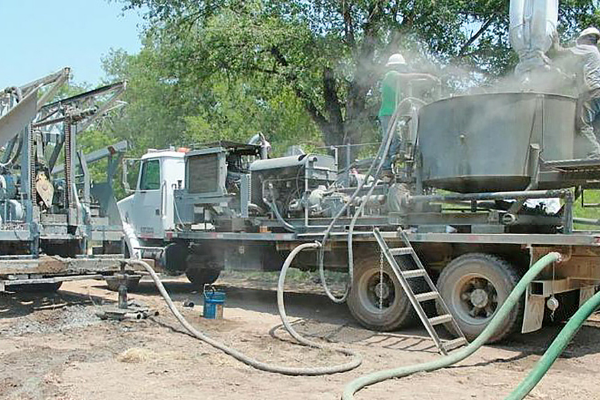
The Corporation Commission hired private contractors to plug 462 abandoned oil and gas wells in Oklahoma over the last five years. The total cost was $6,153,962, an average of $13,320 per well, agency records reflect.
The commission has licensed 80 companies to plug oil/gas wells in Oklahoma. That number includes 12 from Texas, 10 from Kansas, five from Arkansas, one from Louisiana, and 52 in Oklahoma. They include one private contractor from Duncan and one from Wichita Falls, Texas.
OERB RESTORES OLD WELL SITES
Besides the Corporation Commission’s well-plugging efforts, the energy industry itself is spending millions to clean up problems that others created.
Nearly three decades ago, in 1993, representatives of Oklahoma’s oil producers and royalty owners, working with the state Legislature, established the Oklahoma Energy Resources Board (OERB); natural-gas producers joined the organization soon after.
“At the heart of our mission is the OERB’s ongoing commitment” to clean up Oklahoma’s abandoned well sites “left to ruin by those who have long since passed or disappeared,” the privatized state agency declares.
Funded through voluntary contributions paid by producers and royalty owners, the OERB’s environmental restorations “cost landowners and taxpayers nothing.”
During its existence the OERB has spent in excess of $132 million to restore more than 18,000 unattended well sites, “employing Oklahoma contractors along the way,” the agency reports.
“We restore about 750 sites a year,” said Steve Sowers, the agency’s environmental director. That’s equivalent to two sites per day, seven days a week, year-round. “We’re working on 400 to 600 sites at any given time,” he said. Each of those locations is a health and safety hazard, he noted.
FEDERAL BILL SEEKS $4.7B TO PLUG IDLED WELLS
Legislation pending in the U.S. Senate proposes allocating $4.7 billion to states, Native American tribes, and the U.S. Department of Interior’s Bureau of Land Management (BLM) to plug and rehabilitate abandoned oil and gas wells.
The grants would be earmarked for plugging, remediating and reclaiming orphaned wells on state-owned, privately owned and tribal lands alike, and to remediate soil and restore native species degraded “due to the presence of orphaned wells and associated pipelines, facilities and infrastructure.”
S. 1076, the Revive Economic Growth and Reclaim Orphaned Wells (REGROW) Act of 2021, was filed by Sen. Ben Ray Lujan, D-NM. The bill was assigned to the Senate Committee on Energy and Natural Resources, and that panel’s Subcommittee on Public Lands, Forests and Mining held a hearing on that measure and several others on June 16.
Most abandoned oil/gas wells “predate state regulatory actions” to hold operators accountable, U.S. Sen. Kevin Cramer testified. These abandoned wells are leaking methane (a “greenhouse” gas), contaminating groundwater supplies, creating safety risks for humans and livestock, and inhibiting productivity on agricultural land, the North Dakota Republican said.
S. 1076 would provide funds to plug and rehabilitate 56,000 orphaned and abandoned oil/gas wells across the nation that have been identified by the Oklahoma-based Interstate Oil and Gas Compact Commission, Cramer said.
The appropriation would support 10,000 jobs a year for “highly skilled oilfield workers” who were laid off during the coronavirus pandemic. Their labors would reduce emissions and put land “back into productivity,” Cramer said.
S. 1076 is one of those rare pieces of legislation that’s supported by regulatory, industry and environmental groups alike, he added.
Nada Culver, deputy director of policy and programs for the U.S. Bureau of Land Management, told the Senate subcommittee that S. 1076 is a priority issue for the Biden Administration.