

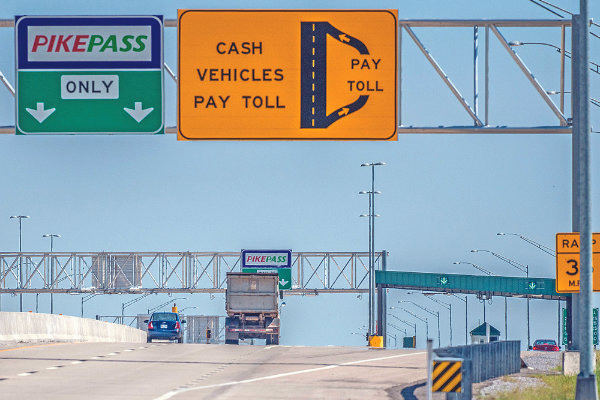
OKLAHOMA CITY – A $7.4 million contract to convert the H.E. Bailey Turnpike to totally “cashless” tolling by mid-2022 was approved Tuesday by the Oklahoma Turnpike Authority.
At $7,429,764, Haskell Lemon Construction Co. of Oklahoma City was the lower of two bidders for the job. The other company, Downey, bid $7.63 million for the job; its price was not only higher but exceeded the number of maximum number of days to complete the work, OTA Engineering Director Darian Butler told the Authority.
The project will feature conversion of the turnpike mainline, entrance/exit ramps and spur interchanges at SH-4, SH-5, US-277, US-62 and SH-76. The work will include installation of overhead gantries (trusses), guardrails, generators, cabinets, propane tanks, conduit, and some paving construction,
The contractor will have about four months to complete the work and must start no later than September 13, Butler said.
There was “quite a difference” between the project engineer’s estimated cost of $4 million and the two bids, he noted. He nevertheless recommended approval of the contract, attributing the disparity to the size and scale of the Bailey project and its “uniqueness.”
Although the bids submitted by both contractors were $3 million higher than the engineer’s estimate, the two bids were “close together,” Butler said. “We think we had a low engineer’s estimate” because “this is a different kind of project.”
The Bailey conversion is “a long-track project,” Butler pointed out. The HEB mainline (Interstate 44) extends 86 miles from south Oklahoma City to just north of the Red River and has an 8.2-mile Norman spur that connects to SH-9. The conversion project will require temporary closure of multiple on/off ramps.
In addition, Butler speculated that another reason only two companies bid on the HEB project is because the state highway department (Oklahoma Department of Transportation) “has several projects out on the street” and those are “the bread and butter” for highway contractors.
The conversion away from cash began on the John Kilpatrick Turnpike in north Oklahoma City on July 25, following a trial run conducted on one ramp in Jenks on the Creek Turnpike.
The H.E. Bailey is scheduled for conversion in the spring/summer of 2022, said Jack Damrill, the OTA’s director of communications and facilities. The switch to cashless tolling on all other turnpikes will occur throughout the next four years.
Oklahoma has 11 turnpikes totaling more than 625 miles, and another toll road, the 5.7-mile Gilcrease in Tulsa, is expected to open in mid-2022.
TOLL BOOTHS, COIN MACHINES TO DISAPPEAR
Toll booths and coin machines will become a thing of the past. Motorists who do not have a PikePass transponder will no longer have to stop to pay a toll. Instead, their license plate will be photographed automatically, and an invoice will be sent to the registered owner of the vehicle. This cashless tolling system is known as PlatePay.
“We recognize the fact that our customers want a safe, fast and efficient way to travel our system,” Oklahoma Secretary of Transportation and OTA Executive Director Tim Gatz said. “Converting to cashless tolling will relieve motorists who struggle to find cash to put in the coin machines.” One of the biggest complaints from patrons of Oklahoma’s turnpike system “is that we still expect them to carry a pocketful of quarters,” Gatz said.
Additionally, coin receptacles on Oklahoma’s turnpikes “have to be specially manufactured because nobody uses them anymore.”
This year marks the 30th anniversary of Oklahoma’s electronic PikePass, Gatz said.
The Turnpike Authority reports approximately 2.1 million vehicles are equipped with PikePass transponders that are attached to the vehicle’s windshield and electronically record when the vehicle enters and exits a toll road.
In a related matter, the OTA gave the Customer Service Division permission Tuesday to spend up to $3.2 million to buy 615,100 more transponder PikePasses from TransCore.
PlatePay rates will be substantially higher than Pikepass rates. The OTA in June approved new toll rates for customers who will begin receiving PlatePay invoices for travel on the John Kilpatrick Turnpike.
“We always encourage those who will be traveling the turnpike system that the cheapest way to travel is with a PikePass account,” Gatz said. PikePass benefits include:
• Lowest toll rates while traveling the turnpike system. PikePass customers receive nearly 20% discount on tolls across the turnpike system and a volume discount program.
• PlatePay customers will pay an average of 75% more than the current cash rates, because of the expenses incurred in collecting the tolls via mailed invoices.
Approximately 80% of toll transactions systemwide are electronic, and on the urban turnpikes (such as the Kilpatrick in north Oklahoma City and the Creek in Tulsa County) use of the PikePass is above 90%, Gatz said. Roughly 40% of all toll revenue is generated from out-of-state motorists, Turnpike Authority records reflect.
Average daily traffic on the HEB in 2019 (the latest year for which traffic counts are available) ranged from 10,600 vehicles near the SH-9 spur to 3,500 at the junction of US-70 near Randlett, OTA records show.
The turnpike systems in Oklahoma, Texas and Kansas now have “interoperability” agreements. That means any motorist from any of those states who has a turnpike “tag” can travel on any turnpike in those other states without having to stop and pay a cash toll.