

Comanche Chief Quanah Parker lived at Fort Sill in ‘Star House’
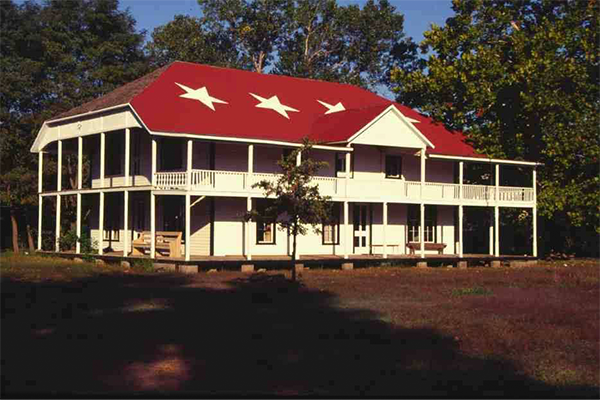
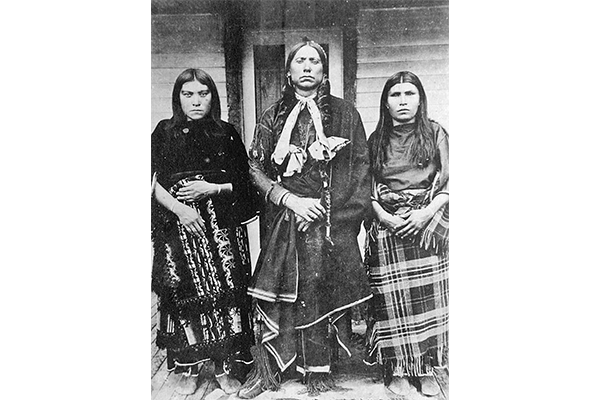
One of the most prominent visitors to Comanche Chief Quanah Parker’s Fort Sill home, known as the Star House, was President Theodore Roosevelt.
In the Spring of 1905, after the presidential inauguration, Roosevelt traveled to the Southwest to hunt gray wolves/coyotes in an area of the territory known as the Big Pasture. This area was once part of the Kiowa-Comanche-Apache Reservation and was located south of the Wichita Mountains and north of the Red River. It totaled about 480,000 acres and was part of Comanche, Cotton and Tillman Counties.
Roosevelt, an avid outdoorsman, was drawn to the area by stories of a man who could catch wolves with his bare hands. John “Jack” R. Abernathy, also known as the Wolf Catcher and Catch ‘Em Alive Jack, a cowboy widely known across the Red River Valley of Oklahoma and Texas, was Roosevelt’s guide. Abernathy could catch a wolf alive by jumping off a horse, wrestling the wolf to the ground and jamming his fist into the back of the wolf’s jaw. He would then wire the captured wolf’s muzzle closed and hog-tie its feet.
In addition to riding with Abernathy and witnessing the catching of wolves by hand, Roosevelt also expressed an interest in seeing and riding with Parker, who the president considered a friend. The chief had been to Washington many times to advocate for his people and he was one of six Indian chiefs who rode in Roosevelt’s inauguration parade. Parker was never elected chief by his own people; he was appointed by the U.S. government as principal chief of the Comanche Nation.
Not everyone in the tribe trusted Parker, as he was half white and half Indian. His mother, Cynthia Ann Parker, had been kidnapped as a young girl from her family home in a raid by Comanches near Waco, Texas. Cynthia grew up as a daughter of the tribe and was given the name of Naut-da, meaning “Someone Found.” She married Comanche War Chief Pete Nacona and gave birth to Quanah around 1848 in the Wichita Mountains. He was 11 years old when Texas Rangers took Cynthia and her daughter, Prairie Flower, from her Comanche family and returned her to Texas.
Although vowing a hatred of the white man, when Parker was forced to surrender at Fort Sill in 1875, he took his mother’s last name and began trying to help the Comanche people transition to the “white man’s road.” With the buffalo gone, he knew survival meant trying to adapt and he tried to be an example.
“Quanah Parker became a strong, pragmatic peacetime leader who helped his people learn to farm, encouraged them to speak English, established a tribal school district for their children, and lobbied Congress on their behalf. Parker welcomed new technology – he bought a car and owned one of the first home telephones in Oklahoma – yet held on to his cultural traditions, refusing to give up any of his eight beautiful wives, his magnificent braids, or his peyote religion.
“With help from Charles Goodnight and other friendly cattlemen that he once had raided, Quanah Parker became a wealthy rancher and built his stately, two-story Star House … Parker also entertained many important guests at his Star House tables, paying a white woman to give his wives cooking lessons and hiring a white woman as a house servant,” said an article on the National Park Service website, nps.gov.
There are different stories on why Parker wanted the stars painted on the roof of his home. One of the more common explanations is that the chief was impressed by the stars on U.S. general’s uniforms, and he wanted to show that he was a general of his people. Whatever the reason, Parker was proud of his ranch home, with its open-air porches and red roof with large white stars.
In 1906, a reporter for the “New York Tribune” visited Parker at his home and wrote about the Star House. Atherton Brownell wrote that the home was visible for over a mile away.
“Every bedroom is furnished with a brass bedstand and a mixed assortment of some fine and some plain furniture. The floors are carpeted with Brussels of rather high colors. The walls and ceilings are papered,” Brownell wrote in the Dec. 2, 1906, article. He reported there were multiple rooms for multiple wives and children.
“Pictures are mostly prints and bizarre colored chromos. President Roosevelt in a bloody hunting scene, with more big game than the West has seen for many a year making a concerted onslaught upon him, pleases Quanah greatly. Another picture on which he comments especially is a high chromo of the Custer massacre, in a gilt frame, which advertises some brand of beer,” Brownell wrote.
Quanah told the New York reporter that he built the home himself; it wasn’t given to him by the government. He wanted his people to see that the chief had taken the white man’s ways.
Fast forward over a hundred years and another New York newspaper, the “Times,” wrote that efforts to preserve the Star Home, which is on the National Register of Historic Places, had been challenging.
“The crumbling house sits on the back lot of a long-shuttered amusement park. It has been deteriorating for years, especially because large sections of the roof are missing, allowing the elements to damage the upper floors,” reporter Stuart Miller wrote in 2015. A severe flood that spring damaged or ruined original rugs, wallpaper and furniture.
The years have not been kind to the Star House, wrote “Daily Oklahoman” reporter Graham Lee Brewer in an Oct. 21, 2016, article. But, if walls could talk, the Star House would have many rich stories to tell.
Sources for this article include “The Wilderness Warrior: Theodore Roosevelt and the Crusade for America” by Douglas Brinkley, Chapter 21 – The Oklahoma Hills, pages 585 – 630, HarperCollins Publisher, ©2009; The Encyclopedia of Oklahoma History and Culture, “Roosevelt’s Wolf Hunt” by Matthew Rex Cox, okhistory.org; “Big Pasture” by Richard Mize, okhistory.org; legendsofamerica.com/john-abernathy; Quanah Parker: Comanche Chief by William T. Hagan, University of Oklahoma Press, Norman; forttours.com; en.wikipedia.org/wiki/Quanah_Parker; nps.gov/people/quanah-parker; oklahoman.com/article/5523496/last-comanche-chiefs-home-continues-to-crumble.