

OKLAHOMA CITY – A legislative package intended to “foster a safer, fairer free market” for the medical marijuana industry in Oklahoma has been proposed by Republicans in the state House of Representatives.
In response to myriad complaints of regulatory inaction and rogue marijuana farms consuming huge volumes of fresh water, the Republicans’ “12-point plan” consists of multiple bills and was unveiled two weeks after the largest single-day marijuana bust in state history.
Ever since Oklahoma voters endorsed State Question 788 in 2018, authorizing medical marijuana, “We have seen ‘black market’ elements competing with legitimate Oklahoma businesses in an illegal, unethical manner,” Majority Floor Leader Jon Echols said. “The black market is not the free market.”
The GOP’s proposal “aggressively attacks the spread of illegal marijuana operations statewide,” said Echols, R-Oklahoma City. The 12-point plan would:
make the Oklahoma Medical Marijuana Authority a stand-alone agency rather than a unit of the State Health Department. (Senate Bill 1543)
create a grant program for county sheriff’s departments to fund law enforcement efforts in every county. (House Bill 3530)
require full implementation of a seed-to-sale system (either via court order or new legislation).
establish provisional licensing requiring pre-license inspections and increased document submission prior to approval. (HB 3734)
create tiered grow license fees based on grow size. (HB 2179)
require separate licensing for medical marijuana wholesalers. (HB 3634)
require public utilities to report to the OMMA the amount of water, electricity and natural gas each utility supplies to licensed medical marijuana grow operations. (HB 4055)
direct all medical marijuana businesses to post standardized permit signage at their place of business. (HB 2025)
require annual inspections of commercial marijuana operations. (HB 2024)
create product packaging standards and establish expiration or maximum beyond-use dates for perishable medical marijuana products. (HBs 3019 and 4288)
require standardized laboratory testing and equipment. (HB 4056)
require medical marijuana commercial grow licensees with outdoor facilities to register with the Oklahoma Department of Agriculture, Food, and Forestry as environmentally sensitive crop owners. (HB 3827)
If all of those measures were enacted, “It would make a significant dent in the marijuana program in this state,” Echols said.
“These bills create a multifaceted, synergistic approach to extinguish illegal growing and distributing while focusing on product safety and public health,” said Rep. T.J. Marti of Broken Arrow. “If we can get rid of the bad actors, everybody else will flourish.”
Marti is chairman of the House Alcohol, Tobacco and Controlled Substances Committee, which advanced most of the bills containing the GOP plan.
“The key here is legitimate operators have nothing to fear,” Echols pledged.
However, said Rep. Scott Fetgatter, “If you’re an illegal operator in Oklahoma, your time is up.” Fetgatter, R-Okmulgee, is a member of the Alcohol, Tobacco and Controlled Substances Committee and has introduced several marijuana reform measures over the past three years.
A seven-member Republican working group collaborated for months with industry stakeholders, other legislators, regulators, law enforcement and other experts to develop the GOP’s plan. The working group was comprised of Echols, Fetgatter, Marti, and Reps. Rusty Cornwell of Vinita, Jay Steagall of Yukon, John Pfeiffer from Orlando and Kevin McDugle of Broken Arrow.
Moratorium proposed
Several other bills that are not part of the GOP’s MMJ package are nevertheless pending in the Legislature.
One of those “live rounds” is House Bill 3208 by Cornwell, which would temporarily pause the issuance of commercial medical marijuana licenses until existing facilities are fully in compliance with state laws.
HB 3208 would impose a moratorium on State Health Department issuance of MMJ licenses to commercial farmers, processors and dispensaries, but not patient licenses, said Cornwell, R-Vinita.
The pause would give the Oklahoma Medical Marijuana Authority “a chance to catch up” on its responsibilities, Cornwell told Southwest Ledger. The OMMA would have ample time to “pay a visit” to all commercial licensees and verify by inspection whether they are in compliance with state laws.
Cornwell said many land purchases for marijuana farms are completed with cash, causing concern among constituents that illegal drug money is being laundered for illegal commercial facilities in this state.
The moratorium would “sunset” after a maximum two years.
New requirements
enacted last year
Last year the Legislature passed HB 2904, which required the OMMA to hire 76 more employees: 62 compliance and enforcement positions, six employees to perform legal and financial duties, four investigators, and four employees to perform planning and logistic duties.
The OMMA has boosted its staff by more than 100 since May 24 last year and now has 198 employees, agency Communications Director Kelsey Pagonis said. Those include:
92 compliance and enforcement officers; one more compliance inspector has been hired but hasn’t started work yet.
7 investigators.
74 employees in planning and logistics.
12 in legal/financial.
9 other employees.
4 interns.
Also enacted last year was HB 2272, which requires current medical marijuana business licensees and applicants to confirm or deny, under penalty of perjury, the existence of any foreign financial interests in their business operations.
HB 2272 also requires the OMMA to schedule on-site meetings and compliance inspections of business licensees within the first 180 days of licensure, to verify the licensee is actively operating or working toward operational status. If a licensee fails to provide proof that they are doing so, they will be granted two grace periods of 180 days each. If the second grace period expires without proof that the licensee is operating or working toward operation, the license will be terminated.
County vote idea
stalls in House
One proposal that wasn’t approved in committee this year was HB 2989, a proposal that would give county voters a say on who is licensed to grow marijuana in their counties.
The measure would require applications to grow marijuana to be filed by June 30 each year in the county where the grow facility would be located. County commissioners would then set a date for a vote to be held every other year for applications to be approved or denied. If denied, an applicant would not be able to reapply for five years within that county. If growers operate in multiple counties, they would have to apply and be approved by voters in each county where they conduct business.
“Many of our rural voters did not approve State Question 788 that resulted in the legalization of medical marijuana in our state,” said Rep. Todd Russ, author of HB 2989. “Yet they are saddled with the ill consequences. And they are facing the possibility that petitioners will place a question on a future state ballot to legalize recreational marijuana,” the Cordell Republican noted.
Record MJ raid
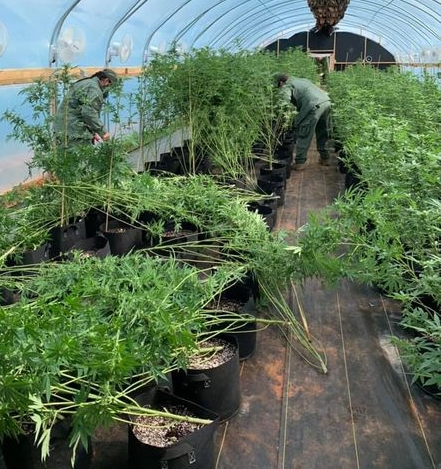
In a related matter, more than 200 state, federal and local law enforcement officers executed search warrants and arrest warrants Feb. 22 at a dozen locations across the state implicated in a marijuana investigation.
For more than a year, the Oklahoma Bureau of Narcotics and Dangerous Drugs Control “has been targeting numerous individuals and organizations that have moved to Oklahoma from out-of-state and used fraudulent business structures and ‘ghost owners’ to obtain their Oklahoma medical marijuana licenses,” said Mark Woodward, spokesman for the state agency. “These criminals try to blend into our state’s medical marijuana program while trafficking marijuana onto the illicit market around the United States, laundering money and moving millions of dollars in illicit drug proceeds overseas.”
The investigation identified brokers moving millions of dollars in marijuana from multiple Oklahoma farms onto the black markets in states that have included, but were not limited to, Texas, Missouri, California, North Carolina and Indiana, Woodward said.
Marijuana grown in Oklahoma can be consumed only in Oklahoma, and authorities have said far more marijuana is being grown here than can be consumed here.
OMMA inspectors assisted the OBNDD on Sept. 8, 2021, when a search warrant was served at a licensed farm in Depew that was illegally selling marijuana out-of-state on the illicit market, Woodward announced.
Search warrants were executed Feb. 22 at nine farms and three residential locations connected to illegal shipments. Woodward said 13 arrest warrants were issued for people in Oklahoma linked to the investigation, as well as one in California and three in Texas.
The OBNDD reported that search warrants were served at residences in Edmond, Norman and Mustang; at two marijuana farms in Wilson, two in Chandler, and at one each in Chickasha, Amber, Ratliff City, Madill and Burneyville. The largest target was an 80-acre farm at Wilson that contained more than 500 structures, officers reported. Eight of the nine farms were licensed with the OMMA.
An estimated 100,000 plants and thousands of pounds of bulk processed marijuana were seized from the farms during the operation, Woodward said. OBNDD also will file asset forfeiture applications on multiple vehicles, bank accounts, cash, equipment, and at least eight of the properties linked to illegal marijuana shipments and money laundering, the agency reported.
Five persons were arrested in Oklahoma during the raid last month, while arrest warrants for other suspects are still outstanding, Woodward told the Ledger on March 8. The criminal charges will be filed in Carter County, he said.