

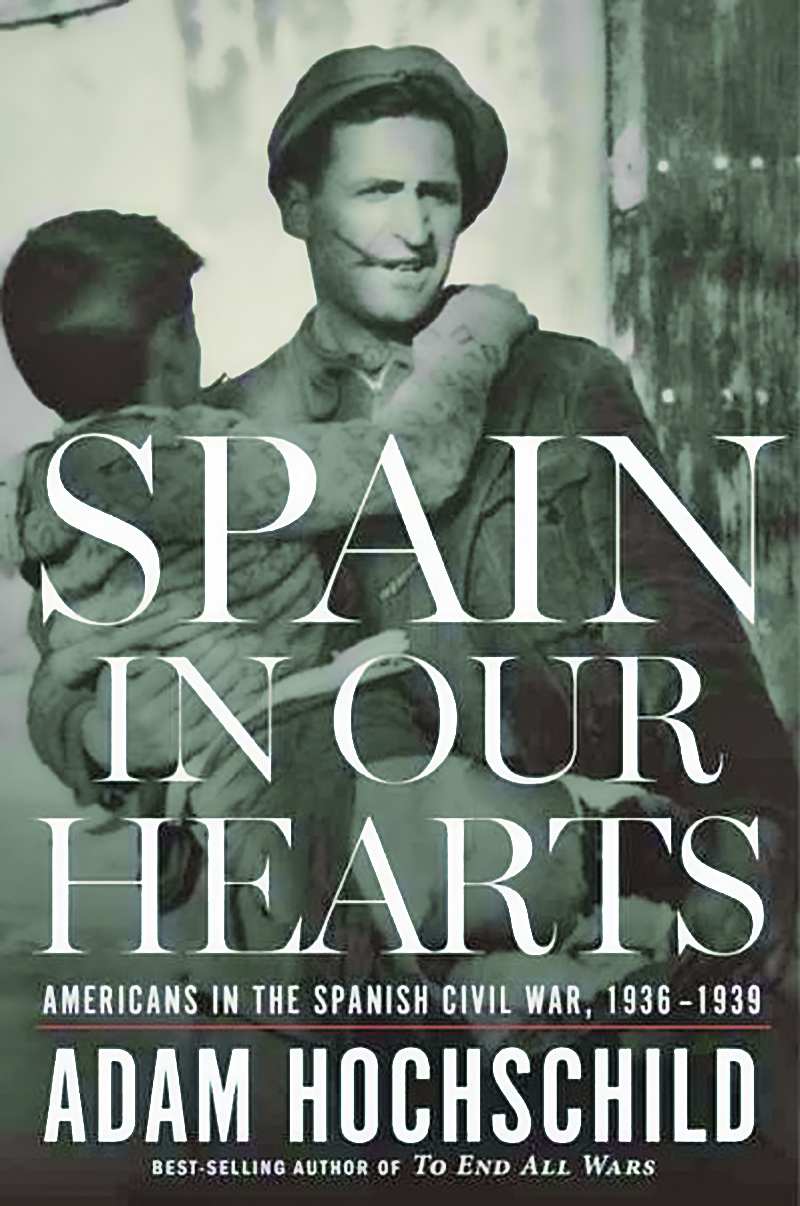
Eighty-five years ago, hundreds of idealistic, young Americans – including several Oklahomans – ventured to western Europe to enlist in a clash between democracy and tyranny that ultimately became the prelude to World War II.
Author Adam Hochschild tells their story in “Spain in Our Hearts: Americans in the Spanish Civil War, 1936-39” (Houghton Mifflin Harcourt, 438 pages).
The democratically elected government of the Spanish Republic found itself under siege from a military uprising led by Francisco Franco, who was backed by Nazi Germany and Fascist Italy.
Almost 40,000 men and women from 52 countries voluntarily traveled to Spain and joined the International Brigades (known informally as the Abraham Lincoln Brigade) to fight on the side of the republic.
Approximately 2,800 of the volunteers were Americans from 46 states who “came from across the social spectrum,” Hochschild relates. “Spain in Our Hearts” is “the story of a collection of people whose paths took them an ocean away from home,” the author writes.
Several of these men and women, however courageous, had beliefs that “seem illusions to us today…” For example, the Republican army was egalitarian. “Everyone from general to private drew the same pay, ate the same food, wore the same clothes,” a recruit wrote.
Most of the Americans who went to Spain considered themselves Communists, a sign of the time when there was “widespread conviction” that the capitalist system was in crisis “and could endure no longer.” The U.S. was still in the grip of the Great Depression – 34 million Americans lived in households with no wage earner – aggravated by the Dust Bowl of the Great Plains.
The conflict in Spain was at the same time “both a right-wing military coup and a left-wing social revolution,” Hochschild writes.
Approximately 90 of the U.S. volunteers were Black. At least one was the grandson of a Mississippi slave. Another, Oliver Law, became the first Black man who ever led an integrated military unit of Americans in combat; however, his career as a commander lasted for only a few days before he was fatally wounded. An estimated 750 of the American volunteers, almost 27% of them, died in the Spanish Civil War.
The American volunteers included many labor unionists, about 140 medical workers, a vaudeville acrobat and a Jewish rabbi. More than two dozen of the volunteers had Oklahoma connections, and at least two of them were from Southwest Oklahoma, records reflect.
One was James Cleveland “Doc” Hill, who was born in Marlow in 1914 and later lived in Lawton and Oklahoma City. After serving in the U.S. Army for six years, Hill sailed for Spain in 1937. He was killed in action 13 months later, archives of the Abraham Lincoln Brigade reflect.
The other was Eugene Debs Poling, who was born in Lone Wolf in 1908 and lived in Hobart and later Oklahoma City, records indicate. Poling was named for Eugene V. Debs, an American union leader, a founding member of the Industrial Workers of the World (the “Wobblies”), and a five-time Socialist Party candidate for President of the United States. Poling was wounded in combat in Spain; subsequently he was captured and later released. After changing his middle name to Victor, Poling mounted unsuccessful bids for an Oklahoma congressional seat in 1954, 1956, 1976, 1986 and 1990. He died in 2000 at age 91.
The Spanish Republicans were outmanned and outgunned by the Nationalists. Despite the Republic’s vast gold reserves, the only countries that sold arms to the Republic were the left-wing regime in impoverished Mexico and Josef Stalin’s Soviet Union. U.S. ties to Spain were weak and “for the moment” President Franklin D. Roosevelt was “far more concerned about battling the ravages of the Great Depression at home.”
Consequently, Spain’s Republicans often had to use antiquated weapons. A postwar inventory found among their armaments 49 types of rifles – including American Winchesters that left the factory in the 1860s, and Italian rifles captured during an 1877 war – along with 41 models of machine guns and 60 varieties of artillery.
In comparison, the Nationalist army was “rich in modern weapons,” the author writes. Mussolini sent tanks, bombers, and 80,000 well-equipped troops to Franco.
Similarly, 19,000 German soldiers, aviators, instructors and advisers “would see action in Spain or take part in training thousands” of Nationalist troops. During the Spanish Civil War, Germany tested 27 models of aircraft; 28 German aviators who became fighter aces in World War II “received their first taste of combat in Spanish skies.” The war in Spain was “a superb laboratory for Hitler,” Hochschild observes.
U.S. law barred the export of arms, ammunition and implements of war to countries that were at war. Bizarrely, though, Hochschild points out, the law did not prohibit the export of crude oil, gasoline or aviation fuel, nor trucks and the tires on which they rode.
As a result, most of the trucks used by Franco’s army were manufactured in the U.S. And the aircraft flown by German and Italian pilots to bomb and strafe Spanish towns and American volunteers were powered with fuel procured from Texaco, which was led by a “swashbuckling American oilman with a penchant for right-wing dictators.”
Atrocities were committed by both sides.
An imprisoned Socialist parliamentary deputy who was diabetic was force-fed sugar until he died; Franco’s forces “machine-gunned hospital wards full of wounded soldiers”; and two young members of the Republican assault guards were tied back-to-back with wire, doused in gasoline and burned alive. Franco once returned from an expedition against guerrillas with 12 severed heads.
Spain’s Catholic hierarchy backed Franco and the Nationalists; in retaliation, nearly 7,000 clergymen were executed by the Republicans and hundreds of church buildings were torched. After the Nationalists began bombing Republican towns, right-wing prisoners were hauled out of their prison cells and shot “in direct reprisal for the indiscriminate Nationalist air raids.”
The carpet bombing of Guernica, Spain, by the Germans on April 26, 1937, led to Pablo Picasso’s famous mural-sized cubist painting that hangs in a museum in Madrid.
Among the journalists covering the war were author Ernest Hemingway, then working for the North American Newspaper Alliance, and Willy Brandt, who became chancellor of West Germany several decades later.
George Orwell, pen name for British author Eric Blair, enlisted to fight for the Republicans as a soldier and was sent to the front, where he was shot in the neck by a sniper. Years later, lies printed about the Spanish Civil War were reflected in references to the Ministry of Truth in Orwell’s classic book, “1984.”
The internationals were withdrawn in late 1938, and by March 1939 the Republican armies had begun to disband and surrender. Franco ruled Spain with an iron fist for 36 years, until his death in 1975 at age 82.
Soon after the Spanish Civil War ended, Stalin and Hitler made the infamous pact that divided Eastern Europe between them. And the Nazis invaded Poland on Sept. 1, 1939, the catalyst for World War II.