

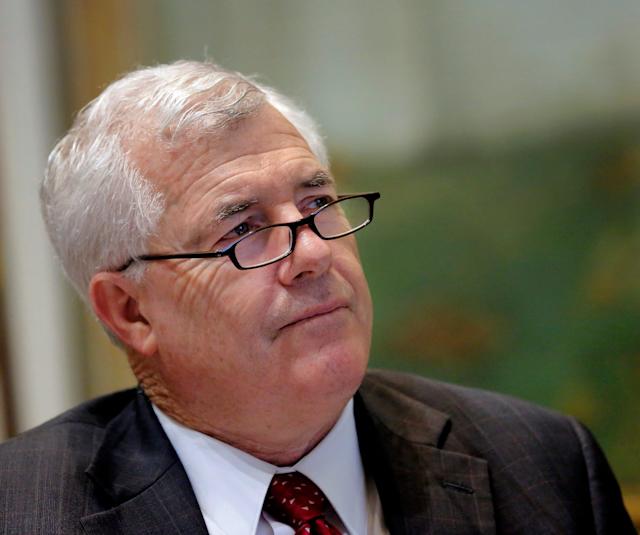
OKLAHOMA CITY – Former state legislator Mike Reynolds, in a protest against $3 billion in ratepayer-backed bonds that would pay the extraordinary expenses public utilities incurred in the February 2021 winter storm, accused two Corporation Commissioners of corruption.
Commissioners Dana Murphy and Todd Hiett endorsed the issuance of bonds that would “securitize” the 2021 winter storm expenses of Oklahoma Gas & Electric Co., Oklahoma Natural Gas Co., Public Service Co. of Oklahoma, and Summit Utilities (formerly CenterPoint Energy).
Securitization would enable the utility companies to transfer their winter storm debts off their company books. The Oklahoma Development Finance Authority would issue bonds, and the proceeds from the sale of those instruments would be used to purchase debts that the utility companies incurred during the February 2021 freeze, to buy electricity and natural gas to keep their customers warm.
Bond buyers would recover their investment from a tariff – a surcharge – that would be tacked onto a utility company’s monthly bill for several years until the debt was retired. The company would periodically remit that tariff revenue to a trustee bank selected by the ODFA.
Although the bond proposals were approved by the Corporation Commission, the enabling legislation that created the securitization plan, Senate Bill 1050, enacted last year, dictates that before the bonds can be sold, they must receive the state Supreme Court’s blessing.
Securitization plans authorized by Commissioners Hiett and Murphy, but not Commissioner Bob Anthony, include OG&E, a maximum $800 million; PSO, $688 million; ONG, $1.45 billion; and Summit Utilities, $95 million.
Settlements approved by the Corporation Commission provide that OG&E residential customers would pay an average of $2.12 per month for 28 years to retire the debt; Summit Utilities customers would pay an extra $4.36 per month for 15 years; a PSO residential customer who typically uses 1,100 kilowatt-hours of electricity each month would pay an extra $4.06 per month for 20 years; and the securitization agreement approved by Murphy and Hiett would require the majority of ONG customers to pay an extra $7.82 per month for 25 years.
Besides his protests against the OG&E bonds, Reynolds has urged the Supreme Court to declare the securitization laws (SB 1049 for unregulated utilities, and SB 1050 for regulated utilities) unconstitutional. If the justices were to strike down those laws, it would invalidate all of the pending 2021 winter storm ratepayer-backed bond proposals.
In a related matter, state Rep. Mark McBride filed House Bill 3566, which would require public utilities regulated by the Corporation Commission to “submit annual Emergency Update Plans and Maintenance Plans” to the commission.
A public utility would have to submit such a plan before the company’s application for a rate hike could become effective, and the utility “shall have been in compliance with the Commission for five years,” HB 3566 stipulates.
“I have obligations that I need to do for the people,” McBride told an Oklahoma City television station. “I’m elected to represent the people of Oklahoma, not shareholders. That’s kinda my job, ya know?” the Moore Republican said.
HB 3566 was approved 83-0 by the House of Representatives and was transmitted to the Senate.
Murphy and Hiett
fundraising, expenses
targeted by Reynolds
In Part III of his protest against OG&E’s request, Reynolds accused Murphy and Hiett of illegally receiving contributions from attorneys and other interested parties in cases affecting OG&E, PSO, ONG and other utilities. In doing so, the filing exposed the obvious political and personal differences those two officials have with their colleague, Commissioner Anthony.
For example, Reynolds wrote of Hiett’s “post-election slush-fundraising from regulated entities with significant interests in the 2021 winter storm…”
Murphy, who chairs the three-member Corporation Commission, responded with a statement to OK Energy Today.
“Of significant concern is that these delay tactics using misinformation will result in increases to ratepayers as interest rates rise and time passes. I have always followed the law and the donations are publicly disclosed. My record over the past 14 years shows that my decisions are not influenced by donations. My votes are not for sale.”
Reynolds’ 122-page filing also accused Hiett of illegally spending more than $80,000 of those and other campaign funds on personal expenses, including rent on a second home “(his primary residence remains in Kellyville),” travel, meals and illegal loan payments.
Unlike state legislators “who are statutorily bound to reside in [their] home district, while being forced to work certain months during the year at the Capitol,” statewide elected officials are expected to live near the Capitol in Oklahoma City, Reynolds wrote.
Consequently, he continued, statewide elected officials “are therefore not provided a per diem for travel, nor are they allowed to expense a second residence or commuting miles…”
Reynolds quoted a state Ethics Commission rule which states, “the Commission finds that moving to the Capitol city is reasonable for a four- to six-year term of office. [Corporation Commissioners are elected to six-year terms.] Therefore, purchase of a second residence does not qualify as an ‘ordinary and necessary’ non-reimbursed officeholder expense for a statewide officer. The Commission further finds that a second residence would not be necessary ‘but for’ the officeholder’s personal choice to live at his/her primary residence. It therefore holds that surplus campaign funds may not be used to purchase and maintain a condominium under these facts, nor is rent on such a dwelling an appropriate use of surplus campaign funds for this official.”
In response, Hiett told OK Energy Today, “There’s nothing to it. It’s just a continuation of the Bob Anthony--Mike Reynolds witch hunt. None of it has merit,” added Hiett, who declared, “Bob’s not a well man.”
Hiett did not elaborate but repeated the claim again in the interview with OK Energy Today. “It’s just frustrating. But it is what it is.”
He said Reynolds’ allegation of a “mysterious” loan from SpiritBank, an institution of which Hiett is a director, was simply a mistaken filing by his CPA who reported the $200,000 campaign loan as fully paid but omitted the estimated $2,000 interest and continuing fee. Hiett said he knew he was about $2,000 out of balance and had the CPA do a full audit of his campaign expenses and an amended report was filed with the Oklahoma Ethics Commission.
Hiett also said he and his CPA met with the Ethics Commission and agreed to change his campaign expense description of an Oklahoma City office and lodging to just lodging. “I did a full vetting with the Ethics Commission.”
He also defended his acceptance of campaign contributions, saying none were in violation of state rules that prohibit a Corporation Commission candidate from receiving campaign donations prior to a 120-day period before a primary election.
“I received some after the deadline and I returned it,” Hiett said in reference to a prohibition of receiving campaign contributions after a 120-day period following a general election.
Reynolds repeated his assertion that Hiett has an unconstitutional conflict of interest that makes his seat “vacant” and any vote he casts at the OCC illegitimate. Hiett owns stock in and serves on the board of a bank that could benefit from approval of these ratepayer-backed bonds, Reynolds pointed out.
The former lawmaker made the same claim in July 2021 in a filing with the Supreme Court. While the case was eventually dismissed, the Court never did rule on the constitutionality of the claim.
Reynolds claims the conduct of Murphy and Hiett, who voted 2-1 to approve the OG&E winter storm bond deal in December, is unlawful and fatally taints the proposal and the Supreme Court should invalidate it. The lone vote in opposition was cast by Anthony.
Cheaper alternatives
to proposed bonds
In earlier filings, Reynolds and other protestors have insisted that the winter storm costs were not properly investigated before being passed through. They also have argued that the proposed ratepayer-backed bonds are unconstitutional and will be more expensive for ratepayers than other, simpler alternatives.
A protest filed in the case earlier this month called SB 1050, the Regulated Utility Consumer Protection Act, “a license to steal from ratepayers.”
The protestant also noted that only Oklahoma’s investor-owned public utilities have taken advantage of the new law and applied for the ratepayer-backed bonds; electric co-ops and others who are not trying to profit from the winter storm have made better financing deals for their customers elsewhere.
The Oklahoma Municipal Power Authority, the Grand River Dam Authority, and all of Oklahoma’s electric co-ops “who have gone looking found better alternatives to deal with their February 2021 winter storm costs” than the ODFA’s ratepayer-backed bonds, the protester wrote.
Commissioner Anthony pointed to Canadian Valley Electric Cooperative as an example.
CVEC gets its electricity from Western Farmers Electric Cooperative, based in Anadarko. WFEC’s extraordinary fuel costs in Winter Storm Uri last year were in excess of $200 million. CVEC’s share of that included $15,869,552 in extraordinary purchase power costs incurred during Winter Storm Uri last year, plus $2.6 million in interest on a loan, gross receipts tax and some legal expenses.
To pay its bill in one lump sum, CVEC opted to secure a loan from CoBank at a fixed interest rate of 2.465% annually for the duration of the 10-year loan. The “average” CVEC residential customer will pay an extra $2.64 per month for the next decade.
A Supreme Court administrative law judge has already conducted a hearing on OG&E’s case, and hearings on the PSO, ONG and Summit Utilities bond proposals are scheduled at the Supreme Court on April 13.