

Two of the projects may be let for bids this year, and nine dams are in the rehabilitation design or planning phase, according to Tammy Sawatzky, director of the Conservation Programs Division of the Oklahoma Conservation Commission.
One of those projects is Fourche Maline Dam #7M in Latimer County, better known as Wilburton’s Lloyd Church Lake, is scheduled for multiple renovations. It will be upgraded for two reasons, Sawatzky said.
First, it needs to comply with dam safety regulations of the U.S. Department of Agriculture’s Natural Resources Conservation Service and the Oklahoma Water Resources Board.
Also, the project is intended to meet Wilburton’s water demands for another 100 years.
The top of the dam will be raised 6 feet, making the embankment 71 feet high and increasing the lake’s water storage capacity. Blueprints show the dam has a 150-foot-wide combination principal and auxiliary spillway that includes a reinforced concrete labyrinth weir crest structure over the dam embankment, two ports within the labyrinth weir walls for principal spillway discharge, a reinforced concrete chute spillway, and a stilling basin.
The rehab project will cost an estimated $14 million; the Conservation Commission’s share would be $4.9 million and federal funds would finance the balance. The work will take two years to complete, Sawatzky said.
The Fourche Maline 7M project may go out for bids in May, with construction starting this fall, she said.
Lloyd Church Lake was built two miles south of Wilburton in 1964 by impounding a tributary of Bandy Creek, OWRB records reflect. It was designed for flood control, water supply and recreation.
The lake’s drainage area is 4.13 square miles, and protects rural land and homes, State Highway 2, Cravens Road, Golf Course Road, Pleasant Hill Road, and several bridges, Sawatzky said.
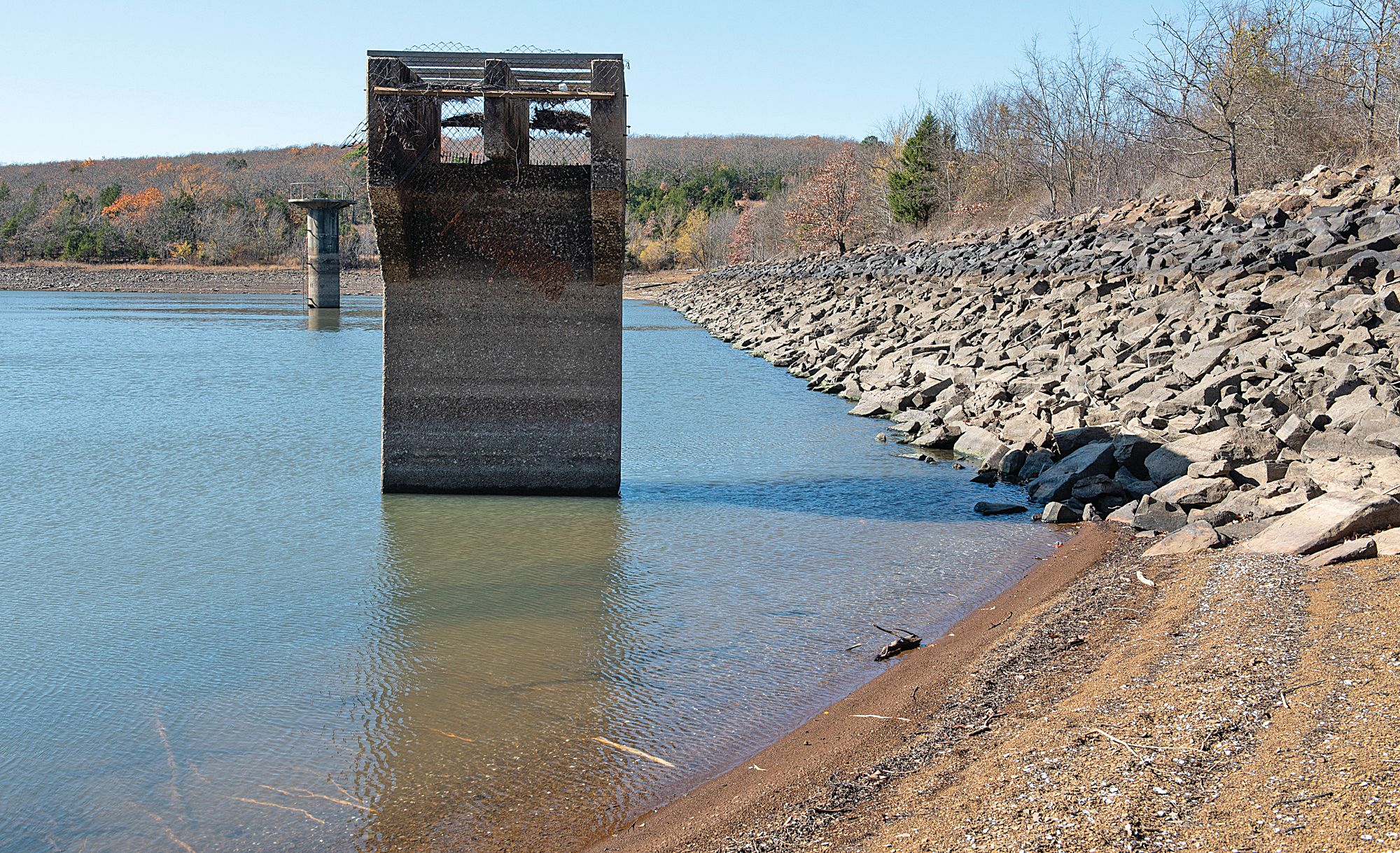
According to an OWRB lakes atlas produced in 2015, Lloyd Church Lake encompasses 154 surface acres, has a maximum depth of 47 feet, and contains 3,025 acre-feet of water (985 million gallons) at normal pool elevation. However, the reservoir’s levels have been low recently.
Perry Lake CCC dam
to be raised 2.8 feet
Another project that could be under construction in the near future is rehabilitation of Upper Black Bear Dam #62, commonly known as Perry City Lake CCC. It, too, will be renovated to comply with USDA NRCS and OWRB dam safety regulations and to meet Perry’s water needs for a century, Sawatzky said.
The lake was created in 1935 by impounding the Upper Black Bear Creek two miles south of the Noble County town, and has a drainage area of 16.2 square miles. Details about the reservoir’s volume and depth are unavailable.
The Perry dam will be raised 2.8 feet, making its embankment almost 68 feet high, Sawatzky said. The existing 400-foot-wide spillway on the north side of the lake will be raised 2.2 feet, and a second 400-foot-wide spillway will be constructed on the south side of the dam, she said. After that work is finished the existing road will be replaced by the City of Perry, she added.
The City of Perry “continues to finalize land rights issues” on that project, Sawatzky said. She “guesstimated” that the project would be let for bids in November and construction might start next February.
The Perry dam job will cost an estimated $11 million and will take about two years to complete, Sawatzky said. Federal funds will pay 65% of the project cost and the OCC will contribute a 35% match, she said.
3 other dams are
in design phase
Three other dams are in the design phase, she reported.
Upper Clear Boggy Dam #26, in Pontotoc County. That dam is 850 feet long and 41 feet high, and has a drainage area of 1.7 square miles. The dam was built in 1980 with a projected service life of 50 years.
Quapaw Dam #15M, which is better known as Meeker City Lake in Lincoln County. That dam is 1,220 feet long and 47 feet high, impounds South Quapaw Creek and protects a drainage area of 11.42 square miles, Sawatzky said. The dam was constructed in 1970 with an estimated service life of 100 years.
Meeker Lake encompasses approximately 200 acres, has a maximum depth of 24 feet and contains 1,960 acre-feet (639 million gallons) of raw water, OWRB records reflect.
Boiling Springs Dam #1, in Latimer County, was constructed in 1973 with an anticipated service life of 50 years. The dam is 760 feet long and 58 feet high, and has a drainage area of 3.5 miles, Sawatzky said.
Project near Elk City
nearing completion
A 45-year-old upstream flood-control dam in the Elk Creek watershed in Beckham County has been undergoing a $4.3 million renovation project for the past nine months and should be completed in April or May, Sawatzky indicated.
The structure is identified technically as Upper Elk Creek Site 23D. The height of its compacted earthen dam has been raised by 4.4 feet (just under 53 inches), which required a county road, North Eastern Avenue, to be raised, too.
The principal spillway is a new 30-inch-diameter reinforced concrete pipe installed in the dam to regulate the amount of water discharged from the reservoir it impounds, NRCS State Conservation Engineer Chris Stoner said. The new pipe replaces the original 24-inch principal spillway pipe, which was abandoned in place and filled with concrete grout, he said.
“The principal spillway pipe is designed to slowly release floodwaters from the dam,” Stoner said. “The dam provides flood protection by storing water and slowly releasing it from the elevation of the principal spillway inlet tower to the elevation of the auxiliary spillway crest.”
The auxiliary spillway is 345 feet wide and 400 feet long, and is lined with articulated concrete blocks, along with 4,000 tons of gravel and 4,000 tons of sand. The auxiliary spillway is designed to protect the dam in extreme rainfall events, Stoner said.
The total storage capacity at the top of the dam will be 1,347.9 acre-feet – 439 million gallons of water – Stoner said.
Rather than removing sediment that has accumulated behind the dam over the past four and a half decades, the height of the dam is being elevated.
“There are too many unknowns in dealing with sediments that have accumulated over the life of the dam, and it is difficult and expensive to remove,” Stoner explained. “We have found it much easier, where possible, to provide additional sediment storage by raising the elevation rather than excavating sediment.”
Construction on Upper Elk Creek Site 23D began last August and the contractor, C-P Integrated Services of Oklahoma City, was allocated 299 days to finish the job, Stoner said.
The dam was originally designed to last 50 years, but the renovations will extend its life “for 75 to 100 years,” Oklahoma Conservation Commission Executive Director Trey Lam said.
Besides the project’s ultimate benefit to property owners in the watershed, Elk City benefits from the work, too, Stoner said, because CPI employees are buying fuel and food locally and staying in local motels during construction.
The federal government pays 65% of the cost of upstream dam rehab projects and the state must contribute 35% in matching funds.
Because of the high cost of the Upper Elk Creek Site 23D project, the Oklahoma Conservation Commission is providing the 35% match on behalf of the project sponsor, North Fork of the Red River Conservation District. The Elk Creek watershed drains into the North Fork of the Red River.
The NRCS and the OCC have completed more than three dozen dam rehabilitation projects, and several others are in the planning or design stage, Stoner said.
Matching funds for the Elk Creek site will come from the $17.5 million bond issue the Legislature authorized in 2020 to finance improvements to high-hazard dams.