

Most sports stories are about games and the athletes who compete in them – especially the winners – or revelations about their illegal or immoral shenanigans.
Throughout his career, though, Gaylord “Gay” Talese trained his sights on the noncelebrity. For six decades he wrote articles about sports figures who aren’t in the spotlight, such as a boxing timekeeper and a referee, a baseball game viewed from the perspective of the spectators in the stands, champions who are past their prime, and the also-rans.
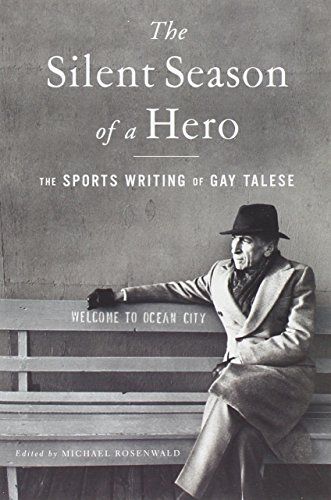
“The Silent Season of a Hero” (320 pages; Bloomsbury Publishing, 2010) is a collection of 38 sports essays the 90-year-old wordsmith penned between 1948 and 2006.
He described roller derby star Gerry Murray as “a curvesome woman pushing 40 with the gentility of a waterfront bouncer.”
Of Mike Gillian, a horseshoe maker, Talese wrote in 1958, “Many of the prize animals that have been running around Madison Square Garden this week have been purchasing Gillian’s footwear for years… None of his tailor-made shoes has ever been returned.”
In reporting on a gridiron scrimmage in the spring of 1953, Talese wrote that then-Crimson Tide Coach Harold “Red” Drew “gently tooted the whistle at 3:30 p.m. and 80 huge hunks of Alabama football scholarships began to smash and lash at one another.” When a freshman halfback was “stopped and cut down” by a defensive guard, Drew growled, “You’d fall over a blade of grass!”
One college baseball game Talese covered was held in freezing early-spring weather in front of only 18 spectators. “There were three mailmen there, some upper classmen and two freshmen, one of whom had a Thermos bottle that contained scotch.” Also in the bleachers was a 19-year-old “hazel-eyed brunette” sophomore who had “shivered through the game out of affection” for a third baseman on one of the clubs.
Judy Frank, a New York golf champion, “says she keeps late hours, smokes excessively and takes a drink from time to time,” Talese related.
He interviewed a dentist who manufactured mouthpieces for professional athletes.
In 1959 Talese interviewed the official timekeeper at Madison Square Garden. George Bannon, 78, “has sat through the cigar smoke of 7,000 fights.”
Talese found the last of the bare-knuckle brawlers still spry at the age of 93. Billy Ray “accredits his long life to street fighting, prize fighting and women.” He was “so tough that when boxing gloves became popular, in the 1880s, he retired” because the game was becoming “too soft.” Billy Ray was still “working as a bouncer in a saloon” when he was 76.
Talese wrote about a midget wrestler who “from a distance looks no larger than a fifth of scotch” and made a handsome living grappling with “midgets, dwarfs and assorted gnomes…”
In an article about a 1979 New York Yankees road trip to Cleveland, Ohio, Talese mentioned a bullpen catcher “whose favorite off-the-field exercise seems to be brushing his hair…”
Rather than interviewing professional golfers, Talese wrote an article in 1960 about their caddies, and he interviewed renowned golf course architect Robert Trent Jones. “To build his famous fairways and traps, Mr. Jones and his employees have had to cut through jungles, dynamite rocks, and stalk across swamps. In so doing they have uprooted alligators in Florida, elks in the Rockies, and snakes nearly everywhere.”
While sports reporters and columnists typically concentrate on the pugilists in a boxing match, Talese wrote about a boxing referee who cut off contact with all his friends in the fight game in order to maintain his reputation for scrupulous integrity. Consequently, Ruby (cq) Goldstein was “the most lonely guy in boxing,” Talese asserted.
Talese wrote about heavyweight champion Floyd Patterson’s 1958 bout with “a backwoodsman named Roy Harris, scion of a Texas family of armadillo lovers and tobacco chewers.” Heavyweight boxer and ex-convict Sonny Liston, who twice knocked out Patterson in the first round, was “precisely the type of gladiator needed to pack arenas as they were jammed in the good old days of Roman lion orgy.”
Joe Louis and “Joltin’ Joe” DiMaggio both were interviewed by Talese in the autumn of their lives. When the journalist asked the Yankee Clipper’s brother, Vincent DiMaggio, whether he envied his famous but reclusive brother, Vince, who had been married for 34 years and had four grandchildren, replied, “No. Maybe Joe would like to have what I have.”
In a 1958 portrait of a prize fighter, Talese said the 22-year-old athlete had “sad, dark eyes” plus “jagged, small facial scars and a flattened nose that has been hit by obscure amateurs he has already forgotten.” The name of the future light-heavyweight star wasn’t revealed until the last paragraph of the story.
Talese has always been sympathetic toward the losers in sports. To illustrate, Patterson confessed to the journalist, “The worst thing about losing is having to walk out of the ring and face those people.”
In a similar vein, during the 1999 women’s World Cup soccer championship held at the Rose Bowl, Talese’s article was not about media darlings Mia Hamm and Brandi Chastain, but about the Chinese soccer player who missed a critical goal which enabled the U.S. team to win.
Talese previously was a journalist for The New York Times and for Esquire magazine. He also is the author of several books, including “Honor Thy Father” about the Bonanno crime family in the 1960s, and “The Kingdom and the Power: Behind the Scenes at The New York Times”.
“The Silent Season of a Hero” is an excellent example of Talese’s attention to detail, his observation of the unnoticed, and his ability to conjure mental images with the written word.