

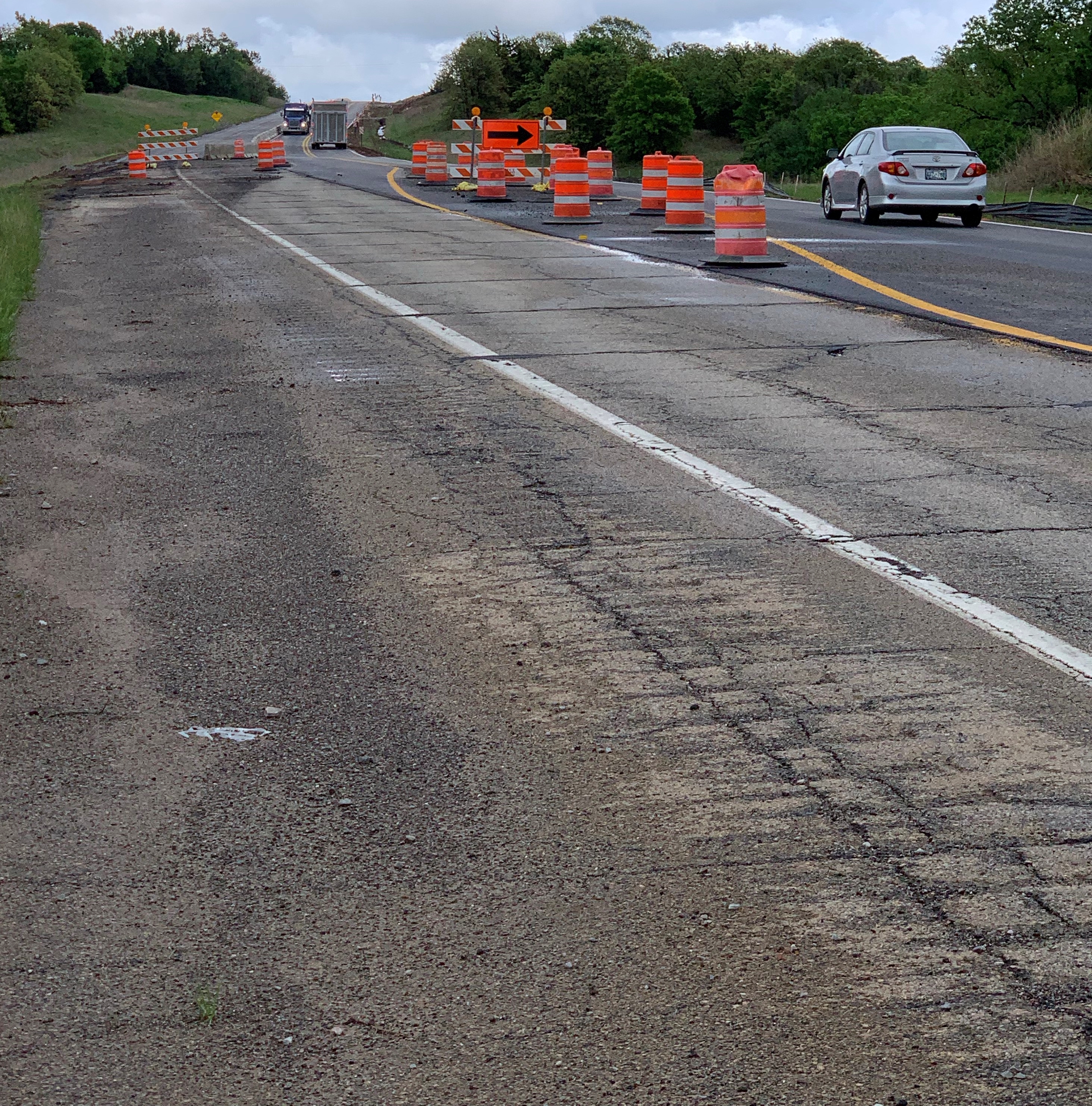
OKLAHOMA CITY – The state Transportation Department is poised to ramp up construction projects that will improve hundreds of miles of rural two-lane highways with assistance from a novel federal loan program.
Oklahoma has nearly 5,300 miles of two-lane highways that have deficient shoulders or none at all, said Cody Boyd of the department’s Strategic Communications Division. That accounts for 56% of the total miles of two-lane highways in the state, he said.
The Oklahoma Department of Transportation continuously updates its 8-year Plan of highway and bridge improvement projects.
The latest 8-Year Plan includes improvements to 1,013 miles of two-lane highways with deficient shoulders, via ODOT’s Rural 2-Lane Advancement and Management Program, Boyd said. “We’d like to advance those projects as quickly as possible,” said Rick Johnson, ODOT’s director of project delivery.
One of those RAAMP projects is under way in Caddo County: a $22.6 million project on SH-9 between Fort Cobb and the US-62/US-281 junction north of Apache and southeast of Fort Cobb. That contract entails reconstructing nearly six miles of SH-9 with added paved shoulders, replacing three bridges, and adding turn lanes at the junction of SH-9 and US-62/US-281. The average daily traffic volume on that section of highway is approximately 2,000 vehicles.
Total costs associated with RAAMP are estimated to exceed $400 million. The program will be financed with regular appropriations from the Legislature and proceeds from “one or more revenue notes” secured through the U.S. Department of Transportation.
USDOT Transportation Infrastructure Finance and Innovation Act loans will be coupled with the state appropriations to “accelerate two-lane projects already listed in the 8-Year Construction Work Plan,” Johnson said.
“We have several shovel-ready projects,” Johnson told Southwest Ledger.
The state Legislature gave ODOT permission last year, in House Bill 2896, to secure up to $200 million in TIFIA loans to jump-start the RAAMP program. “We’re already using our appropriated dollars on some of those projects, and the proceeds from the federal loan will enable us to advance the program,” Johnson said. The loan “will help us get those projects in motion much earlier,” Boyd added.
The state Council of Bond Oversight on May 4 authorized the Oklahoma Capitol Improvement Authority to secure the first TIFIA loan, for approximately $50 million, from the U.S. Transportation Department. A lease agreement provides that ODOT will make regular payments to the OCIA in amounts sufficient to pay the principal, interest, and related costs of the TIFIA loan.
“Using this innovative funding strategy, Oklahoma will be one of the first states in the nation to take advantage of a rural Transportation Infrastructure Finance and Innovation Act loan through USDOT’s Rural Projects Initiative,” ODOT officials said.
The state Transportation Department will repay the TIFIA loans over a 20-year period with appropriations from the Legislature, ODOT Chief Financial Officer Chelley Hilmes said. The interest rate on the loans will be one-half of the U.S. Treasury rate, she said.
TIFIA loan funds will pay for up to 49% of the cost of a RAAMP bridge/highway improvement project and state funds will pay for the other 51%, Hilmes said.
The Transportation Department “typically uses a pay-as-you-go system for highway construction, but RAAMP projects will use additional financing secured at a very low interest rate,” she said.
Using TIFIA loans also will save the taxpayers some money in ‘the long run’ because inflation and the cost of materials such as cement are rising, Johnson noted.
In 2005, state lawmakers created the Rebuilding Oklahoma Access and Driver Safety fund in ODOT to ensure the agency has dedicated revenue for the maintenance and repair of state highway and bridges.
Last year the Legislature passed a measure that raised the ROADS Fund cap from $575 million in Fiscal Year 2022 to $590 million annually effective in FY 2023, which extends from July 1, 2022, through June 30, 2023.
With an influx of federal grants and additional state funding, the Oklahoma Department of Transportation reports it is maximizing new dollars to plan for more than 1,600 critically needed highway construction and safety projects in the next eight years.
With more than 300 new projects added to the 8-Year Construction Plan for 2022-29 approved on Oct. 4, 2021, ODOT will pump nearly $2 billion extra into highway infrastructure and the state’s economy.
This will bring a total impact of nearly $8 billion by the end of the decade. Commissioners also approved a $484 million investment in preventive maintenance through the companion Asset Preservation Plan for 2022-2025.
“Oklahoma truly has some great momentum in bringing our highway system back to a manageable condition, and this year’s update to the 8-Year Plan and Asset Preservation Plan will help us continue to preserve and enhance the transportation system,” Oklahoma Secretary of Transportation and ODOT Executive Director Tim Gatz said.
“We will continue our work completing corridor upgrades, adding shoulders to rural, two-lane highways and improving pavement conditions.”