


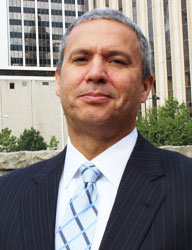
OKLAHOMA CITY – A raid on an illegal marijuana farm in Garvin County in 2021 revealed a “ghost” owner and culminated in a multicounty grand jury indictment lodged against two Oklahoma lawyers named in 22 felony charges filed against them June 16 by Attorney General John O’Connor, accusing them of facilitating illegal medical marijuana operations.
Logan Michael Jones, 56, and Eric Brandon Brown, 41, are each charged with one count of conspiracy to cultivate a controlled dangerous substance (marijuana), six counts of filing a false or forged instruments for official recording, three counts of cultivation of a controlled dangerous substance (marijuana), and one count of pattern of criminal offenses.
The Jones Brown Law Firm has offices in Oklahoma City and Tulsa, and is, or was, managed jointly by Eric Brown and Logan Jones. Brown’s attorney said the two men are no longer partners.
Besides the raft of charges against the two attorneys, the Garvin County drug raid also resulted in criminal charges against a former employee of Jones Brown Law Firm and a marijuana farmer of Chinese descent, and spawned at least one lawsuit.
“Let these charges send a loud and clear message to anyone engaging in criminal operations in Oklahoma: Your actions will not go unnoticed,” the Attorney General said.
OBN Director Donnie Anderson thanked O’Connor and his staff and the multicounty grand jury for “targeting those who created fraudulent business structures and enlisted ‘ghost owners’ allowing criminal organizations to unlawfully obtain a marijuana license.” The OBN has investigated “criminal organizations that hide behind their license while moving literally tons of marijuana onto the illicit market,” he said. “They also are responsible for collateral crimes including money laundering and human trafficking.”
The investigation into Jones Brown, initiated by the Oklahoma Bureau of Narcotics and Dangerous Drugs Control more than a year ago, found that the two attorneys directed medical marijuana businesses to sign consulting agreements with Jones Brown Law Firm employees who posed as ghost owners of the companies – Oklahoma residents who own companies on paper only.
The agreements required the client to pay $3,000 per license per year for the law firm to provide a consultant who would serve as an Oklahoma resident so the client could obtain an Oklahoma medical marijuana license.
The investigation revealed that the law firm submitted documents to the Oklahoma Medical Marijuana Authority and to OBN that listed six of their employees as Oklahoma residents who were 75% owners of medical marijuana grow operations, while the 25% owners were non-Oklahoma residents.
Based on statements and evidence gathered during the investigation, the assertions that Oklahoma residents were 75% owners of marijuana grow operations were fraudulently submitted to the state agencies to obtain licenses, O’Connor said. “This was facilitated by the Jones Brown Law Firm through Logan Jones and Eric Brown,” the Attorney General said.
It was discovered through the investigation that approximately 400 marijuana farms in Oklahoma listed Jones Brown employees as the majority owners.
One former employee, paralegal Kathleen Windler, 69, of Tulsa, was listed on official documents as the majority in-state owner for scores of medical marijuana businesses in the state; she voluntarily surrendered 300 licenses, officials reported.
OBN Director Anderson said that Brown and Jones represented foreigners who were growing marijuana in Oklahoma and shipping it out of state. It is illegal to sell Oklahoma medical marijuana out of state, OBN spokesman Mark Woodward said last April.
Windler, during an interview with OBN agents in April 2021, said the Jones Brown Law Firm “can help individuals from out of state that need 75% of a license held by an Oklahoma resident.” During that interview she called Logan Jones, who said his law firm “offers a bridge to fill the residency requirement” and referred to the practice as a “third-party resident.”
When investigators later asked Jones about “the liability of the 75% owner both administratively and criminally,” he said the “third party” executes an agreement that states “this is just to help fulfill the residency requirements and the third party has nothing to do with the operation.”
In one court document, Windler said she “owned none of the hundreds of businesses whose licenses were sought and obtained” through the “legal handiwork” of Jones and Brown, that she “exercised no control over any businesses, received no profits of the businesses, did not interact with any day-to-day operations of the businesses, and had no access to any bank accounts, assets, or liabilities of the businesses.”
‘Resident fees,’
rebates, ‘rent’
Windler told OBN agents that she received a “resident fee” of $3,000 for each license she signed claiming to be a 75% owner. She said she was “meeting with clients so frequently, this was the only type of work she was doing,” according to an affidavit an OBN agent filed to secure arrest warrants for Jones and Brown.
However, Windler said that starting in January 2021 she was required to rebate one-third of the “resident fee” to the law firm as an “overhead payment.” The kickback was “Eric Brown’s idea,” she told the OBN.
In addition, Jones and Brown began charging her rent “for having this business at their law office,” Windler claimed in a lawsuit she filed in Cleveland County against the two lawyers.
After her interview with the OBN, Windler provided investigators with documents that corroborated her claims. The records included copies of checks and receipts, and documents titled “Consulting Agreement” or “Third Party Resident Agreement.” She also provided proof about $2,000 monthly “rent” payments she was compelled to pay to the law firm.
Two other employees of Jones Brown confirmed they, too, were charged an “overhead fee” of $1,000 per license and $2,000 per month for rent, “which was paid back to the law firm,” according to the affidavit.
20,000 marijuana plants
confiscated in 3 raids
In April and June 2021 OBN agents and other law enforcement officers searched several locations in Oklahoma, including Dao K 88 Farm in rural Pauls Valley, Evergreen Cannabis near Fairview, and Tianz at Strang in Mayes County.
More than 20,000 marijuana plants were seized during the three search warrants, officials said.
Dao K 88 Farm had received a valid OMMA license for its operation, and had applied for but had not received an OBN registration. To legally cultivate marijuana in Oklahoma, both permissions “must be granted, not just applied for,” the affidavit points out.
Consequently, Windler and a man named Dao Feng, who had recently moved to Oklahoma from Colorado, were arrested after law enforcement officers raided the Dao K 88 marijuana farm east of Pauls Valley in late April 2021. OMMA records listed Windler as the owner of 75% of the operation and Feng as the 25% minority owner.
Windler and Feng both were charged in Garvin County District Court with three felony crimes: cultivation of marijuana “without lawful authority,” endeavoring to violate the Uniform Controlled Dangerous Substances Act, and possession of a controlled dangerous substance without a tax stamp affixed.
The charges against Windler were dismissed last November, at the state’s request. Court records provide no explanation why.
After a preliminary hearing on March 9, the charges against Feng also were dismissed. “There is not sufficient cause to believe the defendant guilty of the offenses,” a district judge wrote. Insufficient evidence was presented “as to identification of the defendant as being involved in the cultivation of the marijuana.” The state filed notice of intent to appeal
None of the three MJ farms raided last year was listed as a medical marijuana licensee on June 17.
The number of MMJ licenses reported on June 13 by the Medical Marijuana Authority numbered 399,127, including 385,985 patients licensed to buy and consume medical marijuana products, 11,321 businesses, and 1,821 caregivers.
After the criminal charges were brought against her in Garvin County, Windler filed suit against Jones and Brown in Cleveland County District Court in August 2021.
She claimed she was duped into accepting their assignments “due to her reliance on their legal advice as well as her belief” that the two attorneys “knew and understood the applicable laws and regulations, confirmed the legality of their advice with the OMMA and the OBN,” and wouldn’t give her legal advice “which would subject her to criminal and civil exposure.”
Windler accused her former bosses of legal negligence and fraud, and claimed that she suffered damages in excess of $75,001. The case was settled out of court and was dismissed on Jan. 1, 2022.
Jones, Brown both
Utah, TU college grads
Biographies of Logan Jones and Eric Brown show they received undergraduate college degrees in Utah and both earned their law degrees from the University of Tulsa.
Jones says he was reared on a farm in Utah, received an accounting degree from the University of Utah, then received his juris doctorate from T.U. Brown says he attended Brigham Young University in Utah, where he received a bachelor’s degree in social psychology, then transferred to T.U., where he received his law