

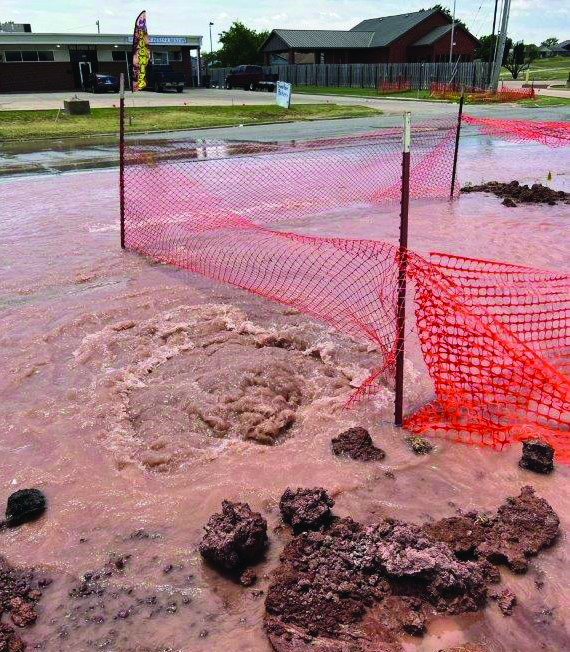
OKLAHOMA CITY — Water and wastewater infrastructure needs across the state between now and 2060 are projected “to be in the $80 billion range,” Joe Freeman, chief of the Oklahoma Water Resources Board’s Financial Assistance Division, told Southwest Ledger.
“There’s a lot of need out there,” Julie Cunningham, executive director of the OWRB, said during a committee meeting last month at which state legislators discussed water infrastructure needs across the state.
In response, the Legislature’s Joint Committee on Pandemic Relief Funding has recommended state lawmakers approve a $97 million water infrastructure package financed from Oklahoma’s allocation in the American Rescue Plan Act. The recommendation is proposed for consideration in the Legislature’s special session on ARPA funding.
The water package includes $50 million for the support and enhancement of water infrastructure throughout the state. The funds would be earmarked for a Water Project Grant Program administered by the OWRB; those grants would include:
• $25 million to finance infrastructure needs in communities of 7,000 or fewer residents and rural water districts that have fewer than 2,300 non-pasture taps.
• $20 million for mid-large system construction. Rules submitted to Governor Stitt for approval define a mid-large system as a community with a population greater than 7,000 or a rural water district with more than 2,300 non-pasture taps.
• $5 million to support dam rehabilitation efforts in communities whose dams are rated poor or unsatisfactory. Expenditures are limited to a maximum $1 million per community.
The $50 million in allocations from the ARPA funding were earmarked in Senate Bill 429 which the Legislature approved, and Governor Stitt signed earlier this year.
The Joint Committee’s $97 million proposed water infrastructure package also includes $12 million to match tribal contributions for creating new water infrastructure in rural Oklahoma communities in need of system upgrades to provide safe and reliable drinking water and wastewater systems.
“This funding will not only benefit the people in my House district, but people throughout the state who live in rural areas that are struggling with aging infrastructure made worse by our current drought,” said state Rep. Jud Strom (R-Copan). “Offering relief to those who need access to clean drinking water and waste disposal is essential to the quality of life of our rural residents.”
The funding package also includes $35 million for partnerships with municipalities, cities and tribes to coordinate on water and wastewater projects in Oklahoma City, including relocation of a water transmission main that supplies drinking water near Tinker Air Force Base.
In a related matter, SB 429 also included a $25 million appropriation to convert portions of the “open ditch” Lugert-Altus Irrigation System to buried pipe. In addition, the Legislature appropriated $3 million this year in House Bill 2959 for an emergency drought relief fund.
Billions of dollars in loans and grants
The OWRB allocates millions of dollars annually for loans and grants to finance water and wastewater improvements in municipalities and rural districts.
For example:
• In Fiscal Year 2022 (which ended June 30), the OWRB awarded $1.1 million in Rural Economic Action Plan grants and $664,800 for municipal sewer overflow and stormwater reuse grants.
The EPA is providing $554,000 in Sewer Overflow and Stormwater Reuse Municipal Grants to finance 80% of these projects in Oklahoma, and the Water Resources Board is contributing $110,800 to cover the other 20%, according to Tonya White, marketing and outreach manager in the OWRB’s Financial Assistance Division.
“This is a new program that was introduced in November 2021,” she said.
In FY 2022 the OWRB also approved $420.5 million in loans to municipalities and rural water/sewer districts: $233.9 million from the Drinking Water State Revolving Fund, for water system improvements; $82.9 million from the Clean Water State Revolving Fund, for wastewater system improvements; and $103.7 million from the State Revenue Bond Loan Program (also known as the Financial Assistance Loan Program).
• In FY 2021 the OWRB approved $574,500 in REAP grants, $227,800 in emergency grants, and almost $381 million in loans.
• In 2020 the Water Board approved $475,000 in emergency grants and $2 million in REAP grants, along with $622 million in loans.
The OWRB began providing emergency grants in 1983 and loans in 1985, Freeman said.
In nearly four decades the OWRB has had 51 FAP bond issues totaling $1.6 billion and 18 State Revolving Fund bond issues that totaled about $1.7 billion, records indicate.
Over the life of the Financial Assistance Program, as well as the CWSRF and DWSRF programs, the Water Board has authorized 1,076 loans totaling more than $5.6 billion, ledgers reflect.
Communities and rural water districts have saved an estimated $1.3 billion in interest charges on loans and grants awarded by the OWRB, Freeman said.
No FAP borrower has ever defaulted
No FAP loan authorized by the OWRB has ever defaulted, because of OWRB security measures, Freeman said.
For example, the state agency files a lien on the borrower’s revenue streams (such as water/sewer and sanitation operations, perhaps the electric system if it’s municipally owned), in some cases on a municipality’s sales tax receipts, and on some loans the OWRB will file a lien on the recipient’s real property.
Also, the loan agreement a borrower signs with the OWRB stipulates that the recipient must maintain a debt coverage ratio of either 1.25 or 1.4. (The debt coverage ratio is net operating income divided by debt service, the ratio of operating income available to pay the principal and interest.)
If not, the borrower must act within 90 days of receiving notice from the OWRB to increase net revenue (such as raise utility rates, reduce expenses, pledge additional revenues, etc.).