

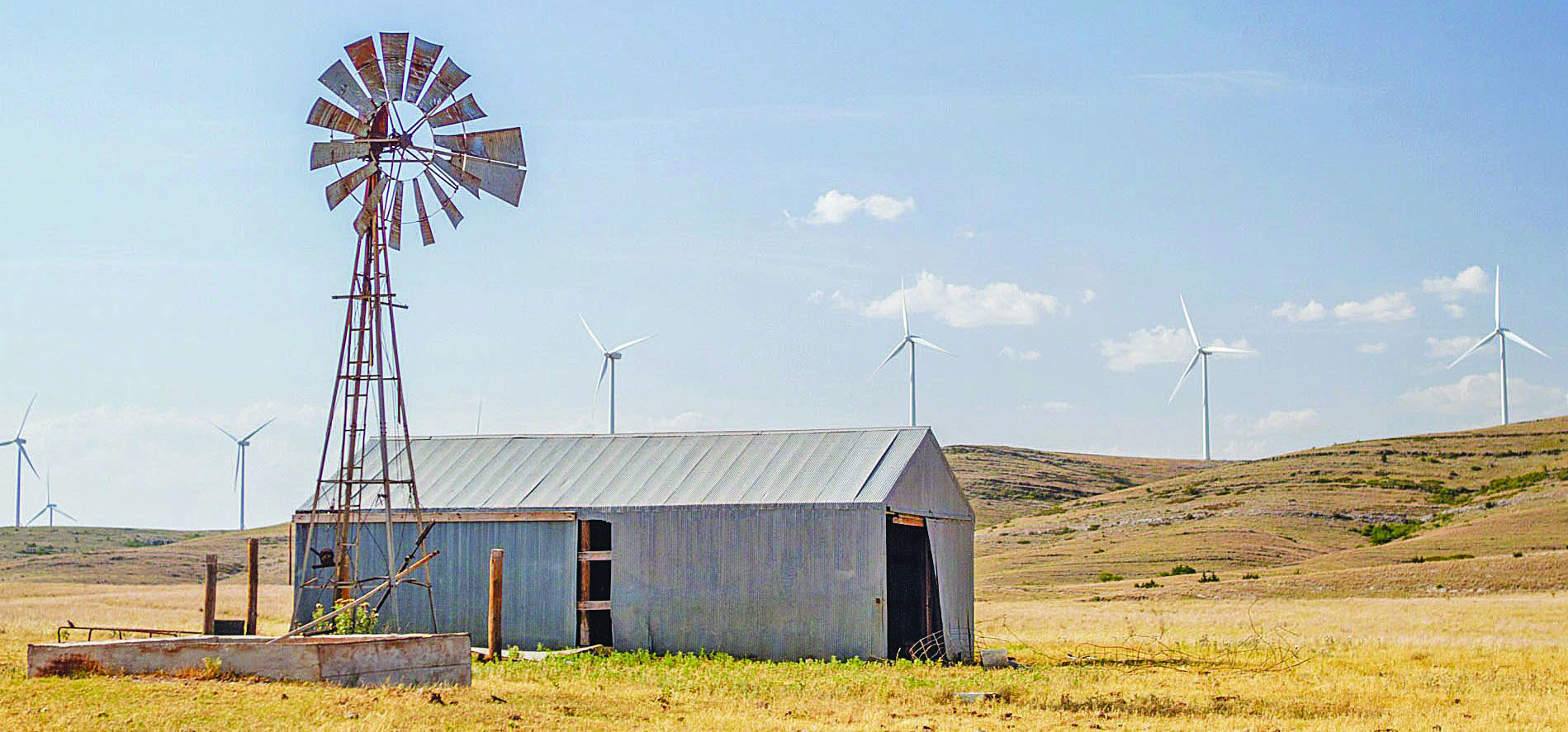
TULSA – Public Service Company of Oklahoma asked the State Corporation Commission to approve its “fuel-free power plan” which would feature the purchase of three new wind farms and three new solar facilities in Texas and Kansas.
“This proposed plan will help meet projected power needs while protecting customers from volatility in energy costs driven by high natural gas and power prices,” said PSO President and Chief Operating Officer Leigh Anne Strahler.
The plan would finance the $2.47 billion purchase of new renewable energy. The six projects were chosen through a competitive bidding process, PSO informed the Corporation Commission.
“These resources will help provide long-term stability in electricity costs, insulating customers from the future market price volatility of natural gas and purchased power through the addition of fuel-free power generation,” Strahler said.
PSO does not need permission from the utility-regulating Corporation Commission to buy wind farms and solar facilities; it can do that with just the approval of the company’s officials and stockholders. But PSO does need pre-approval from the commission in order to recover the purchase price as a “prudent cost” that can be incorporated into the company’s future rate base.
If all of the facilities PSO proposes to buy were online by the end of 2025, an average residential customer would see an estimated initial increase of $3.48 in monthly bills, according to Wayne Greene, PSO’s region communications manager.
Due to ongoing market volatility, it is difficult to project the precise impact on customer bills as prices will continue to fluctuate based on variables like supply chain issues and fuel costs, the company noted.
Additional generating capacity is needed to meet the energy needs of PSO customers, Strahler said. The need has increased due to new rules from the Southwest Power Pool that require utilities to have available additional generation capacity to support reliability. SPP is the 14-state grid balancing authority that includes Oklahoma.
Projected power needs
PSO's most recent Integrated Resource Plan, which was submitted to the Corporation Commission 13 months ago, outlined PSO’s anticipated need for additional capacity: 40 megawatts in 2023, increasing to 80 MW in 2024, up to 733 MW in 2025.
“After reviewing various alternatives to fulfill the need for additional capacity, it was determined that the preferred plan would be to acquire 4,150 MW of new renewable resources,” company officials wrote in their Nov. 17 application to the commission. Those resources would include 1,400 MWs of wind generation for 2024 and 2025, plus 900 MWs of solar generation in 2024 and 450 MWs of solar generation in 2025.
PSO conducted a request-for-proposals, received competitive bids, and settled on a fixed-price “turnkey” bid from Invenergy. The purchase sale agreement is contingent upon the Corporation Commission declaring that the renewable resources would be “used and useful” for PSO customers “upon becoming commercial and therefore eligible for cost recovery” from PSO ratepayers.
PSO proposes a 30-year lifespan for the wind farms and a 35-year lifespan for the solar generation facilities.
Production tax credits from the project would be credited to PSO customers over a 20-year period. PTCs were created under the Energy Policy Act of 1992 and are a 10-year inflation-adjusted federal income tax credit for each kilowatt-hour of electricity generated by certain types of renewable or zero carbon emission projects.
The wind and solar resources PSO wants to buy would produce renewable energy credits that would be sold, which would “produce revenues that would be credited to customers” via the fuel cost adjustment “rider.”
“At PSO we understand the importance of providing affordable service,” Strahler said. “This investment in fuel-free power is another step in our efforts to shield our customers against high costs while meeting their energy needs.”
PSO customers already
benefit from wind energy
PSO customers already benefit from the fuel savings of wind energy, she said. The wind farms of North Central Energy Facilities are estimated to save customers at least $156 million in fuel costs from October 2022 to December 2023 and are expected to save customers $1 billion in fuel costs over 30 years.
They also will help protect PSO customers from sudden spikes in natural gas prices and purchased power like those that occurred during the February 2021 Winter Storm Uri.
The Oklahoma Development Finance Authority sold $696.9 million in “securitization” bonds to pay for the fuel and purchased power costs plus associated financing costs that PSO incurred during the storm. Those bonds will be retired over a 20-year period with the proceeds from a special fee tacked onto monthly customer bills. For the average residential customer who uses 1,100 kilowatt-hours of electricity in a month, the fee is about $4.72, although each customer’s actual cost “will depend on your usage,” Greene said.
Wind, solar facilities
in Kansas and Texas
PSO’s proposed “fuel-free power plan” would require a total investment of $2.47 billion. The plan consists of the 265 MW Lazbuddie wind farm in Parmer County, Texas, and the 189 MW Pixley solar facility in Barber County, Kansas, both of which are expected to be completed in April 2025.
Four other facilities are scheduled for completion in December 2025: the 135 MW Flat Ridge IV wind farm in Kingman and Harper counties, Kansas; 153 MW Flat Ridge V wind farm in Harper County, Kansas; 103.5 MW Chisholm Trail solar facility in Sedgwick County, Kansas; and the 150 MW Algodon solar facility in Terry County, Texas.
Fast Facts about PSO
Public Service Co., a unit of American Electric Power, is a Tulsa-based electric utility company that serves more than 568,000 customer accounts in 232 communities in eastern and southwestern Oklahoma.
The utility serves more than three dozen communities in southwest Oklahoma, including Lawton, Altus, Duncan, Cache, Elgin, Fletcher, Porter Hill, Sterling, Temple, Hobart, Apache, Temple, Rush Springs, Carnegie, Cement, Cyril, Davidson, Duke, Elmer, Fort Cobb, Frederick, Gotebo, Gould, Grandfield, Granite, Headrick, Hollis, Lone Wolf, Manitou, Martha, Mountain Park, Mountain View, Roosevelt, Snyder, Terral, Tipton and Waurika.
PSO has approximately 3,800 megawatts of diverse generating capacity that primarily includes wind and natural gas. It maintains and operates more than 24,000 miles of distribution lines and 3,700 miles of transmission lines and is one of the largest distributors of wind energy in the state.
The company generated 6,377,212 megawatt-hours of power in 2021, and sold 19.35 million kilowatt-hours of electricity to its customers last year, company ledgers reflect.