

OKLAHOMA CITY — A bill filed in the state Senate would authorize county election boards to use GPS to assign voters to the correct precincts to ensure secure and accurate elections.
Senate Bill 426 by Sen. George Burns, R-Pollard, would authorize the secretary of a county election board to use global positioning system technology to ensure a voter is assigned to the appropriate precinct.
The Legislature establishes legislative and congressional district boundaries every 10 years in the reapportionment – also known as redistricting – process. Afterward, county election boards are “responsible for adjusting precinct lines to match new district lines,” said Misha Mohr, public information officer for the Oklahoma State Election Board.
“The secretary of each county election board establishes the precinct lines,” she said. “However, the proposed changes must be approved by the bipartisan county election board,” in accordance with state law.
The State Election Board contracts with the University of Oklahoma Center for Spatial Analysis to create precinct maps and maintain the Election Board’s Street Guide, which is used by the 77 county election boards to determine each voter’s voting district. Each voter is assigned to a precinct based on the information he/she provides on a voter registration application.
“Using GPS to check addresses to ensure they are in the correct precinct will further ensure that we have an even number of voters across every district and in every precinct,” Burns said.
However, there is a flaw in what Burns envisions.
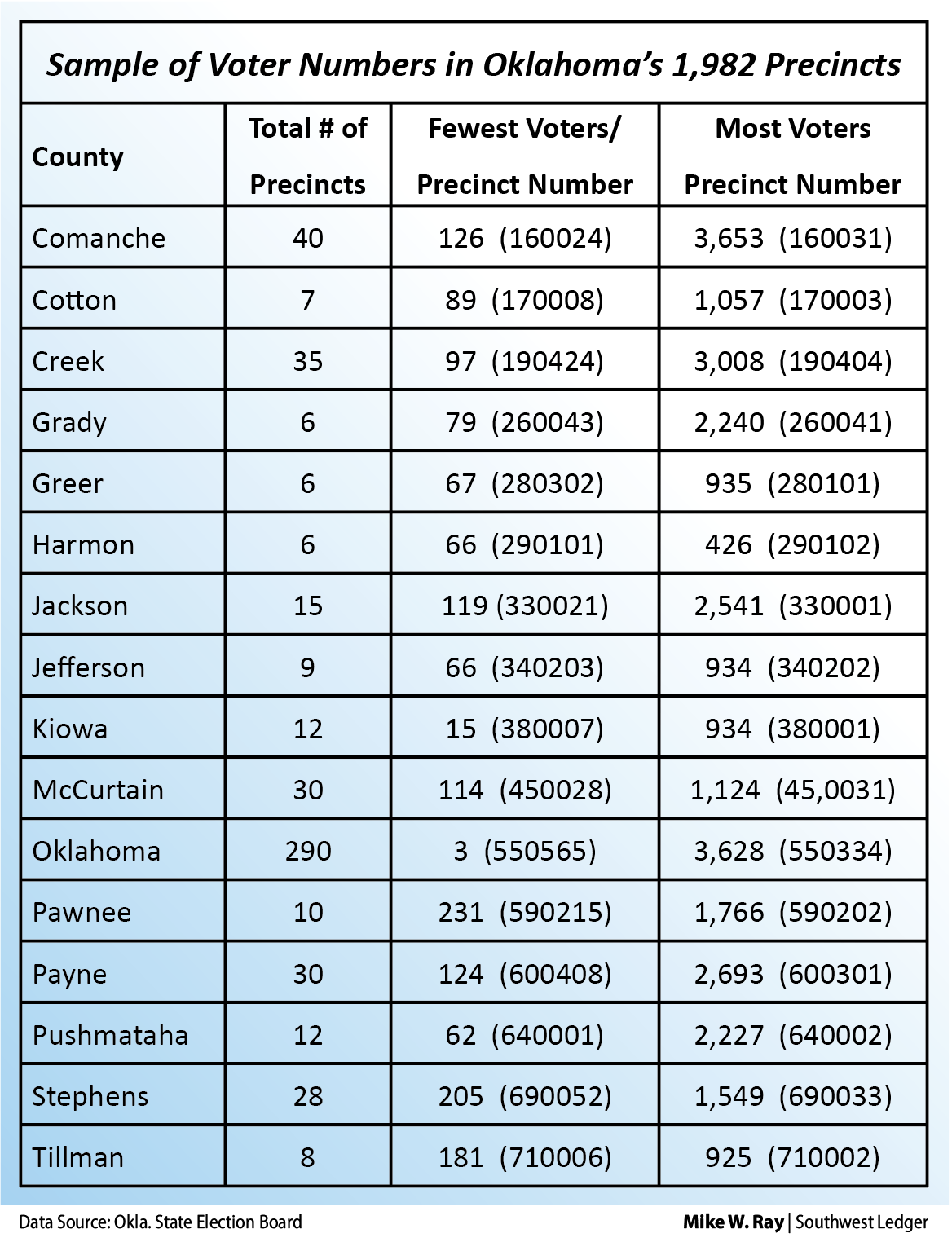
The number of voters in each of Oklahoma’s 48 state Senate districts, 101 state House of Representatives districts and Oklahoma’s five congressional districts are approximately equal. But the number of registered voters in each of Oklahoma’s 1,982 voting precincts is nowhere close to equal.
For example, McCurtain County, where Burns lives, has 30 voting precincts. Voter registration on Jan. 25 ranged from 114 in Precinct 450028 to 1,124 in Precinct 450031.
County election board secretaries must follow statutory guidelines when establishing precinct lines, Mohr said.
As an illustration, state statute decrees that the boundary line of any precinct “shall not cross the boundary line of any district court judicial district electoral division or any congressional, legislative or county commissioner district.”
Boundaries of all precincts “shall enclose a contiguous area and follow clearly visible, definable and observable physical boundaries which are based upon criteria established and recognized by the Bureau of the Census of the United States Department of Commerce for purposes of defining census blocks for its decennial census, provided that no municipal boundary that is not such a visible, definable and observable physical boundary shall be used as a precinct boundary.”
Also, if the governing board of any municipality requests in writing that precinct boundaries be altered to conform to ward boundaries of that city or town, the secretary of the county election board may, at his or her discretion, make such alterations if they “conform to the requirements” outlined in the statutes.
Consequently, the number of registered voters in each precinct in Oklahoma “can vary dramatically,” Mohr noted.
Elections are secure
In a related matter, records indicate Oklahoma’s elections are secure.
All 77 county election boards conducted post-election manual tabulation audits of the general election on Nov. 8, 2022. The post-election audits were conducted Nov. 29-30 and were open to the public.
Of the 108 manual audits that were conducted, “106 of them resulted in zero differences compared to the certified election results,” State Election Board Secretary Paul Ziriax said. Two of the audits identified minor differences compared to the certified election results; however, Ziriax said, “These would not have impacted the outcome of the election.”
Fewer than 10 potential voter infractions were reported to district attorneys after the 2022 general election. More than half of those incidents were for “double voting,” Mohr said.
Often in those instances, a voter mails in an absentee ballot but then inadvertently votes in person on Election Day, too.
Grady and Logan counties each reported a double voter, and Canadian and Ottawa counties each had two individuals who voted twice.
One of the general election reports involved an illegal voter in Alfalfa County, but the district attorney declined to file a criminal charge. In addition, some kind of voting incident was reported in Seminole County, but no details were available.
Those incidents constituted approximately 7 ten-thousandths of 1 percent of the 1,153,284 votes that were cast in the governor’s race in last November’s general election, which was the most votes tabulated in that statewide election.