

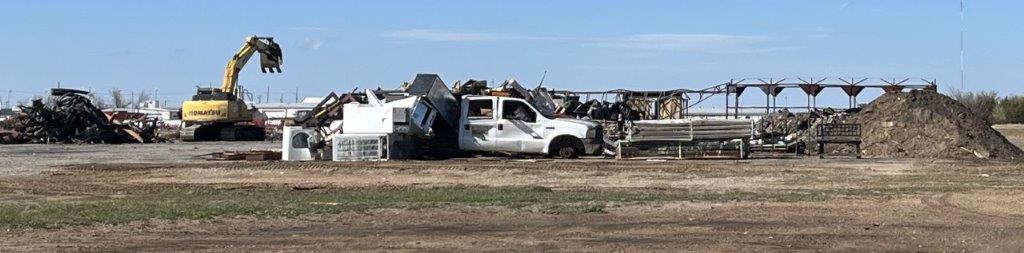
CHICKASHA — Local businessman Brannan Bordwine and three of his companies have been sued for negligence and breach of contract because of a fire last August that consumed a large volume of flammable hand sanitizer “improperly stored” on property leased from Blessed Chickasha Collective.
The state Department of Environmental Quality reported receiving a complaint July 19, 2022, that Bordwine was receiving semi-truckloads of hand sanitizer at the former Chickasha Manufacturing site, 5501 S. Fourth Street (U.S. Highway 81 and state Highway 19), and dumping the product on the ground.
Brannan Bordwine “entered into an oral lease” of that property from Blessed Chickasha Collective in June 2022. A condition of the lease was that Bordwine’s operations were to be conducted “in a safe manner which would protect [the] property from damage.”
The fire broke out on Aug. 7 and burned for several days. Ethanol-laced hand sanitizer at the site was so volatile that when the fire erupted, the cast-iron lids on two manholes were blown off and the municipal sanitary sewer briefly caught fire from sanitizer that flowed into the line, state and local fire officials reported.
During the fire, a warehouse at the site and its contents were “a total loss” and flames consumed all hand sanitizer stored at the site, the State Fire Marshal’s office confirmed. The building reportedly encompassed approximately 100,000 square feet of space.
“Nobody lost more in that fire than Brannan Bordwine did,” one of his attorneys, Peter Scimeca of Oklahoma City, told Southwest Ledger.
On Aug. 8, DEQ personnel inspecting a drainage ditch “in close proximity” to the site reported smelling hand sanitizer and finding dead vegetation for approximately 725 feet. Agency representatives collected water samples for analysis.
The DEQ “determined that there is contamination to waterways and soil on the property” attributed to the improper storage, transportation and handling of the hand sanitizer, Blessed Chickasha Collective alleges.
Blessed Chickasha Collective sued Brannan Bordwine individually; his Bordwine Urban and Rural Development LLC; Bordwine 963PPRD; and Bordwine Development LLC; along with Liquid Latitude LLC a/k/a Latitude Liquids LLC.
The lawsuit was filed Feb. 9 by Oklahoma City attorney R. Lyle Clemens and is still pending in Grady County District Court.
Details about Blessed Chickasha Collective are scant. It is a domestic limited liability company incorporated on Dec. 16, 2020, records of the Oklahoma Secretary of State show.
The registered agent listed for Blessed Chickasha Collective is Kevin Paul Pham of Oklahoma City.
The Ledger called the offices of Clemens and Pham on March 29 and left messages, asking whether they have any knowledge of what Blessed Chickasha Collective does and who its principals are. Neither Pham nor Clemens returned the Ledger’s phone calls.
Pham, 46, has an extensive criminal background, records of the Oklahoma State Courts Network show.
In 1997 he pleaded guilty in Oklahoma County to second-degree burglary; he received a deferred prison sentence and was required to fulfill a community service requirement.
In 2002, Pham was accused of operating a motor vehicle “chop shop” in Oklahoma County.
On Feb. 28, 2006, Pham pleaded guilty in Oklahoma County to 19 felony charges: nine counts of second-degree burglary and ten counts of concealing/receiving stolen property. All of the charges arose from a series of crimes that occurred in November and December 2002, court records indicate.
He received a suspended seven-year prison sentence on the burglary charges and a five-year suspended prison sentence on the stolen property charges. However, he was ordered to serve 52 weekends at Avalon Correctional Services in Oklahoma City and to pay restitution.
Two days after a quadruple homicide last November at a 10-acre marijuana farm at Lacey, in Kingfisher County, state drug agents raided Pham’s office. He was identified as an intermediary to a “ghost” owner for more than 60 marijuana farms; Oklahoma law mandates that 75% of a marijuana grow operation must belong to an Oklahoma resident. The “straw” owner subsequently surrendered all of his illegally obtained licenses, the Oklahoma Bureau of Narcotics and Dangerous Drugs reported.