

The bankrupt company that inadvertently distributed hand sanitizer contaminated with toxic methanol now seeks permission to recycle its tainted products for use in the manufacture of a basic construction material.
Cement manufacturers will employ the hand sanitizer as a solvent to wash their production equipment, the U.S. Bankruptcy Court in Laredo, Texas, was told.
4e Brands Northamerica filed an “emergency motion” on May 31, 2022, asking the U.S. Bankruptcy Court for the Southern District of Texas, Laredo Division, to approve a “destruction and recycling proposal” that the company claimed represented “the most cost-effective, efficient and safest” process for destroying its tainted hand sanitizer.
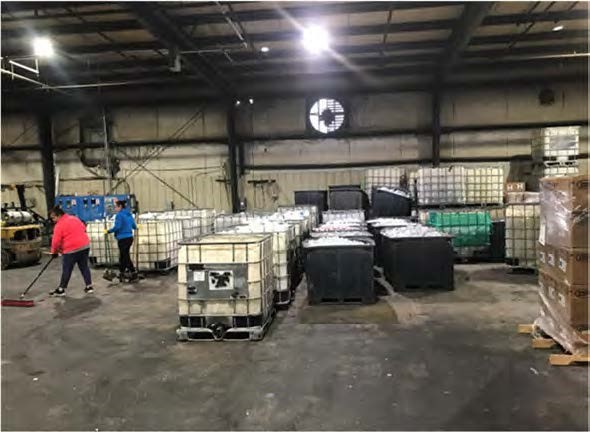
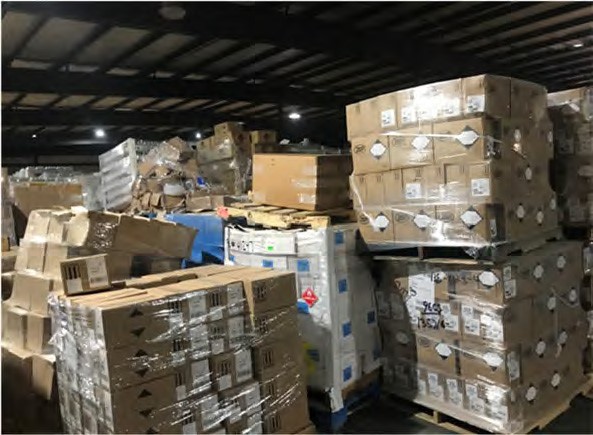
According to the Texas Commission on Environmental Quality, when 4e filed for bankruptcy in February 2022 it had 7,402 pallets of inventory that included hand sanitizer which was recalled by the U.S. Food and Drug Administration “due to the presence of methanol in the product.”
Methanol is a toxic alcohol that is used industrially as a solvent, pesticide, and alternative fuel source.
4e asked the court for permission to start the disposal process with its proposed “recycling vendor:” Latitude Liquids, which submitted “the most favorable bid.”
Latitude Liquids “provides the services of unpacking and recycling methanol- and ethanol-based hand sanitizer,” 4e told the court. “This solution effectively removes expired and unsellable hand sanitizer from the market through socially responsible methods.” The methanol is “typically utilized in biofuels,” 4e wrote.
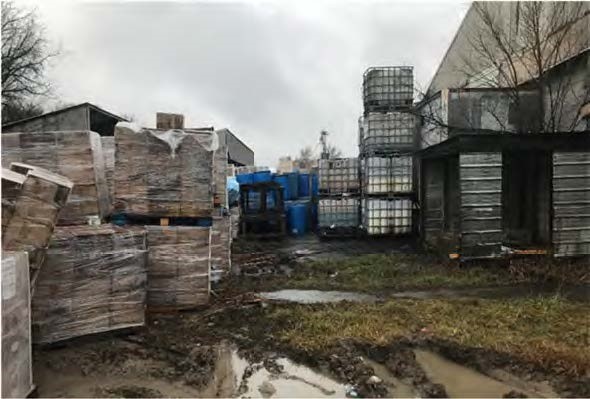
The contractor, Latitude Liquids, told a federal court that the products would probably be destroyed in Mexico, but the TCEQ discovered that Latitude developed an outdoor storage/disposal site near Shamrock in the Texas Panhandle near the Oklahoma border.
One investigator reported finding approximately 1,400 shrink-wrapped pallets of hand sanitizer, plus 111 “totes” of hand sanitizer, stored in an unimproved outdoor pit. (A tote is an industrial-size plastic tub in which liquids can be transported.) Subsequently two fires at the site destroyed all but 10 of the pallets of hand sanitizer.
The “debtor’s plan” confirmed by the bankruptcy court established a “compliance deadline” which decreed that 4e Brands’ vendor had to prepare a regulatory compliance plan within 45 days for the “legal storage, transportation, destruction, discarding, disposition, or recycling” that the TCEQ and the U.S. Environmental Protection Agency did not find objectionable.
Latitude Liquids – which was founded in Wyoming less than a year and a half ago and whose chief executive officer is a professional chef – failed to meet that requirement.
“After it became clear” that Latitude Liquids “could not meet the compliance deadline,” 4e pivoted to another vendor: Clean Management Environmental Group founded 30 years ago and based in Walterboro, South Carolina. That company claims it has expanded its service area “nationwide into all 50 states.”
The TCEQ discovered on Feb. 22 that 4e had contracted with the new vendor. The Texas agency also was told by a confidential informant that Clean Management hired a trucking company to transport 4e’s contaminated hand sanitizer from Laredo, Texas, to a recycling facility in Indiana.
TCEQ personnel on March 1 visited four warehouses in Laredo where 4e Brands Northamerica was storing its hand sanitizer. It appeared to the investigators that nothing had been removed from three of the warehouses, but 576 pallets of the product were missing from the fourth facility.
The TCEQ learned that Clean Management hired Landstar Carriers to transport 24 semi-trailer truckloads of 4e Brands sanitizer – each truck hauling 24 pallets of the product – to a Glycerin Traders facility in LaPorte, Indiana.
On its website, Glycerin Traders says it specializes in the trading of various grades of glycerin, mixed alcohol, vegetable and animal fat, multiple types of feed ingredients “and most other recyclable, organic ingredients.”
The company has a methanol distilling operation in Defiance, Ohio. “We purchase wet methanol from various outlets … and distill it into 99.99% reclaimed methanol,” Glycerin Traders says. The Defiance facility produces 100,000 gallons of reclaimed methanol per month, the company claims.
“[Y]our material is acceptable for use as a virgin wash solvent at the Lehigh cement plant in Logansport, Indiana,” Ray Nobles, alternative fuel manager for Lehigh Heidelberg Cement Group, wrote in an Oct. 21, 2022, letter to Dennis Zeedyk, founder and CEO of Glycerin Traders.
The TCEQ lodged a complaint with the Laredo bankruptcy court on March 14. 4e Brands Northamerica “has, once again, failed to hire a legally compliant company to manage its adulterated hand sanitizer,” the Texas agency charged.
Clean Management “is not permitted or licensed to manage hazardous waste,” and Landstar Carriers “is not permitted or licensed to transport hazardous waste.” Also, the warehouse in Indiana that Clean Management picked to store the hand sanitizer “is not permitted, licensed, or otherwise authorized to accept, store, process, or dispose of hazardous waste,” the TCEQ alleged.
The contaminated sanitizer was improperly transported “as a commodity and not as hazardous waste,” the TCEQ argued. Shipping the product as a commodity is less expensive than shipping it as a hazardous waste “but it means that fewer safety measures were taken.”
In addition, the Texas agency discovered that Glycerin Traders is “under enforcement by the Indiana Department of Environmental Management” and is not “registered, permitted, or otherwise authorized” by the State of Indiana to accept, store, or process hazardous waste on-site.
After conferring with Texas Attorney General Ken Paxton, 4e’s attorney directed Clean Management on March 8 to stop transporting hand sanitizer.
Meanwhile, “thousands of pallets” of hand sanitizer are still improperly stored in Texas: in four warehouses in Laredo and one each in Conroe and Fort Worth, plus the remnants at Shamrock.
4e Brands Northamerica responded two weeks later.
“It is imperative” that 4e “continue and complete the destruction of their hand sanitizer inventory as soon as possible,” the company’s attorneys told the court. 4e “will continue to incur liability” for hand sanitizer still stored in the warehouses.
For example, the Armet Beach and Basswood limited partnership based in Fort Worth “has been and continues to be used to store” 4e Brands hand sanitizer, and asked the court for payment of $75,075 in unpaid rent, operating expenses and electric bills that have accrued since June 1, 2022, when the tenant “abandoned the premises and the hand sanitizer products stored there.”
4e Brands disputed the TCEQ’s classification of hand sanitizer as “solid waste.” Materials are not solid waste “when they are recycled by being used or reused as effective substitutes for commercial products,” 4e argued.
Under current regulations the distinction between solid waste and non-solid waste “does not take the actual material into consideration.” Instead, the designation of ‘solid waste’ “is removed if the destruction is recycled or reused,” 4e wrote. “This flexible policy highlights the government’s commitment to a sustainable future where the regulations reward recycling.”
TCEQ asked the judge on March 14 to schedule a “status conference” to discuss 4e Brands’ latest choice of disposal vendor, and 4e asked the court on March 27 to approve its hand sanitizer disposal plan.
U.S. District Bankruptcy Judge David R. Jones had not acted on either request as of 5 p.m. March 31.