

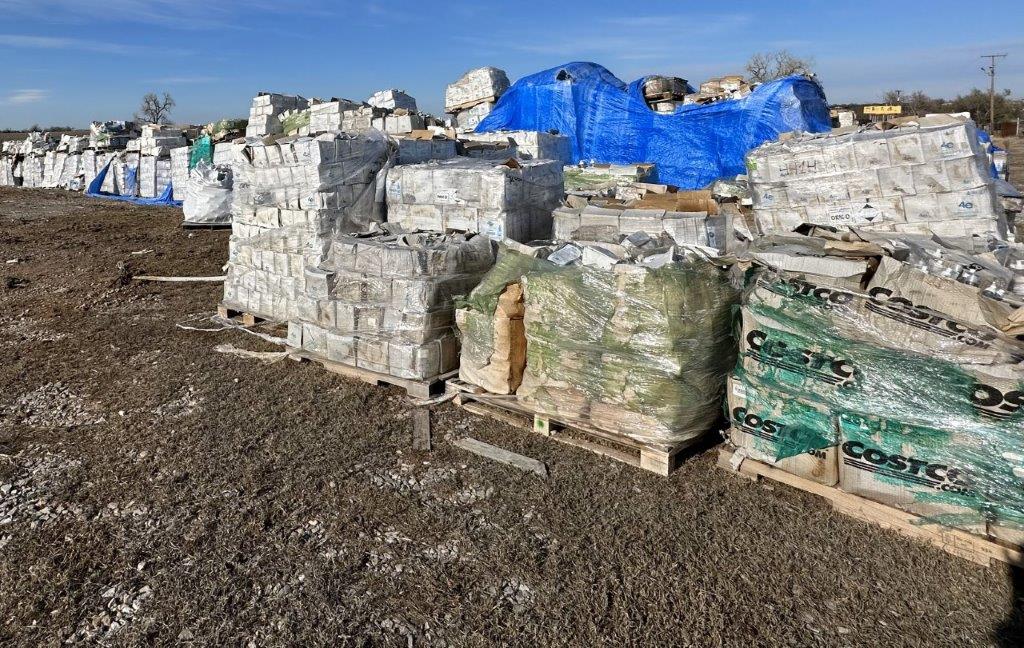
Blumen hand sanitizer which was stored – and caught fire last year – at multiple sites in Grady County owned or leased by Brannan Bordwine, was distributed by a company that is broke.
An Aug. 7 fire at 5501 S. Fourth St., the former Chickasha Manufacturing location Bordwine leased from Blessed Chickasha Collective, was the first of the three.
Four days later, on Aug. 11, firefighters were summoned to extinguish a fire at Bordwine Development’s principal headquarters at 1102 Pikes Peak Road in Chickasha. Bordwine owns that property, records in the Grady County Courthouse show.
According to the Oklahoma Department of Environmental Quality, hand sanitizer dumped into three roll-off containers on the property was incinerated. Agents of the U.S. Environmental Protection Agency also were photographed at the site that day.
DEQ inspectors toured the site on Aug. 14 and observed 28 “totes” (approximately 8,400 gallons) of hand sanitizer. A tote is an industrial-size plastic tub in which liquids can be transported on railroad cars. Agency inspectors said they also found 20 to 30 pallets loaded with hand sanitizer.
EPA representatives returned to Bordwine’s headquarters site last December and excavated some material, a source told Southwest Ledger.
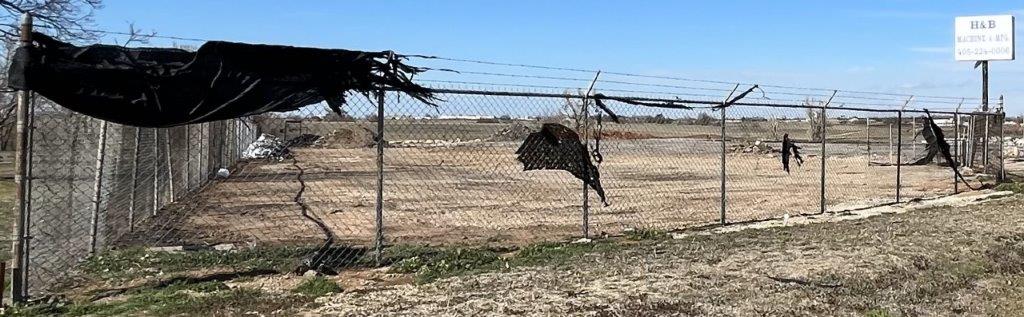
On Oct. 18 a raging fire destroyed a warehouse Bordwine leased in Ninnekah at 1003 W. Quail Lane. Also consumed by flames were an unknown number of pallets of ethanol-laced hand sanitizer stored at the site, which formerly was occupied by H&B Machine & Manufacturing.
The Oklahoma State Bureau of Investigation and the State Fire Marshal’s Office, as well as the DEQ, investigated all three Grady County fires.
The OSBI “did assist in the investigations at the request of Grady County District Attorney Jason Hicks,” Gerald Davidson, special investigator in the OSBI’s Office of Professional Standards and Training, confirmed for the Ledger on March 22. However, the agency’s report on that investigation is confidential “pursuant to state statute,” Davidson said.
No criminal charges associated with those fires has been filed in Grady County, a Ledger search of Oklahoma State Courts Network records showed.
Authorities have never said whether the origin of any of the fires was determined with any certainty.
The hand sanitizer originated in China and Mexico “and cannot be shipped back,” Bordwine told the DEQ. He also said he had a contract to store and recycle the sanitizer.
Numerous pallets of hand sanitizer, and a pile of bottles of Blumen hand sanitizer and St. Genève lemon basil hand lotion, are still at the H&B Manufacturing site in Ninnekah.
Brannan Bordwine’s intention was to recycle the material, Oklahoma City attorney Peter Scimeca said. The supplies of the product that Bordwine amassed had the potential to generate money in three ways, the attorney said:
• The wooden pallets on which the sanitizer is shipped are valuable, particularly in the current economic environment.
• The plastic containers have some value, albeit slight.
• The hand sanitizer is approximately 60% to 70% ethanol-based. Bordwine knows of a company in Tennessee that can separate the ethanol from the sanitizer and sell it for a fuel additive, Scimeca told the Ledger last October.
The executive director of the DEQ assessed a record $6.65 million administrative fine and a compliance order against Bordwine and his Bordwine Development Inc. on Aug. 22, 2022, after the first two fires but before the third.
The fine remains unpaid. In addition, a hearing before a DEQ administrative law judge on the fine and the compliance order has been postponed to an indeterminate date, Erin Hatfield, the agency’s communications director, confirmed.
Sanitizer supplier filed for bankruptcy
The company that distributed some, if not all, of the hand sanitizer stored at the three Bordwine sites in Grady County has ceased operations and filed for dissolution. A flurry of complaints and lawsuits alleged its products were contaminated with methanol blamed for several injuries and at least one death.
Methanol – which an industry trade association describes as “the simplest alcohol” – is “a chemical building block for hundreds of everyday products,” including plastics, paints, car parts and construction materials, and is used to fuel motor vehicles, ships, fuel cells, boilers and cook stoves.
4e Brands Northamerica LLC manufactured, marketed and sold personal care products throughout the U.S. Among them were hand sanitizers marketed under 15 names, including several Blumen brand sanitizers and various other sanitizers, lotions and soaps.
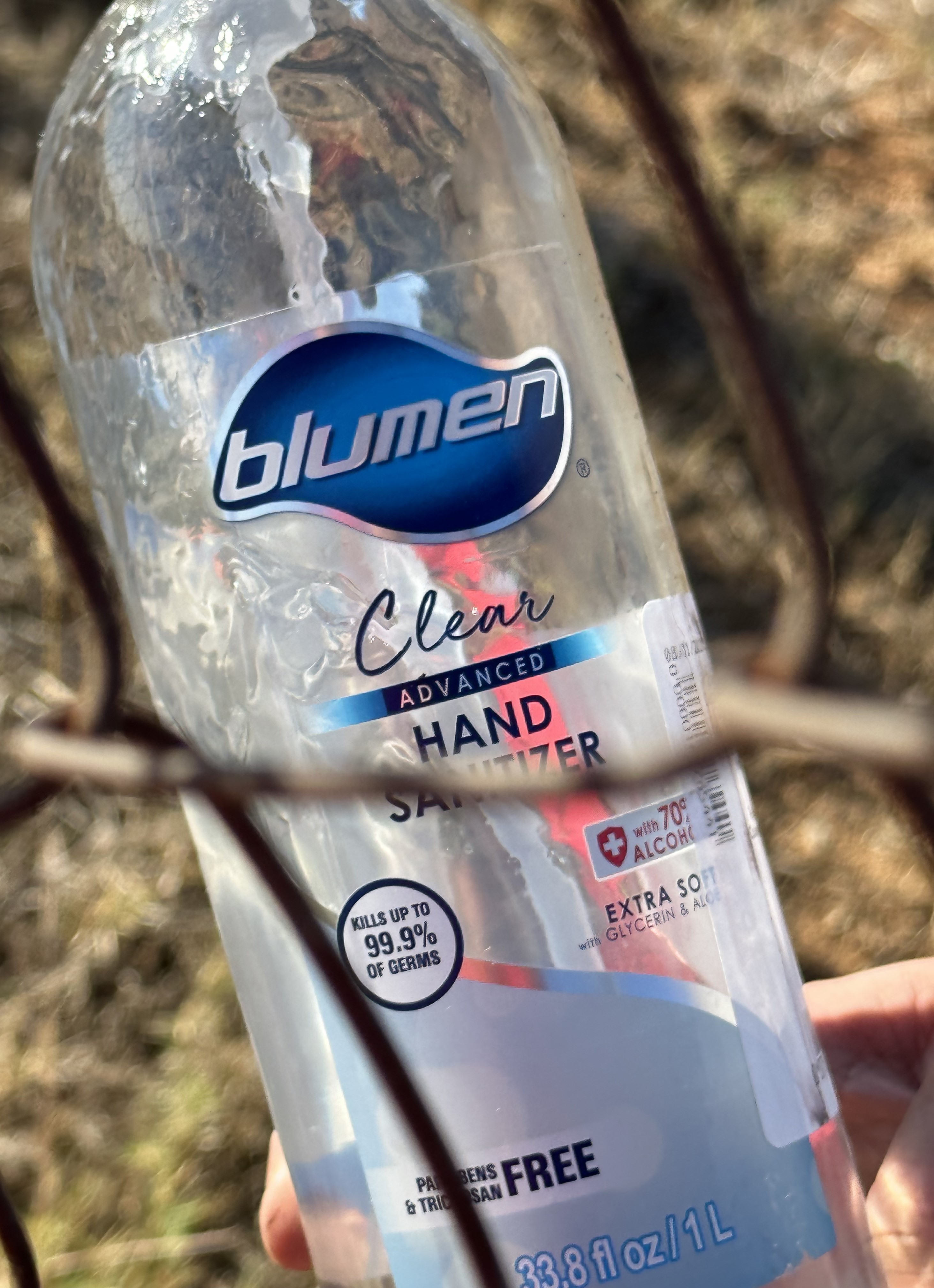
Blumen Clear Advanced Hand Sanitizer was found at the scene of the Oct. 18 fire in Ninnekah where Bordwine Development stored myriad pallets of the product, as well as lotions and soaps.
Bottles of Blumen hand sanitizer and St. Genève lemon basil hand soap were still laying on the ground, and numerous pallets of hand sanitizer and a pile of burned debris still remained, at the old H&B Manufacturing site in Ninnekah less than two weeks ago.
4e Brands Northamerica is a limited liability corporation that was created on May 19, 2014. Its principal place of business is in San Antonio, Texas, but it is wholly owned by 4E Global S.A.P.I. de C.V., a subsidiary of Kimberly-Clark de México, S.A.B. de C.V. and was created “to act as the distribution arm in the United States for personal care and hygiene products manufactured by 4E Global.”
4e Brands warehoused and distributed its products to third-party vendors, including large national retailers, “which then sold and further distributed the products throughout the United States.”
The company is “no longer operating,” according to David M. Dunn, chief restructuring officer of 4e Brands Northamerica. Dunn is a principal with Province, a financial advisory firm, and is a “seasoned corporate restructuring professional.”
4e Brands filed for Chapter 11 in the U.S. Bankruptcy Court for the Southern District of Texas, Laredo Division, on Feb. 22, 2022, “to fully wind down its business.” A judicial order confirming 4e’s combined disclosure statement and joint plan of liquidation was approved on Oct. 27, 2022.
Subsequently, on Dec. 30, 2022, 4e Brands Northamerica filed suit in Laredo’s federal bankruptcy court against Fenix Servicios Aduanales, S.C., of Bellaire, Texas.
The suit alleges that 4e agreed in 2020 to lease three warehouses from Fenix in which to store its personal hygiene products: at Laredo, Fort Worth and Conroe, Texas. However, the suit charges, Fenix failed to tell 4e that no one with Fenix “had authority to offer space in Conroe or Fort Worth.”
The lawsuit seeks $599,200, records indicate.
Sanitizer contained toxic methanol
All of the 4e Brands sanitizers have “an identical design defect,” New York attorney Philip L. Fraietta wrote. “They are defective because they are labeled as containing ethanol as the active ingredient, but are in fact contaminated with and contain methanol, which is toxic…” Exposure to methanol “can result in nausea, vomiting, headache, blurred vision, permanent blindness, seizures, coma, permanent damage to the nervous system, or death.”
Consequently, 4e Brands Northamerica is “carrying out the destruction of adulterated hand sanitizer as required by federal regulations following a voluntary recall” dated July 12, 2020.
At the onset of the COVID-19 pandemic in early 2020, demand for hand-sanitizer products increased dramatically. “This uptick in demand placed a significant strain on the supply chain, including the availability of primary raw materials” used in manufacturing 4e Global’s products, court records show.
The U.S. Food and Drug Administration reacted by issuing a guidance that permitted the manufacture of alcohol-based sanitizers “by producers that were not registered as hand sanitizer manufacturers in the United States…”
Because of the increased demand for hand sanitizer during the COVID-19 pandemic and the FDA’s temporary policy, 4e Global, “like many other hand sanitizer distributors, was impelled to source some of its raw ingredients from suppliers who, whether intentionally or mistakenly, provided methanol instead of ethyl alcohol.”
4e Global “did not know of the substitution” when it received the hand sanitizer, and consequently “distributed the products in accordance with its customary operations,” a court document relates. Labels on the hand sanitizer stated the products contained ethanol as an active ingredient, when in fact the hand sanitizer contained methanol.
Each of the 4e products is prominently labeled as a hand sanitizer and lists ethyl alcohol 70% on the back of the label as the “active ingredient,” Fraietta wrote. None of the products mentions or discloses that the products are “contaminated with methanol, or that the ‘active ingredient’ is in fact to a large extent methanol, not ethyl alcohol – or ‘ethanol.’”
The distinction is “critical,” Fraietta asserted in a class-action lawsuit filed two years ago in U.S. District Court for the Southern District of New York. Ethyl alcohol is an “accepted active ingredient” for hand sanitizers; methanol is a toxic substance that “cannot be consumed by or come in contact with humans” and makes the 4e products “worthless and unsuitable for use” as hand sanitizers.
As a result of the contamination and subsequent recall, 4e Brands Northamerica ceased business operations. The majority of its inventory was deemed worthless and the company faced multiple class action, personal injury, and wrongful death lawsuits, as well as customer demands for refunds or replacement products.
As part of its initial wind-down process, 4e “entered into approximately 90 settlement agreements with certain of its vendors,” bankruptcy court records show. Those settlement agreements totaled approximately $20.9 million as of February 2022, a court document shows.
4e Global agreed to:
• Forgive the $4.6 million Debtor In Possession loan and the full amount of approximately $23.5 million in intercompany transfers it made to its subsidiary, 4e Brands Northamerica, after the recall.
• Pay all costs associated with the transportation and destruction of inventory.