

‘Social experiment’ in Marlow failed
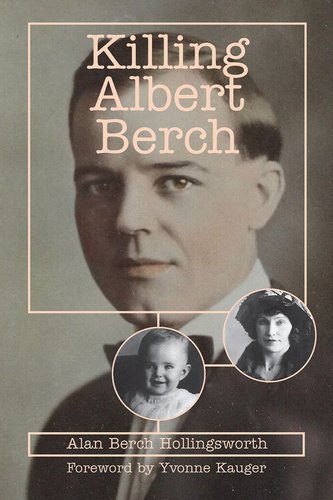
An Oklahoma City physician/novelist wrote a nonfiction book about the lynch-mob murder of his grandfather in southwestern Oklahoma 100 years ago.
Killing Albert Berch, by Dr. Alan Berch Hollingsworth (Pelican Publishing Co., 302 pp) is “a potpourri of history and mystery,” Oklahoma Supreme Court Justice Yvonne Kauger writes in the foreword.
“We are given a close-up look at early aviation, the oil business, the suffragette movement, religious intolerance, conspiracy, politics, education, the Underground Railroad, racism, the Civil War and civil rights, the formal recognition of osteopathy, burlesque, the Ku Klux Klan, the impeachment of a governor,” and “a precedent-setting opinion by the Oklahoma Supreme Court.”
The book’s subject was the author’s maternal grandfather who was murdered in the lobby of a hotel in Marlow that was owned and operated by Albert and his wife, Lula.
The hotel flourished in the midst of an oil boom and Berch hired a Negro porter, Robert Johnigan, because “no whites in town, boys or men, were willing to stoop to shine another man’s shoes.” But Blacks weren’t welcome in Marlow at that time, nor in many other Oklahoma communities. Racism was pervasive in Oklahoma, as demonstrated by the Tulsa Race Massacre of 1921.
After just 10 days the “social experiment” in Marlow failed, “the peril too great,” Hollingsworth writes. Threats of lynching were expressed openly.
On Dec. 17, 1923, Johnigan resigned and told Berch he was headed back to Duncan on the next train out of town; Berch wrote Johnigan a check for his 10 days of labor. But just as the porter was preparing to leave, a hotel guest who arrived from Norman “called out asking if anyone was available” to shine his shoes. Although he had quit a short time earlier, Johnigan “did not hesitate” to offer his services, Hollingsworth relates.
Shortly after sundown a mob stormed into the hotel lobby. One of them, Elza “Roy” Gandy, yanked Johnigan away from the foot of the shoeshine chair and began beating him with a stick, a witness testified. Berch rushed to Johnigan’s defense and struck the assailant. Moments later Marvin Kincannon fired a single fatal bullet into Berch’s chest at point-blank range, then shot Johnigan twice, witnesses testified.
Kincannon was convicted not of murder but of first-degree manslaughter in the death of Berch and was sentenced to 25 years in the state penitentiary at McAlester, but served just 11 years; he spent the rest of his life in Marlow after his release from prison. Gandy, the son of a Marlow policeman, was convicted of manslaughter for inciting the mob, attacking Johnigan, and supplying the pistol that was used in the slayings; he received a seven-year prison sentence.
Hollingsworth said he spent approximately five years researching and writing the book, picking up where his grandmother and mother left off. “My two sisters and I grew up with the family story” about the murders, he said. A photo of Albert Berch that appears on the cover of his book “stared at us from the top of our television set in El Reno all those years while we were growing up,” he said.
Hollingsworth said he began investigating the incident because “many blanks” remained in the story of the double murder. For example, the trial transcript from Stephens County was missing until Justice Kauger eventually discovered it in Oklahoma City. Hollingsworth pored over records of historical societies, museums, the Oklahoma History Center, newspapers from Duncan and Oklahoma City, “and, of course, the internet.”
As for biographical details about Albert Berch, “historians have pinpointed the date when Jesus Christ was born with more accuracy than it appears at first glance for this stranger,” Hollingsworth quipped.
During his research Hollingsworth discovered several interesting details about his family. For example, in 1920 a distant relative, Della, shot and killed a cousin who murdered her husband and left her a widow with eight children. Della was acquitted “under the age-old precedent of ‘an eye for an eye,’” he said.