

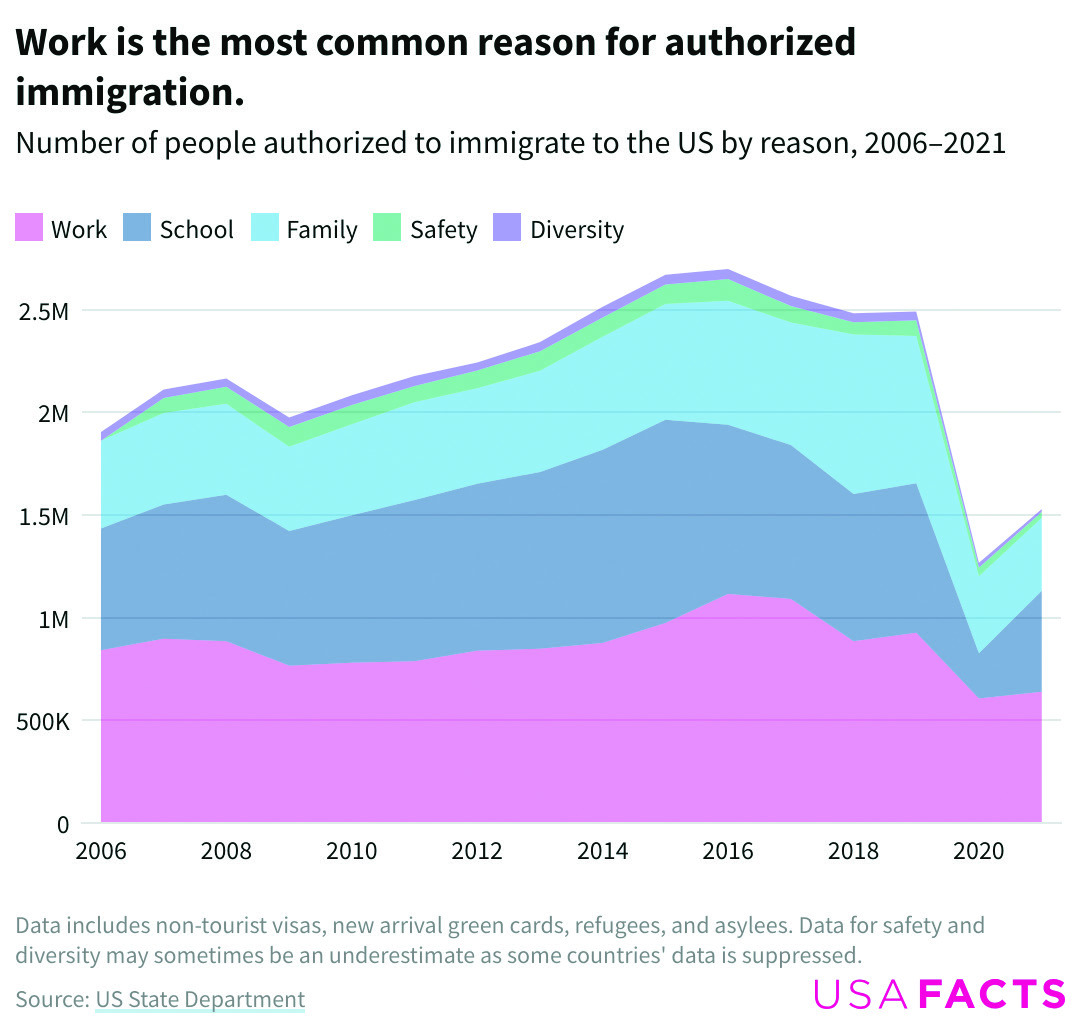
From staff reports People immigrate to the U.S. to work, reunite with family, study, or to seek personal safety. In 2021, 42% of the 1.5 million people who immigrated to the U.S. came for work.
The U.S. government generally allows legal immigration for five broad reasons: work, school, family, safety, and encouraging diversity.
People immigrating for work or school are often granted temporary entry rather than permanent residency.
Immigration for family generally means the immigrant has a relative who is already in the U.S. as a citizen, green card holder, or temporary visa holder with whom they want to be reunited. Those who immigrate for safety are refugees or asylum-seekers. And finally, up to 50,000 immigrants obtain green cards annually through the Diversity Immigrant Visa Program lottery which grants entry to individuals from countries with low rates of immigration to the U.S.
Of the 1.5 million people who immigrated to the U.S. in 2021, approximately 42% came for work, 32% for school, and 23% for family. Nearly 2% were seeking safety, and about 0.9% were admitted on Diversity Immigrant Visas.
Since 2006, work has consistently been the top reason people immigrate to the U.S., with the exception of 2013–2015 when immigration for work was equal to or slightly lower than for school.
School is usually the second most common reason for immigration except for 2018, when a higher percentage of people began immigrating for family reunification. In 2021 school again became the second most common reason.
Safety and diversity have consistently been the fourth and fifth most common reasons for immigration, respectively.
Of the 638,551 immigrants who came to the U.S. for work in 2021, 61% came from North America. Immigrants from Asia represent the largest geographic cohort among the other four primary reasons for immigration: school (58%), family (45%), safety (34%), and encouraging diversity (33%).
In 2021, 74% of all immigrants came from Asia and North/Central America. Roughly 53% of Asian immigrants came from China and India, while nearly 80% of immigrants from North/ Central America were from Mexico.
School was the top reason Chinese people immigrated between 2006-21; 19% of people who came to the U.S. for school were from China, the highest percentage of any other country. The number of Chinese immigrants coming to the U.S. for school peaked in 2015, multiplying from 40,477 individuals in 2006 to 315,628 in 2015.
Despite a sharp decrease after 2016, most Chinese immigrants continue to come to the U.S. for school. Fewer than 57,000 Chinese immigrants have come to the U.S. per year for work or family reasons since 2006, and those numbers hit record lows of 5,323 and 13,412 in 2021.
The largest share of immigrants who came to be with family were from India, at 18%. But in 2021, more Indians immigrated for school than for family reunification. Work was the third most common reason.
Prior to 2021, most Indian immigrants came to the U.S. for family and work, but those numbers have been decreasing. Fewer people came to the U.S. from India for work (54,032 people) and family in 2021 (62,407) than in 2006 (117,189 and 81,045 people, respectively).
Meanwhile, the number of Indians immigrating for school increased by more than 300% between 2020 and 2021: from 20,629 to 85,385.
In 2021, people from Mexico comprised the largest share of immigrants coming for work: 55% of all immigrants, or 351,586 people. Work has consistently been the top reason Mexican people immigrate to the U.S. Family and school have consistently been the second and third reasons.
More than twice as many people immigrated from Mexico to the U.S. for work in 2021 (351,586 people) than in 2006 (168,619 people).