

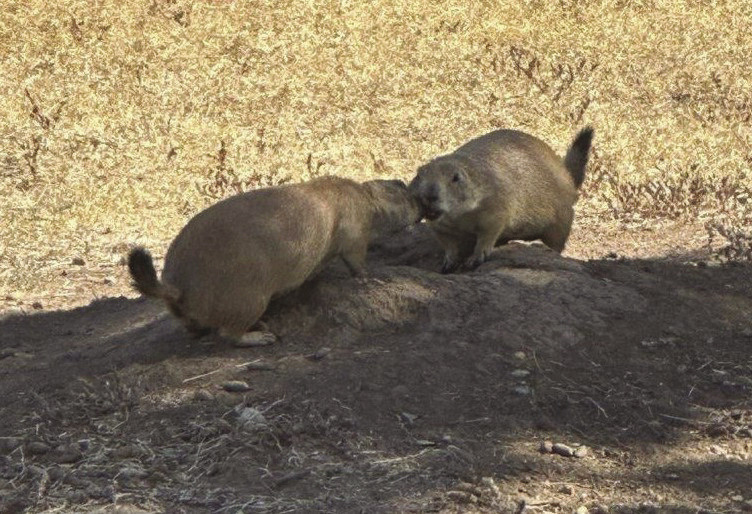
Many Lawton residents appreciate wildlife, but the proliferation of prairie dogs and Canada geese causes a few problems.
“We have more than 500 prairie dogs on the east side right now,” Larry Parks, director of Lawton’s Parks and Recreation Department, estimated in September. The animals “do not respond to barriers, do not like tall grass, and do not like water.”
Although they’re cute and attract tourists, the little rodents cause property damage and can be a health hazard.
They can spread diseases to other animals, pets and humans. Their burrows cause erosion and water loss in some areas, and they can damage vegetation. They also can undermine structures and roadbeds, and gnaw through cables and irrigation systems.
Parks said the little critters “caused almost $50,000 in damage at Elmer Thomas Park” from chewing through wires and damaging the light displays during Holiday in the Park. “That seems to happen nearly every year,” said Caitlin Gatlin, the city’s communications manager.
Another reason to thin the prairie dog population is because limited resources can cause starvation and disease, resulting in failure of the entire colony.
The Lawton City Council identified a need to relocate a population of prairie dogs that are living on municipal parkland within the city. The presence of the colony “has raised concerns due to overpopulation, public safety, environmental concerns, potential conflicts with planned development, and citizen concerns,” Parks related.
“Although we prefer nonlethal measures,” Parks said, on some occasions the City of Lawton has had to resort to lethal measures to thin the prairie dog colonies. “In about 60 days they will move into their mating cycle,” Parks told Southwest Ledger after a Parks and Recreation Commission meeting Dec. 2.
“On July 1 I had two prairie dogs, and by the 8th I had more than 30,” member David Tyler told the Parks Commission in September. “Every time they do work in Elmer Thomas Park, the prairie dogs start working toward the Lawton Public Schools ballfields.”
“We want them out before construction begins on the aquatic facility” in Elmer Thomas Park, said Parks. “We are even seeing hawks now because of how many prairie dogs we have.”
Several dozen of the animals have been relocated to wildlife management areas:
• The 29,766-acre Sandy Sanders Wildlife Management Area (WMA) in Greer and Beckham counties, administered by the Oklahoma Department of Wildlife Conservation (ODWC).
• Cooper WMA northwest of Woodward.
• Cimarron Hills WMA, which covers 4,200 acres in Woods County.
The ODWC has been on site to supervise the relocation efforts, and the project is being coordinated with landowners and local authorities, Parks said.
Efforts are made to transport prairie dogs in family units, because the animals live in tight-knit family groups called coteries.
The relocation program is “going as well as we can,” Parks told the Ledger.
Lawton also has ‘our fair share’ of Canada geese P&R Commission member Terry Brierton asked Parks whether any measures are in place to control Canada geese because, “We’ve got our fair share of them.”
The city has been in conversations with the Oklahoma Department of Wildlife Conservation about trying to relocate some of the birds, Parks said.
Oklahoma has hosted several subspecies of Canada geese during their annual fall and spring migrations and also serves as a principal wintering area for the migrant fowl. Resident Canada geese, on the other hand, are largely nonmigratory and reside year-round throughout Oklahoma. Although resident Canada geese are a wildlife resource highly valued by hunters and non-hunters alike, in urban areas such as Lawton and Oklahoma City, local concentrations of geese can lead to conflicts with people.
According to the ODWC, resident Canada geese have benefited from the way humans have altered the landscape. Resident Canada geese are attracted to areas that provide food, water, and protection, and urban areas provide all of those resources.
In addition, in most urban situations where resident Canada geese have become a nuisance, feeding by humans is invariably at the root of what usually becomes an escalating problem, the ODWC contends. Typically, a pair of geese shows up at a site and people begin feeding them. Eventually the feeding results in large concentrations of birds as they congregate for free handouts – and goose droppings and aggressive bird behavior soon become issues.
Feeding causes extreme changes in goose behavior; the birds quickly lose their normal fear of humans and instead come to recognize humans as a source of food. The first step in addressing any urban conflict situation with resident Canada geese is to ensure that there is no supplemental feeding of the birds.
Canada geese are protected by federal and state laws. The Migratory Bird Treaty Act protects Canada geese, their nest and eggs. Federal and state laws prohibit capturing or killing Canada geese outside of legal hunting seasons without a permit.
Nonlethal control activities such as harassment with pyrotechnics or other sound making devices, chasing with dogs, visual deterrents and use of approved chemical repellents are all allowed year-round so long as there is no direct contact with geese and no harm is done to geese, goslings, eggs, or nests. Nonlethal control activities such as these do not require state or federal permits.
The ODWC has been issued a federal Special Canada Goose Permit by the U.S. Fish and Wildlife Service (USFWS). This allows the department or its designated agents to destroy eggs and nest of breeding resident Canada geese. The ODWC has used certified Nuisance Wildlife Control Operators (NWCO) operating under the department’s special permit to conduct egg and nest control work on resident Canada geese in urban areas.
Egg and nest control work combined with other population management activities can help alleviate problems associated with resident Canada geese in urban areas.
The USFWS has adopted new rules for managing resident Canada geese, including a nest and egg depredation order that authorizes private landowners, public land managers, homeowners’ associations, and local governments to destroy resident Canada goose nest and eggs on property under their jurisdiction when necessary to resolve or prevent injury to people, property, agricultural crops, or other interests.