

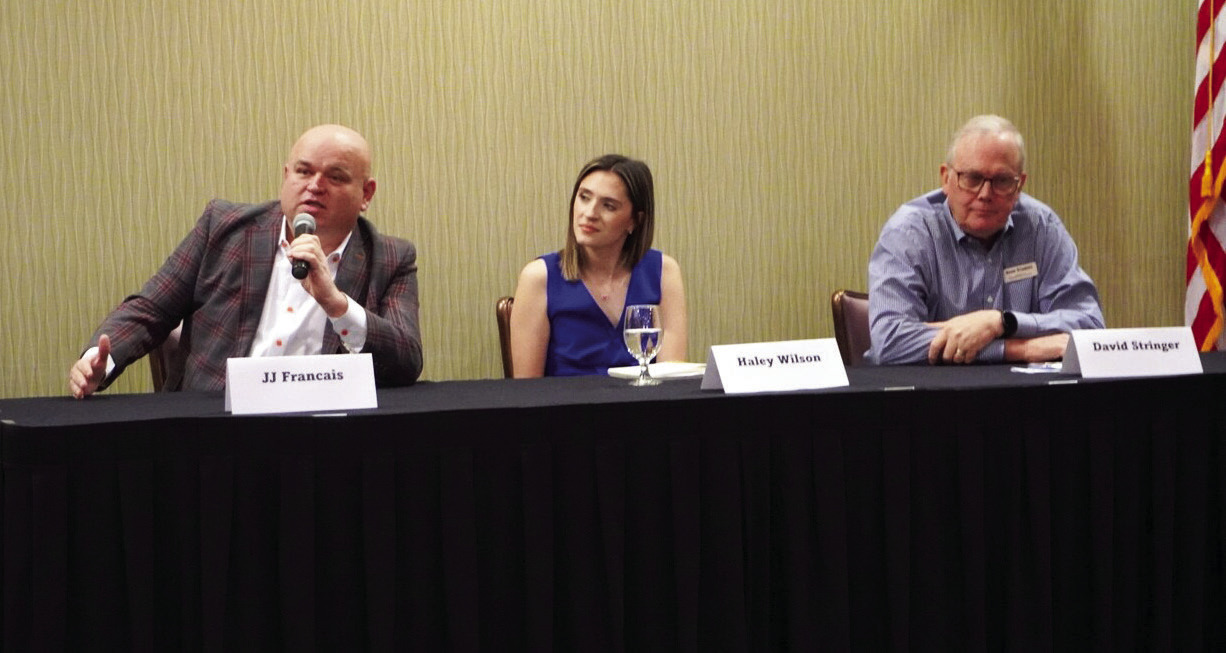
LAWTON – News organizations can fight misinformation and boost their credibility by acknowledging their political leanings, said JJ Francais, associate publisher of Southwest Ledger.
“I think some of it is just owning it,” he said. “If you’re a conservative news network, then own the fact that you’re a conservative news network.”
Francais joined Haley Wilson, an anchor at KSWO, and Lawton Constitution Publisher David Stringer recently for a discussion of is sues facing the media. The Lawton-Fort Sill Chamber of Commerce hosted the luncheon March 6 at the Apache Casino Hotel.
Combating misinformation Wilson said reporters can combat misinformation by ensuring their information is coming from credible sources.
“It’s people that you’re able to trust,” she said. “It’s being able to go to that person and say, ‘What is happening here?’ Not believing what’s on social media.”
Stringer said he thought media outlets should address misinformation head-on and be transparent about what they do.
“If somebody calls us out on something, I’m going to talk to you,” he said. “I’m going to call you. I’m going to email you back. I’m going to tell you why we did what we did.”
AI and the media Combating misinformation wasn’t the only topic of discussion. The panelists also talked about other media-related topics, including artificial intelligence and its impact on news organizations.
Stringer said his staff is still trying to figure out how to use AI properly.
“If you read the trade press, like I’m sure many of you will, there’s been some really colossal failures of newspapers and media that have used AI and not produced a good result,” he said. “Our policy right now is, we don’t use it.”
Wilson said the policy in KSWO’s newsroom, and for the station’s corporate parent, is not to use AI at all.
“Every story that’s written is written in house by someone at KSWO,” she said. “There’s no robots or anything writing our news.”
Francais said AI could eventually make it easier for reporters and editors to research their stories.
As an example, Francais cited an open-records request he sent to the city of Altus at the height of the COVID-19 pandemic. He said the city responded to the request by sending him 14,000 emails.
“It was fun, for the first 200, to sit there and read all these emails,” Francais said. “But I can see, in time, where AI will allow you to do better searches, better sorting of that data.”