


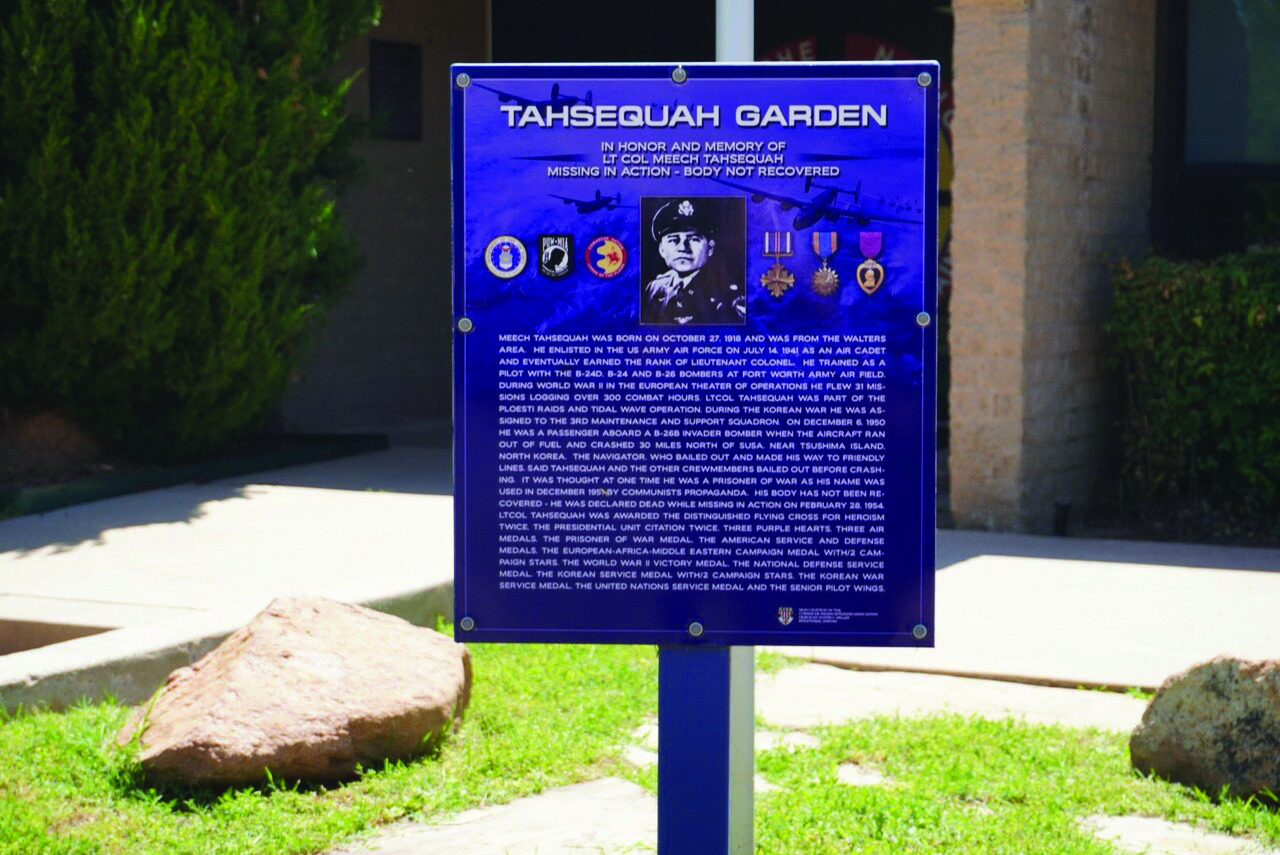
LAWTON – Lt. Col. Meech Tahsequah was a passenger on a B-26 Invader bomber on Dec. 6, 1950, when it ran out of fuel and crashed 30 miles north of Susa near Tsushima Island, North Korea.
A U.S. Army Air Force pilot, Tahsequah, was declared missing in action as a result of the crash, according to the American Legion. His body was never found, and he was declared dead Feb. 28, 1954.
Tahsequah is the only Comanche veteran whose body has not been recovered, according to the American Legion.
Nearly 75 years after the crash, Tahsequah’s descendants and fellow Comanche Nation members paid him tribute with a rededication ceremony at the American Legion post at 427 SW 11th St. in Lawton. The building was named Meech Tahsequah American Legion Post No. 6 in his honor.
Comanche Nation Chairman Forrest Tahdooahnippah said he was pleased to see Lawton recognize Tahsequah’s contributions to his homeland and his sacrifice.
“Sometimes, it feels like with Native Americans – we’re such a small proportion of the population – that sometimes our contributions are overlooked,” Tahdooahnippah said. “So, it really means a lot to us that he’s been recognized.”
Tahsequah’s second cousin, Harry Tahsequah, said his family was glad to see the community pay tribute to their ancestor.
“It’s just a great honor that we’re the f irst American Legion to be named after a Native American,” he said. “I think that is just a definite honor that they did this.” Serving in the Air Force A native of Walters, Meech Tahsequah enlisted on July 14, 1941, as an air cadet and eventually earned the rank of lieutenant colonel, according to the American Legion. He trained as a pilot with the B-24D, B-24 and B-26 bombers at Fort Worth Army Air Field in Texas.
Tahsequah flew 31 missions in the European Theater of Operations during World War II, logging more than 300 combat hours. He participated in the Ploesti raids, a series of aerial attacks on the Nazis’ oil fields in Ploesti, Romania, which were part of the Air Force’s Operation Tidal Wave.
During the Korean War, Tahsequah was assigned to the Air Force’s 3rd Maintenance and Support Squadron, according to the American Legion. He was declared missing in action after the crash, and presumed to be a prisoner of war before he was declared dead in 1954.
Tahsequah received several military honors during his career, including two Distinguished Flying Crosses for heroism, two Presidential Unit Citations, three Purple Hearts and three Air Medals. Carrying on his memory After the rededication ceremony at the American Legion Post in Lawton, some of Tahsequah’s relatives and fellow Comanches met at the Coma nche Nation Tribal Complex near Medicine Park. There, the group honored Tahsequah’s memory with a short ceremony at the Meech Tahsequah Memorial Garden, which included a proclamation designating May 21 as Meech Tahsequah Day.
Tahsequah’s relatives were glad that the Comanche Nation has honored his memory, said his second cousin, Jerry Tahsequah.
“The importance of this to our family is that it ca rries on a person who sacrificed his life for the United States of America,” he said. “Serving his people, not only the military, but also the Comanche people.”