

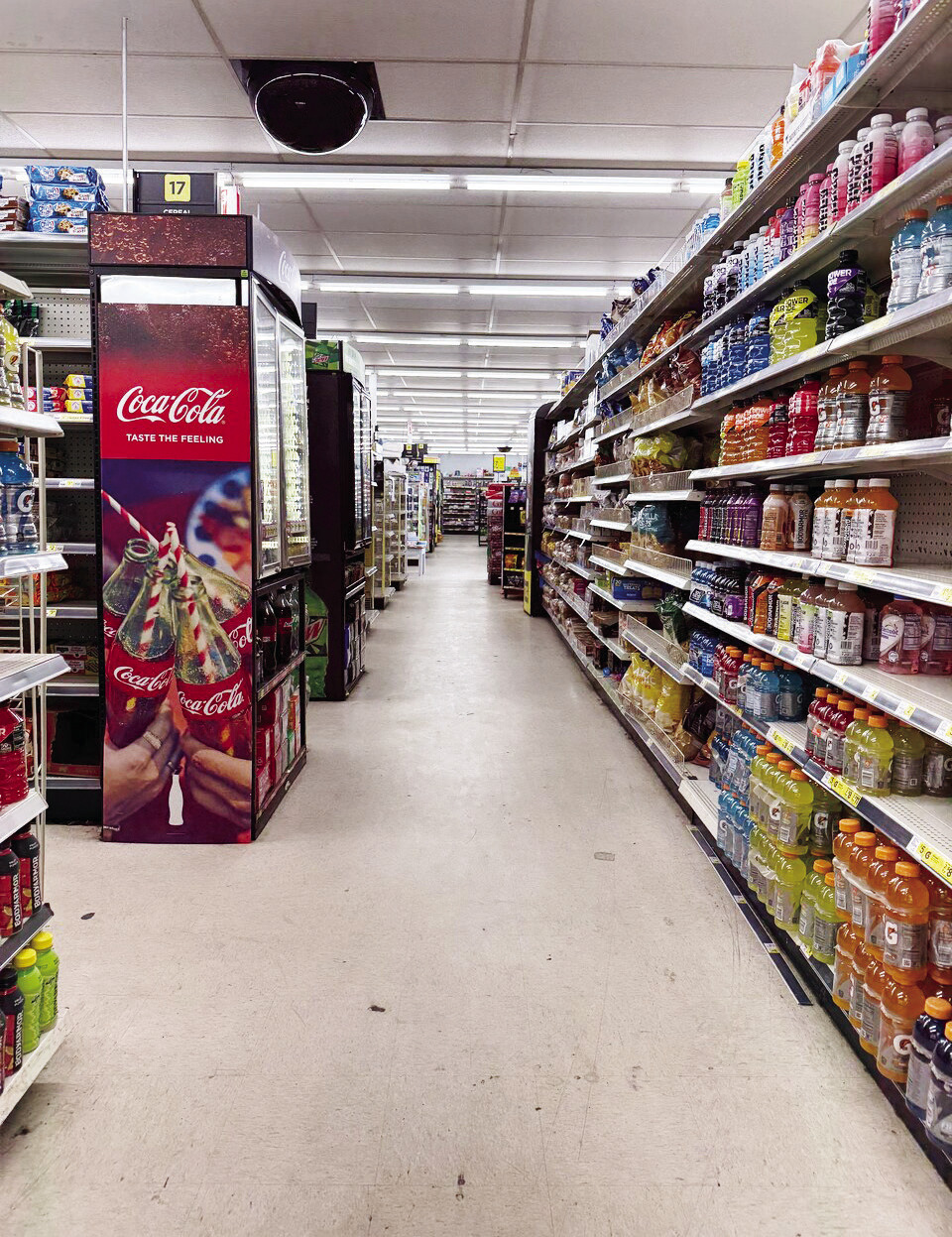
OKLAHOMA CITY – Twilight. Just south of the Council Road and 122nd Street intersection, the glow of lights from the Dollar General store bathe the parking lot in amber.
It’s closing time. Early spring has been busy. Customers trek back and forth and traffic is heavy.
But on that spring evening, things changed. The store was closing for the day. The employees were packing up.
One Dollar General employee had left the building, when a man wielding a gun forced his way inside, took money and shot an employee, striking her in the leg. The other employee, in the parking lot, is forced back into the store by the robber.
Both are lucky. Both survive.
But the shooting terrified what was a quiet neighborhood. Still, it’s not the f irst time a Dollar General store in Oklahoma has been the scene of a crime.
Three years earlier in 2022, 28-year-old Daniel Donnell Smith was shot and killed at the Dollar General at 9800 Spencer-Jones Road in Jones. Dollar stores are popular in Oklahoma Dollar General is popular nationwide – and in Oklahoma.
According to a study by Nonprofit Quarterly, Dollar General – the industry leader of the dollar store market – operates more than 16,000 stores in 44 states. Records show that Oklahoma has 503 of those stores.
In 2019 to company opened 900 new outlets.
And while the brand is popular, with net sales up 9.2% from 2017–2018, questions have been raised about the effect the stores have on independent retailers and the small communities where they call home.
“As replacements for grocery stores in the inner cities and rural communities where they are commonly found, dollar stores are poor substitutes for a supermarket,” Nonprofit Quarterly said. “More than plugging market gaps, dollar stores perpetuate and exacerbate community economic decline as a ‘secondary invasive species.’ They provide little if any fresh food, create few jobs, and provide few economic multipliers for a local economy. But they are often welcomed, particularly in rural places, as the only place to shop.”
That’s what happened in Yale, Oklahoma.
Several years ago, the town’s small, independent grocery store closed and, eventually, a Dollar General took its place – now the only place in town to buy groceries.
“It’s the only place in town,” one resident, who asked not to be identified, said. “It’s not good, but that’s all we have.”
Problems come with the stores In towns where there is more than one grocery store, the Nonprofit Quarterly study said the arrival of a dollar store causes problems.
“The arrival of a dollar store typically spells doom for a neighborhood’s surviving grocery stores,” the study said. “Reports from many communities suggest that when a Dollar General opens, sales drop by 30 percent in the pre-existing supermarket. That’s not sustainable for a business with razor-thin margins.”
Another study – this one from the Michigan Journal of Economics – echoes the report by Nonprofit Quarterly.
“It seems intuitive that dollar stores allow low-income consumers to buy the resources they need at a price they can pay for them,” the Michigan Journal of Economics reported. “What often goes unnoticed is the economic distress and imprisonment of poverty that the rise of dollar stores creates.”
The biggest problem that dollar stores create, the journal wrote, is that their abundance makes it virtually impossible for smaller businesses to open. “In fact, when there is an excessive number of any large corporation chain, other shops struggle to open or stay open due to their inability to compete with dollar store prices.”
Dollar stores drive local stores out of business because of their boundless presence in rural America, the Michigan study said.
“This creates a bigger problem because small community economic development depends on small businesses circulating money throughout the community. When an outsider like Dollar General or Dollar Tree shows up, the money that was once circulating within the community now goes to a large corporation instead,” the study said. “That is to say, money is taken away from the local residents and distributed elsewhere; they put a halt on any productive economic development possible for small rural communities.”
Records show that across the country, Dollar General faces numerous legal issues, including accusations of racial discrimination in hiring practices, workplace safety violations, deceptive pricing practices and issues related to gun violence and robberies. The company has been fined millions of dollars for safety violations and is facing lawsuits related to overcharging customers and alleged discriminatory hiring practices.
In 2024, news outlets across the country reported that Dollar General was forced to pay a $12 million fine and improve safety at its 20,000 stores nationwide to settle claims it had put workers in danger by blocking emergency exits, the U.S. Department of Labor said.
The company must “significantly scale back its inventory and improve stocking to prevent unsafe storage that hinders exits and makes electrical panels and fire extinguishers inaccessible,” the Department of Labor said.
Jena Good, a member of the Board of Directors of the Oklahoma Grocers Association, said the company does more harm than good. Her family owns grocery stores in Walters and Waurika.
Good, whose family has long been involved in the retrial grocery industry, said Dollar General has become a huge problem for independent grocers in small towns.
Many of Oklahoma smaller communities, she said, can only support one grocery store and when stores such as Dollar General that include groceries into their floor plans “it destroys the independent grocer.”
Another problem, Good said, is that said stores like Dollar General don’t feed back into the community. “They don’t donate. They don’t buy ads in the yearbook,” she said. “They don’t reinvest in your town.”
And, because Dollar General is so large, she said, they can purchase merchandise – and get ‘back end’ deals – that allow them to sell that merchandise for much less than a family- owned grocery store.
“I can’t buy a case of Coke for what Dollar General sells it at,” she said. “You have this disparity. It just an unfair business practice, basically.”
Dollar General says it’s good for a town For its part, Dollar General says it does invest in communities by providing access to g oods and by providing jobs across the country. In addition to postings on its corporate website, the company also created a website called ‘here for what matters’ which features stories and information about its stores and employees.
The company also pushed its 2024 Corporate Social Responsibility and Sustainability Report, which states: “In 2024, we provided access to more than 20,500 stores across 48 states in the U.S. and five cities in Mexico. Since our founding in 1939, Dollar General has pursued opportunities to serve and support our communities, customers, neighbors and each other. From providing convenient access to everyday essentials and offering name brands at great prices, to creating jobs that grow into careers and investing in educational programs that can change lives, we strive every day to positively impact the communities we call home.”
The report also touts Dollar General’s investment in communities.
“We balance our efforts with local initiatives and strategic partnerships that drive social impact through education, hunger alleviation, disaster relief and reforestation. During fiscal year 2024, Dollar General and its foundation donated more than $27 million to local and national efforts extending hope and opportunity,” the report said.
Those efforts, the company said, include a literacy foundation, hunger relief, habitat preservation and disaster relief.
In an email to Southwest Ledger, the company said it cares about and is invested in the health of its communities.
“While we are not a grocer, we understand the importance our stores play in providing affordable and convenient access to everyday household items, including nutritious foods, often in communities where other retailers cannot or will not serve. Every Dollar General store in Oklahoma (and across the country) offers components of a nutritious meal including proteins, grains, dairy, frozen and canned vegetables, canned fruits and more,” the email said. “We also developed Better For You resources that include recipes to create healthier meals from products sourced primarily from DG, and we are a USDA MyPlate National Strategic Partner through its Center for Nutrition Policy and Promotion Nutrition Communicators Network.”
In communities throughout Oklahoma, Dollar General said, “our neighborhood general stores operate alongside local grocers and business owners to collectively meet customers’ and communities’ needs.”
Dollar General said it believes the addition of each new store provides positive economic benefits.
Those benefits include “additional access to affordable products for customers; the creation of new jobs for local residents and career development opportunities for our employees; the generation of additional tax revenue for the City; and the ability for local nonprofits, schools and libraries to apply for literacy and education grants through the Dollar General Literacy Foundation,” the company’s email said.
Food deserts and a lack of support Even with those efforts, Good said, the issues with Dollar General remain.
In some instances, she said, the company will come in and build a big store that, over time, eliminates many other retailers in the area.
At that point, Good said, Dollar General then closes its store, saying the market has changed. “Now you have a food desert,” she said. “It really creates a problem in small towns. They might think they are doing well because they are getting tax revenue, but they are really not generating anything new, they are just taking it away from all other businesses. Then they’ll eventually leave because they can’t support the bills they have.”
For small communities, Good said, Dollar General may seem like a good thing.
“But in reality, it’s a bad thing,” she said. “It may seem like a good thing, but it’s a bad thing in disguise. They don’t reinvest. They don’t donate. They don’t show up to things. They don’t care about the communities in the same way.” How can communities deal with Dollar General?
In Oklahoma, some communities are fighting back, trying to keep new dollar stores from opening as well as creating locally owned options.
Tulsa has more than 50 dollar stores in its city limits—most of them located in north Tulsa, the site of the 1921 race massacre.
And when the area’s lone grocery store closed in 2017, Vanessa Hall-Harper, the district’s city councilor persuaded her colleagues to pass a sixmonth moratorium on permitting new “smallbox discount stores” in her district.
Hall-Harper also proposed a permanent change to the zoning code that prohibited a dollar store from opening within one mile of an existing dollar store in a designated “overlay” district and privileged full-service grocery stores by halving the number of required parking spaces. This, too, passed the council.
Hall-Harper told Vice News in 2021 that she wasn’t opposed to dollar stores in principle, but said the stores’ presence makes the areas less attractive to fully stocked supermarkets or grocery stores that may want to move in.
Dollar General told Vice News that its stores were a complementary option to grocers.
Hall-Harper disagreed.
“I believe their business model is to seek out food deserts and communities that have no other options, and then they can make it more difficult for other retailers to come in and be successful, particularly, quality, full-service grocery stores,” she told the outlet.
Nonprofitonprofit’s study noted that many rural communities, when faced with the closure of their last grocery store, haven’t gone the regulatory route.
“Some have looked to public ownership,” the study said. “In Little River, Kansas, the town purchased the last remaining grocery store from its local owners, applied for a renovation and equipment grant from the local community foundation and then leased the property back to the original owners and managers.”
And in Baldwin, Florida, the city itself runs the last remaining grocery store. All employees on the municipal payroll, the town’s maintenance department unloads deliveries and residents are going directly to the mayor to request a specific type of milk.
“These rural communities are essentially saying that food access is a public good, worthy of public dollars,” the study said.
In Tulsa, municipal leaders stepped in to help – in a different way.
North Tulsa leaders recruited Eco-Alliance, an Oklahoma investment company focused on hydroponic agriculture and food deserts, to operate a full-service grocery store and secured a $1.5 million federal grant through the Tulsa Economic Development Corporation to help.
The Oasis Fresh Market opened in in May of 2021.