

Shawn Black, the new executive director of the Oklahoma Educational Television Authority, was promoted to his post at a critical moment in its 69-year history.
The Public Broadcasting Service is a nonprofit American public broadcaster and noncommercial, freeto- air television network based in Arlington, Virginia. PBS is the most prominent provider of educational programs to public television stations – including OETA, which is a network of PBS-member TV stations serving Oklahoma – in the United States.
PBS, founded in 1969, is underwritten by a combination of member station dues, pledge drives, corporate sponsorships, and donations from private foundations and individual citizens.
Until this year, PBS also received funds from the Corporation for Public Broadcasting. However, President Trump and the U.S. Congress rescinded the $1.8 billion in funding for the CPB earlier this year, which eliminated all federal support for PBS.
Fortunately, CPB gave OETA its funding in advance of this fiscal year, Black said. In addition, the Oklahoma Legislature appropriated $2.95 million to OETA for FY26. Therefore, OETA has enough money to make it through federal Fiscal Year 2026, which ends next Sept. 30, Black said.
Furthermore, “We spend our money toward the end of a cycle, which gives us some leeway to replace the loss of the CPB funding,” Black said.
Repeal of the federal funding “has made us look more closely at our operations,” he said. “We’re now engaging with the public and our donors to let them know how much we appreciate them and how much we need their help.”
OETA has scheduled two fundraising events in FY26.
The first is slated for the end of November and the beginning of December and will last 12 to 14 days.
The second event will be held next March, when legislators and community leaders will be asked to come into the OETA studio and answer telephones, to jot down information from viewer pledges large and small. This will be OETA’s first telethon since 2020, Black said.
“So far, our donors have stepped up and provided us with funding, for which we are grateful,” he said. “To a great degree because of them, we are well-positioned for the challenge we face going forward.”
OETA entered the broadcast airwaves for the first time on April 13, 1956.
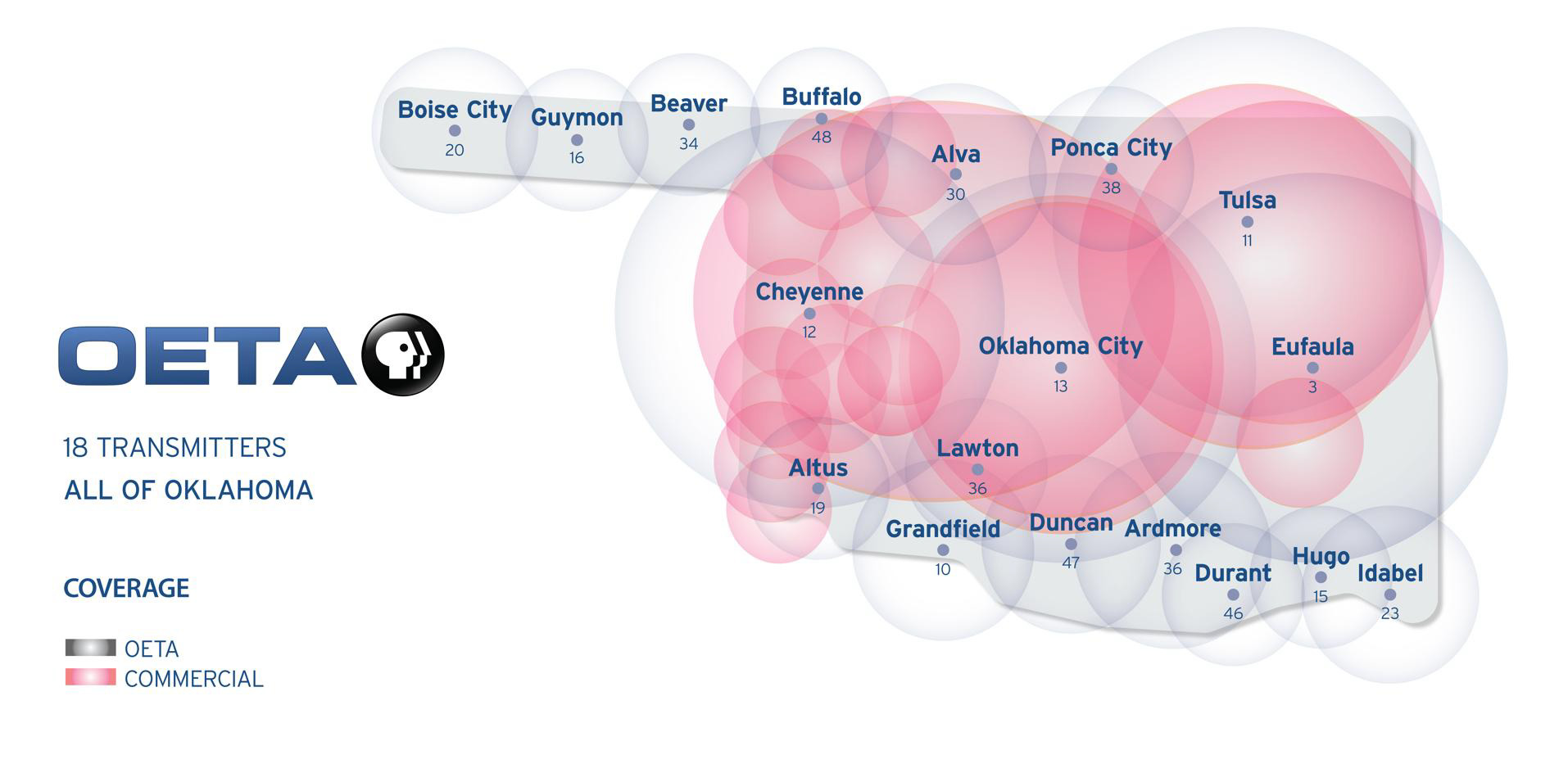
It began with one transmitting station, little money, limited broadcast hours, and a tiny, almost immeasurable, audience. Today, OETA has 54 employees, and with its statewide network of four high-power transmitting stations and 14 translator stations, more than 650,000 viewers tune into OETA on a weekly basis.
OETA is “still running the same programming we’ve had in the past,” Black noted.
Those include Sesame Street, Great Performances, Poirot, Rosie’s Rules, All Creatures Great and Small, Hero Elementary, Independent Lens, Austin City Limits, Molly of Denali, Masterpiece, Odd Squad, Antiques Roadshow, NOVA, Frontline, Annika, OETA Movie Club, Oklahoma Gardening, Rick Steves’ Europe, Outdoor Oklahoma, PBS News Hour, Oklahoma News Report, BBC News, This Old House, BBC programs such as Midsomer Murders, Father Brown, and Grantchester, and much more.
According to Black, PBS President and Chief Executive Officer Paula Kerger said that during its first three nights, Ken Burns’ documentary, “The American Revolution,” was “the moststreamed show they have ever aired.” OETA broadcast the series Nov. 16-21.
Besides its routine, typical programs, OETA is responsible for maintaining the state’s infrastructure for the PBS Warning, Alert, and Response Network (WARN), which provides a path between the Federal Emergency Management Agency and cellular service providers to relay important emergency information statewide via cellular networks.
Weather alerts are sent from the National Weather Service “to our transmission towers, and our broadcast network pushes that signal to TV stations and smart phones across the state,” Black related. And that signal supersedes a user’s “do not disturb” feature on his/her phone, he added.
“That, for example, is how we got the message out” about the anhydrous ammonia leak from a tanker truck in Weatherford on Nov. 13, Black said.
OETA is reportedly America’s most-watched PBS network. “We get Nielsen ratings every week,” Black said, “and two to three nights each week we’re in the top 5 in both the Tulsa and Oklahoma City markets.”
OETA has four channels: the high-definition OETA channel, World, Create, and the PBS Kids channel. All four broadcast 24 hours a day.
OETA is the only television station whose broadcast signal extends throughout the entire state. “Our signal reaches every county in Oklahoma, all 77 of them.” (See the accompanying graphic.)
In addition, other entertainment venues such as Netflix and Amazon Prime stream OETA programming. Because of that, out-of-state viewers, too, “can watch our broadcasts.” Consequently, OETA’s Kids programming streamed to four million households last month, Black said.
The most-watched programming is the Kids channel, followed by dramas in second place, with science and culture coming in third, he said. When he was teased about OETA’s lack of football coverage in Oklahoma, he laughed and said, “You could tell those nights when the OKC Thunder were playing for the NBA Championship, because our viewership dropped off.”