

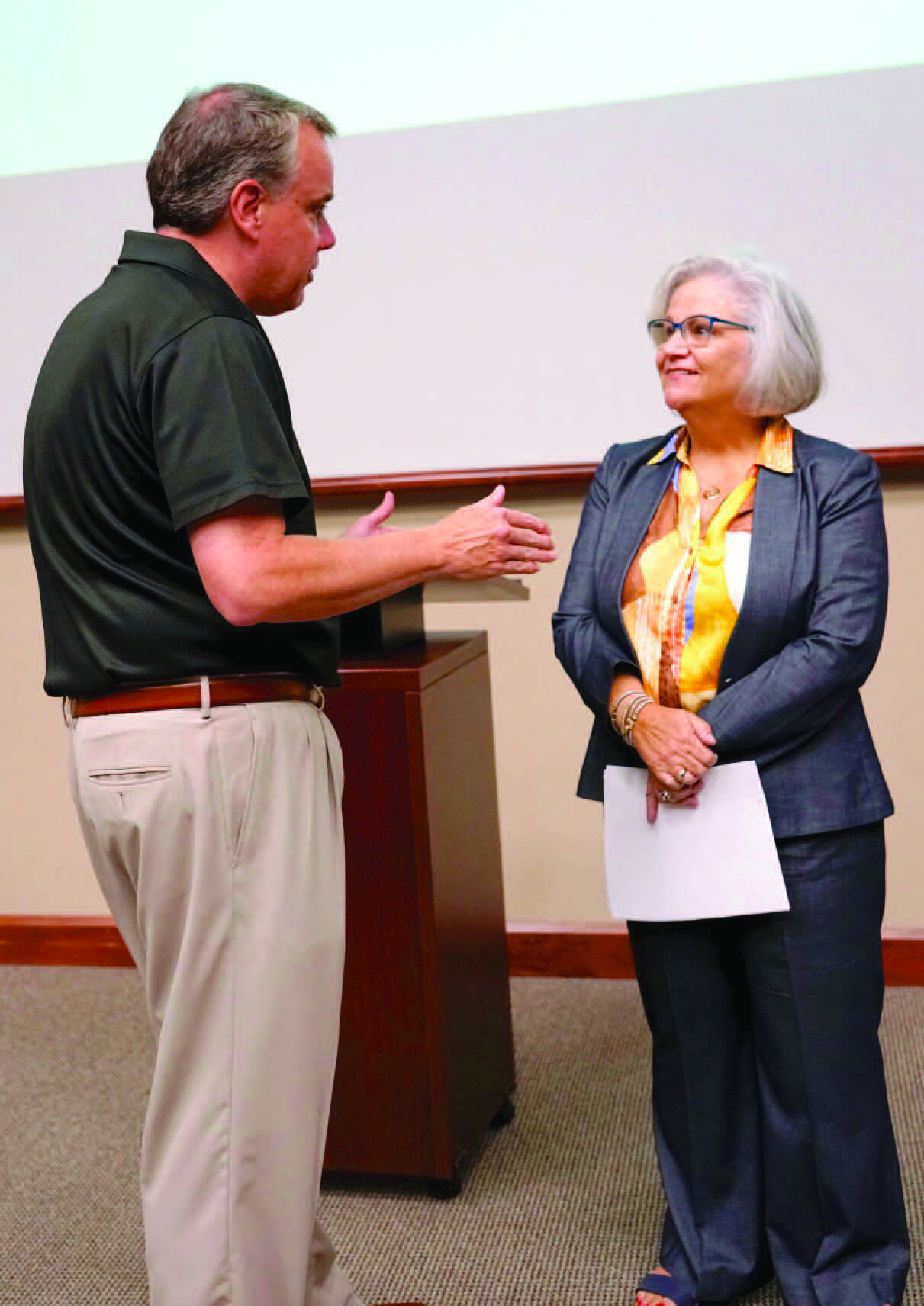
LAWTON – Community leaders, service providers and residents gathered Thursday to begin a fact-finding process aimed at developing recommendations for the future of the city’s homeless encampment.
The Homeless Encampment Community Action Forum began at 9 a.m. July 9 in Johnson Auditorium at Cameron University’s Ross Hall. The meeting marked the first phase of a four-part process developed after the Lawton City Council agreed to delay a decision on the socalled “Tent City” for 60 days. The Lawton Unhoused Trust Authority previously requested discussion about future use of the encampment site at 1303 SW E. The Salvation Army deeded the five lots to LUTA in August 2025.
City officials previously raised concerns about the property’s proximity to a floodplain and potential safety risks to those camping there. The council agreed to allow additional time for community organizations and residents to develop alternatives and recommendations.
Fact-finding begins Brenda Spencer-Ragland, director of the C. Carter Crane Center for Empowerment and Advancement, helped organize the forum and described the first phase as “fact finding.”
“Our city leadership was presented a course of action, and the course of action was, ‘Let’s close down the housing encampment,’” Spencer-Ragland said.
She said she asked for time to examine the issue before a recommendation was made without input from residents and service providers.
The forum brought together representatives from city government, the Oklahoma Attorney General’s Office, behavioral health and substance abuse treatment providers, public health officials, faith-based organizations and food assistance programs.
Lawton interim City Attorney Jari Askins said the city must distinguish between its role as a government and the broader responsibility of Lawton as a community.
“The city as government doesn’t have funds for departments that deal with mental health,” Askins said. “They don’t have departments that deal with substance abuse.”
However, she said city leaders recognize a broader community responsibility.
“Every single councilman and mayor that I have worked with in the short time I’ve been here understands that the city, as a community, has an obligation to help all the people who are here,” she said.
‘Homelessness is not a crime’
Eric DiGiacomo, supervisory assistant attorney general with the Oklahoma Attorney General’s Office of Civil Rights Enforcement, discussed laws affecting people experiencing homelessness and the rights of property owners.
“Homelessness is not a crime by itself,” DiGiacomo said.
He said complaints and law enforcement responses rather than a person’s housing status.
Questions also focused on whether homeless people are migrating into Lawton from other communities. DiGiacomo said the Attorney General’s Office has not compiled its own data tracking that movement.
The forum also addressed protections for children experiencing homelessness. Under the federal McKinney-Vento Homeless Assistance Act of 1987, children who are unhoused are entitled to equal access to a free public education and may enroll even when they lack documents normally required for enrollment.
The law can apply to children living in shelters, motels, campgrounds and other unstable housing situations. Lawton Public Schools’ local McKinney-Vento contact is ShaLeah Ramirez-Sanchez, who can be reached at (580) 357-6900, ext. 2030.
Different paths to homelessness
Much of the forum focused on the different circumstances that can lead to homelessness.
Speakers described substance abuse and mental illness as significant issues among some people living on the streets and in the encampment. Others pointed to domestic violence, job loss, medical problems and low or fixed incomes.
Melissa Simms, community engagement and health planning manager for the District 5 health departments, said homelessness must be viewed through the needs of the whole person.
She said stability can depend on access to a safe place to sleep, food, clean water, transportation, medication storage, a phone and a trusted support system.
Simms described one recent case in which several local organizations worked together to help a medically vulnerable person who was behind on rent and had lost utility service, preventing that individual from becoming homeless.
Addiction and mental health
Retired Col. Scott Patton, pastor of Centurion Hope Chapel, argued that homelessness is often a symptom of deeper problems.
“Homelessness is not a problem,” Patton said. “It’s a symptom.”
Based on his ministry’s experience, Patton identified methamphetamine and fentanyl addiction and untreated mental illness as major obstacles to helping some people leave homelessness. He called for expanded detoxification, substance abuse treatment and mental health services.
His comments drew pushback from another pastor in the audience, who stressed that not every person experiencing homelessness is addicted to drugs or has a mental illness.
Patton later clarified that he was speaking about the people he personally works with.
Spencer-Ragland also emphasized the complexity of the issue, pointing to recent cases involving domestic violence and a person leaving the hospital with nowhere to go.
Shelby Tucker, housing director and facility manager for Catalyst Behavioral Services, brought his own experience with addiction and homelessness to the discussion.
Tucker said he was addicted to heroin and experienced homelessness before entering recovery. He and his wife celebrated seven years of sobriety in March.
He agreed that not everyone experiencing homelessness is addicted to drugs or alcohol, but said substance abuse and untreated mental health problems remain significant among the people he encounters through outreach and treatment.
“There is a lot of mental health (problems), but there’s a lot of mental health issues out there right now that are being treated with drugs and alcohol,” Tucker said.
Homelessness often unseen
The discussion also highlighted a portion of the homeless population that may never appear at an encampment or shelter.
One community member warned against judging the size or makeup of the homeless population solely by those visibly living on the streets.
He said some homeless families deliberately avoid identifying themselves because they fear stigma or consequences involving employment or their children.
“The people who are sober that are actually homeless will never let themselves be seen,” he said.
The forum did not establish how many people in the Lawton area fall into that category. Spencer-Ragland also noted limitations with the federally used Point-in-Time count, which measures homelessness during a specific period.
Adrienne Davis of Hungry Hearts Feeding Ministry said her organization serves not only people living on the streets but elderly residents, people on fixed incomes and working families who may be close to losing housing.
“Homeless is not just the ones that struggle with alcoholism, drugs, addiction,” Davis said. “It’s people with jobs who don’t know if they’re going to have their jobs tomorrow.”
Local services at work
Lawton Police Sgt. Matt Dimmitt, the department’s homeless liaison, was scheduled to speak but was called away for an emergency.
In his place, Kandis Cotton shared her experience of moving from homelessness into permanent housing with help from multiple local agencies.
Cotton said she arrived at C. Carter Crane after losing custody of her child, recovering from a C-section and struggling with postpartum depression. Through local organizations, she connected with therapy, family services and parenting classes.
She moved into an apartment July 1 and said she is continuing to work toward permanent reunification with her son.
Spencer-Ragland said Cotton’s experience resulted from cooperation among the Lawton Police Department, Lawton Housing Authority, health department, behavioral health providers, United Way of Southwest Oklahoma, faith organizations and others.
Amista Chambers, administrator of Memorial Health Behavior Center, also discussed the role of mental health treatment.
“Trauma and substance abuse are rampant in our unhoused community,” Chambers said.
The 76-bed inpatient facility treats people experiencing acute behavioral health crises, regardless of whether they are housed or insured. She said people experiencing a behavioral health crisis who arrive for emergency care simply cannot be returned to the streets without treatment or placement elsewhere.
Chambers also identified transportation after discharge as one of the facility’s most significant current challenges, particularly when patients no longer meet the definition of being in crisis and therefore may no longer qualify for certain transportation services.
What comes next?
The July 9 meeting represents the first phase of the proposed four-phase process.
Phase II, scheduled for July 24, will divide participants into working groups focused on legal issues and public safety; medical, behavioral health and wellness; physical well-being and basic human needs; and prevention, education and family support.
The groups will identify immediate interventions, service gaps and longer-term strategies.
Later phases will evaluate whether recommendations are feasible and sustainable, determine who would be responsible for implementation and measure results.
The process is intended to produce recommendations for city leadership and the City Council.
The council previously requested a progress report during the 60-day pause and an action plan by Aug. 25.
___
Hannah Owens, a 2024 graduate of Cameron University, is the specials editor where she oversees magazine and special section content for The Lawton Constitution. She can be reached at hannah. owens@swoknews.com.