

OKLAHOMA CITY - Activities in Oklahoma in Fiscal Year 2018 on lands managed by the U.S. Department of the Interior (DOI) resulted in $2.5 billion in economic output that supported 13,600 jobs, U.S. Secretary of the Interior David Bernhardt announced in a report released Oct. 15.
OKLAHOMA CITY - Activities in Oklahoma in Fiscal Year 2018 on lands managed by the U.S. Department of the Interior (DOI) resulted in $2.5 billion in economic output that supported 13,600 jobs, U.S. Secretary of the Interior David Bernhardt announced in a report released Oct. 15. The report highlights DOI activities covering conventional and renewable energy, recreation, non-fuel minerals, irrigation, and conservation that resulted in $315 billion in economic output and supported 1.8 million jobs during the year – up from $254 billion in economic output and 1.6 million jobs in 2016.
Activities in Oklahoma on DOI-managed lands in FY 2018:
• supported 10,900 jobs and provided $2.2 billion in economic output plus $1.2 billion in value-added from energy production and materials development;
• supported 1,550 jobs and provided $179 million in economic output plus $96.8 million in value-added from recreation;
• provided 613 jobs, $77.4 million in economic output and $43.6 million in value-added from major grants and payments;
• resulted in 536 jobs, $73.1 million in economic output and $40.2 million in value-added from the payroll;
• generated one job and $34.1 million in economic output from grazing and timber activities.
“As the stewards of our public lands and waters, we are committed to being a good neighbor and serving alongside local communities,” Bernhardt said. “The Department of the Interior is entrusted with managing a wide variety of activities on public lands that support nearly two million jobs and generate $315 billion in economic impact, benefitting local and state economies.” The report on FY 2018 activities “highlights the significant contribution our public lands make in our economy.”
The U.S. Department of the Interior has a large footprint in Oklahoma. The DOI is comprised of several agencies, including the Bureau of Indian Affairs, the Bureau of Land Management, the Bureau of Reclamation, the National Park Service, the U.S. Fish & Wildlife Service, and the U.S. Geological Survey. All of those have a presence in Oklahoma.
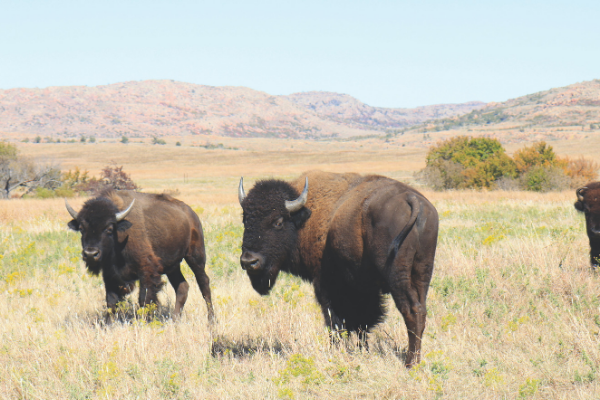
• The U.S. Fish & Wildlife Service manages the 59,020- acre Wichita Mountains Wildlife Refuge plus its Elmer Thomas and Quanah Parker lakes.
• The National Park Service manages the Chickasaw National Recreation Area (formerly known as Platt National Park) near Sulphur, in the foothills of the Arbuckle Mountains, and has an office in Oklahoma City. The Park Service also administers the 12-square-mile Washita
Battlefield Historic Site and the 30,000-acre Black Kettle National Grassland, near Cheyenne in Roger Mills County.
• The Bureau of Land Management manages 7.4 million acres of federally owned land and minerals (primarily oil, gas, and coal) in Oklahoma, Texas and Kansas. The BLM has a field office in Norman.
• The Bureau of Reclamation constructed and manages seven lakes in Oklahoma: Tom Steed Reservoir near Mountain Park, Fort Cobb Lake in Caddo County, Lugert-Altus Reservoir north of Altus, Foss Lake west of Clinton, Lake of the Arbuckles in Murray County, McGee Creek Reservoir in Atoka County, and Lake Thunderbird near Norman.
• The Bureau of Indian Affairs has five offices in Oklahoma, including one at Anadarko. This state has more than 300,000 Native Americans and 39 federally recognized Indian tribes, including the Kiowa, Comanche, Apache, Caddo, Fort Sill Apache, Osage, Kickapoo, Miami, Muscogee (Creek), Ottawa, Pawnee, Delaware, Iowa, Shawnee, Sac & Fox, Kaw, and the “Five Civilized Tribes”: Cherokee, Choctaw, Chickasaw, Creek and Seminole.
• The U.S.G.S. has an office in Oklahoma City and works closely with the Oklahoma Geological Survey.