

OKLAHOMA CITY – Mike Melton, who retired from the Oklahoma Water Resources Board after a 38-year career, said in 2000 that water would be the most important commodity on this planet in the 21st century.
The intervening years have proven him right. Water is essential to the survival of humans and animals alike; needed for irrigation of plants and trees, lawns and agricultural crops; and used for washing clothes and dishes and vehicles, taking baths and flushing toilets. And in energy-producing states such as Oklahoma, water is used in vast quantities for hydraulic fracturing in the oil/ gas exploration and production business. As ever greater demands are placed on finite supplies of water, conservation of the precious resource becomes ever more important. Communities and rural water districts spend large sums of money to buy, disinfect and distribute potable water to their customers, and waste prevention is a high priority.
Consequently, the Oklahoma Department of Environmental Quality (DEQ) and the Oklahoma Rural Water Association (ORWA) have joined hands to provide a water leak detection program for municipalities and rural water districts. The DEQ was allocated $230,630 this year for water loss auditing, and “leak detection work” with the ORWA “under a separate contract” for $300,000, according to Erin Hatfield, the DEQ’s communications director. Both contracts are financed through the Drinking Water State Revolving Fund, which is underwritten with capitalization grants from the U.S. Environmental Protection Agency (EPA).
WATER LOSSES AVG. 19.5%
In 2002, the EPA determined a national average of municipal water that was unaccounted for was 8.4%. As a comparison, a survey project in 2000 administered by the American Water Works Association (AW WA) found “non-revenue water” ranged from 7.5% to 25% across the U.S. Non-revenue water is water that has been produced but is lost before it reaches the customer. Losses can be blamed on leaks, which are sometimes referred to as “physical” losses, or “apparent” losses from theft or faulty meters.
Average “real” water loss in Oklahoma, based on 163 water loss audits, is 19.5%, Ms. Hatfield said. “Real” losses, also referred to as physical losses, are actual water losses from the system and consist of leakage from transmission and distribution mains, leaks and overflows from a water system’s storage tanks, and leakage from service connections up to and including the customer’s meter. The top honor for least real water loss is held by Tahlequah: less than 1%.
At the other end of the spectrum was an unidentified small town that was losing 65% of the potable water in its system, Ms. Hatfield said. The problem was discovered during a leak detection and meter analysis completed in 2015 by the ORWA at the request of the DEQ, she said. “The main problem turned out to be inaccurate metering and problems with recordkeeping,” Ms. Hatfield said. To improve their water system the town “will need to install enough isolation valves to control flow in the system and will need to work on improving mapping,” she said. The DEQ “has given them a list of tasks to complete, and we believe they are working on those,” she wrote earlier this month. Water losses can never be eliminated entirely, but the AW WA recommends a standard of 10% or less for “non-revenue water.”
AGE CAUSES WATER LOSSES
The primary cause of water leaks is aging infrastructure (pipes, joints, connections reaching and/ or exceeding their useful life and becoming brittle), said Brandon Bowman, coordinator of the Capacity Development Section of the DEQ’s Water Quality Division. Other causes, he said, are improper installation (pipes that weren’t bedded properly or joints that weren’t sealed properly) and damage by heavy equipment. “We do not know the exact frequency for earthquakes or ground shift causing leaks, but we know it does occur,” Ms. Hatfield said.
Oklahoma has 1,677 drinking water systems, according to Shellie Chard, director of DEQ’s Water Quality Division. The number of leaks in Oklahoma’s public water supply systems varies widely year-to-year and depends on many factors, such as the age of the system, operations and maintenance (such as controlling pressure and corrosion), weather and demands customers impose on the system, Ms. Hatfield said. Breaks and leaks occur “at all portions of a water system - from the largest water mains and tanks, from the packing on pumps and valves, down to the small lines on service connections,” Bowman said.
However, he said, the most commonplace for water loss to occur via leakage is on service connections pipes coming from the main, “due to frequent fluctuations in pressure, the presence of several joints or bends, potential changes in pipe diameter and composition and shallow installation depth.” Flushing a system is not consid- ered water loss, Ms. Hatfield said; instead, it’s categorized as unbilled authorized usage. Flushing “reduces the chances of formation of disinfection byproducts, keeps the system full of ‘fresh’ water that has an appropriate level of disinfectant present, helps remove sediment from water mains, and prevents taste/odor/color problems that may develop with ‘stale’ water,” she said.
Leaky pipes, line breaks, inaccurate metering and data management problems result in the loss of billions of gallons of water and millions of dollars in revenue every year. That’s why the DEQ has partnered with the ORWA over the past four years to help reduce water losses, thereby “keeping more water in transmission and distribution pipes and more revenue in water systems’ bank accounts,” Bowman said.
AUDITS SAVE WATER, $$$
The DEQ/ORWA free and voluntary program includes a water loss audit, a copy of the American Water Works Association auditing software, technical assistance in leak detection and meter accuracy analysis, and training in all aspects of water loss control. “We train municipal and rural water system operators how to do their own audits, and we provide them with the necessary software, so they can control losses on their own,” Bowman said. The software identifies water losses in two categories, he said: “apparent” losses (due to metering or data inaccuracies or water theft) and “real” losses (from leaks and breaks). Specialists teach system operators how to locate leaks that may or may not be visible to the eye, and how to find meters that may be transmitting inaccurate data or costing the water system money, he said.
Although “it sounds like a financial audit,” Bowman noted, “All it means is tracking all the water that comes into the system and all the water that flows out of the system.” More than 5.9 billion gallons per year of real water losses have been detected in the 163 systems that have been audited to date, Bowman said recently. “That’s enough water to fill more than 9,000 Olympic-size swimming pools,” he said. Because of the audits, system operators “have repaired leaks that totaled 490.4 million gallons of water annually, valued at $1.2 million per year,” Bowman said.
DETECTING LEAKS
Leaks are detected in a variety of ways, said Bowman:
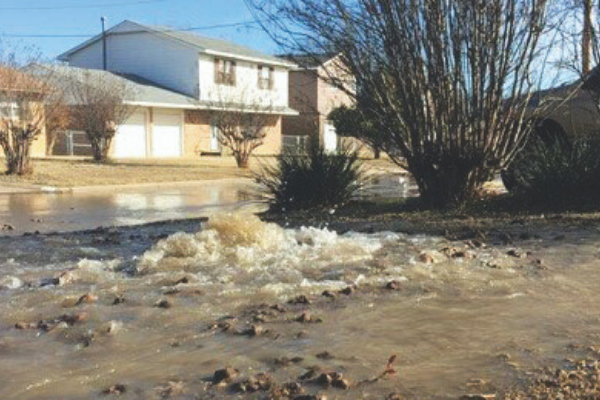
- visual inspection (water bubbling to the surface);
- peculiar meter readings;
- unusually high run times on pumps and equipment;
- night listening” (hearing water running through pipes during overnight hours);
- valve squealing (listening for water moving through a line after a valve on that section of pipe has been closed);
- leak “correlation” (acoustically determining the presence and location of a leak via electronic listening devices).
ORWA HAS 550 MEMBERS
The ORWA is a nonprofit association that was founded in 1970 to “assist water and wastewater systems with day-to-day operational and management problems.” More than 550 water and/or wastewater utilities are members of the organization. The organization is governed by a 16-member board of directors who include Larry Bogges of Lawton, Dennis Meyers of Indiahoma and Bill Sims of Mountain View.