

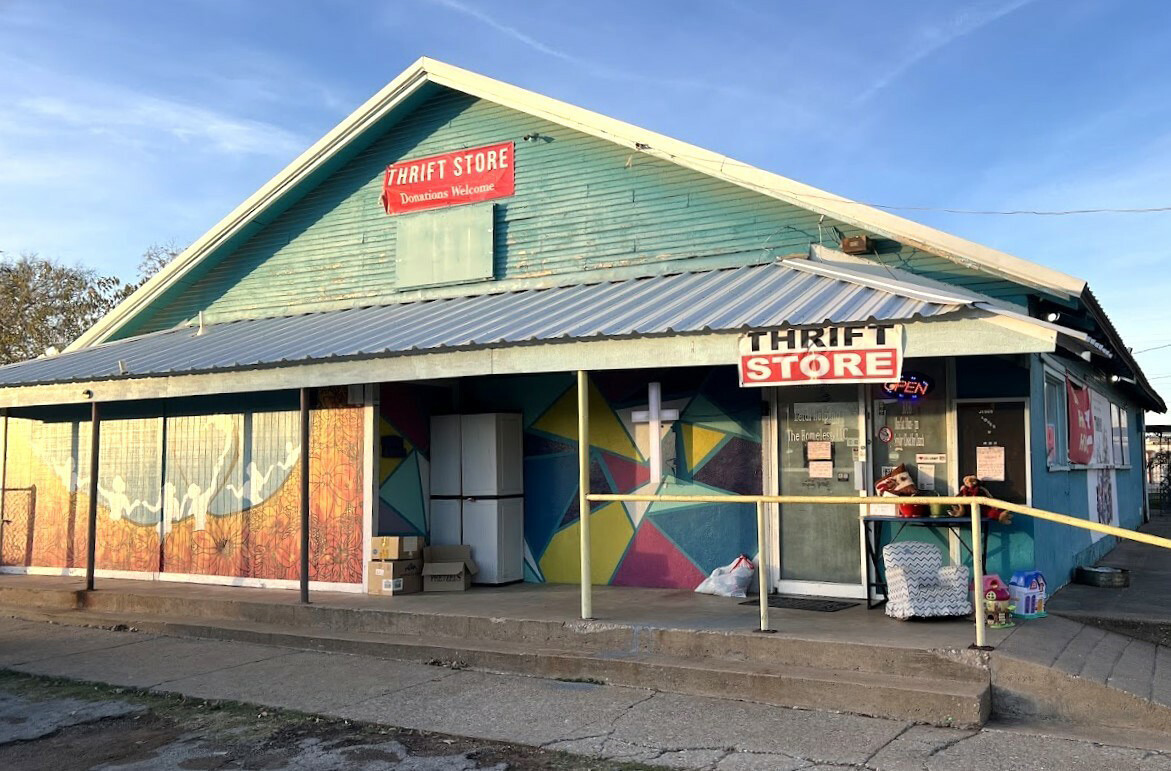
CHICKASHA – Heidi Harrison’s request for a refund of the $500 fee she paid for an application to rezone four lots in Chickasha where she operates a homeless assistance center was denied by the City Council, for multiple reasons.
Services Harrison provides at her “Heidi Helping the Homeless” thrift store at Third and Minnesota include food and clothing assistance, tents, bedding, laundry, showers, and computers.
She accords homeless individuals access to computers “so they can obtain their birth certificates and other documentation, apply for benefits or jobs, and keep in touch with loved ones via social media,” Harrison wrote on her website. “We also have a printer and fax machine, as well as a television so our unhoused patrons can get out of the weather, have a snack, and relax for a bit.”
Since one of the biggest barriers for people experiencing homelessness is that they don't have an address to list on applications, “We allow them to use our address (and keep their mail in a safe for them) so they can overcome this barrier and receive much-needed services,” Harrison explained.
Harrison came to City Hall last Oct. 3 and said she wanted to rezone four lots from residential to commercial, and she had a question concerning a lot merger “about combining to make one address,” city officials wrote. She said the lot would be used as “a smoking area, lunch location, and phonecharging station for the homeless.”
Harrison also asked “about putting a stage on those lots,” city staffers said. The lot is in a regulatory flood zone established by the Federal Emergency Management Agency; an applicant must elevate any structure placed inside such a zone by 3 feet and is required to obtain a floodplain permit, city personnel explained.
Community Development Director Rachel Bernish said former City Councilman Mark Keeling spoke with her on Oct. 16 about Harrison’s rezoning request. “I told him it would be best to request a special-use permit for that type of structure,” Bernish said.
Keeling said he was told that Harrison and her governing board “only wanted a rezoning.” That would be illegal “and would be considered spot zoning,” Bernish replied.
The International Zoning Code defines ‘spot zoning’ as “a small parcel of land that is arbitrarily selected for a zoning classification that is unrelated to the surrounding uses and zoning districts, and cannot be justified based on health, safety, or general welfare of the community.”
Spot zoning “puts liability on the Planning and Zoning Commission as well as the City Council,” Bernish said, “and I would not be able to provide a positive staff recommendation for something of that nature.”
Keeling told Bernish the property “would not be used for the homeless but rather for Heidi’s staff to smoke, eat lunch, and take breaks.”
Bernish said she “mentioned that the current location has a covered and lit gazebo area” where people can smoke and eat lunch. Keeling “was unsure why they could not use this area.”
Unauthorized stage has been removed Meanwhile, between Oct. 3 and Oct. 16 a stage was built in the 200 block of West Minnesota on the lot where rezoning was requested. “This structure was not permitted and is illegally located in the flood zone,” Chief Building Official Darren Martin told the council. Martin placed a “stop work” order on the job and initiated “next steps in the legal process.”
An electrician came to the Community Development office in City Hall on Nov. 27 and asked for an electrical permit for the stage and area at Harrison’s business location. He was “advised that we would be unable to issue permits until the illegal structure issue is resolved,” Bernish said.
Permanently changing the zoning classification on lots inside of a block surrounded by residential uses “would harm the rest of the residents in the neighborhood,” Bernish wrote.
“I am also concerned about long-term plans for the area, since the applicant is unwilling to consider a special-use permit, which is the most appropriate route to try to accomplish her goals.” The flood zone in which the targeted area is located “presents a lot of building challenges,” Bernish said. “This will cause complications for any future building on these lots.”
City officials sent a notice to Harrison, dated Dec. 9, 2024, ordering her to remove the “illegal accessory structure” no later than Jan. 1, 2025. Harrison removed the structure, Bernish told Southwest Ledger.
Letters for, against City Hall received six letters in favor of the rezoning request and 18 letters in opposition.
Chickasha has “a serious homelessness problem that has been largely ignored by our city officials,” one supporter of the rezoning wrote. “To deny HHH a zoning change on top of the ridiculously exorbitant fee for a simple request is unreasonable, unethical and unacceptable.”
One citizen wrote in an email: “A place to smoke? This would create a fire hazard. A place to eat lunch? There would be no way to control the trash… A place for staff and homeless to congregate? Who is going to actively oversee the loitering?”
The same citizen added, “I have witnessed and been informed by residents close to the HHH building of people going and getting soap, toothpaste and essentials, and then going door-to-door trying to sell them to homeowners in that area.”
Chickasha “has a serious homelessness problem that comes with our sky-high poverty and crime rate, problems that are largely ignored by our city officials,” one local couple wrote.
More than one opponent noted that Lincoln Elementary School is nearby, and parents are concerned about their children’s exposure to homeless people.
City officials calculated that they spent approximately $2,650 on legal notices and letters mailed to area property owners informing them of the rezoning request; preparing the Planning Commission agenda; plus time spent answering telephone calls and emails and conducting meetings “regarding this matter.”
After considering those issues, and the fact that a 501(c)(3) tax-exempt status “would not qualify a group” for a refund, the City Council voted 7-0 to deny Harrison’s request for a return of the $500 she spent for the rezoning application.