

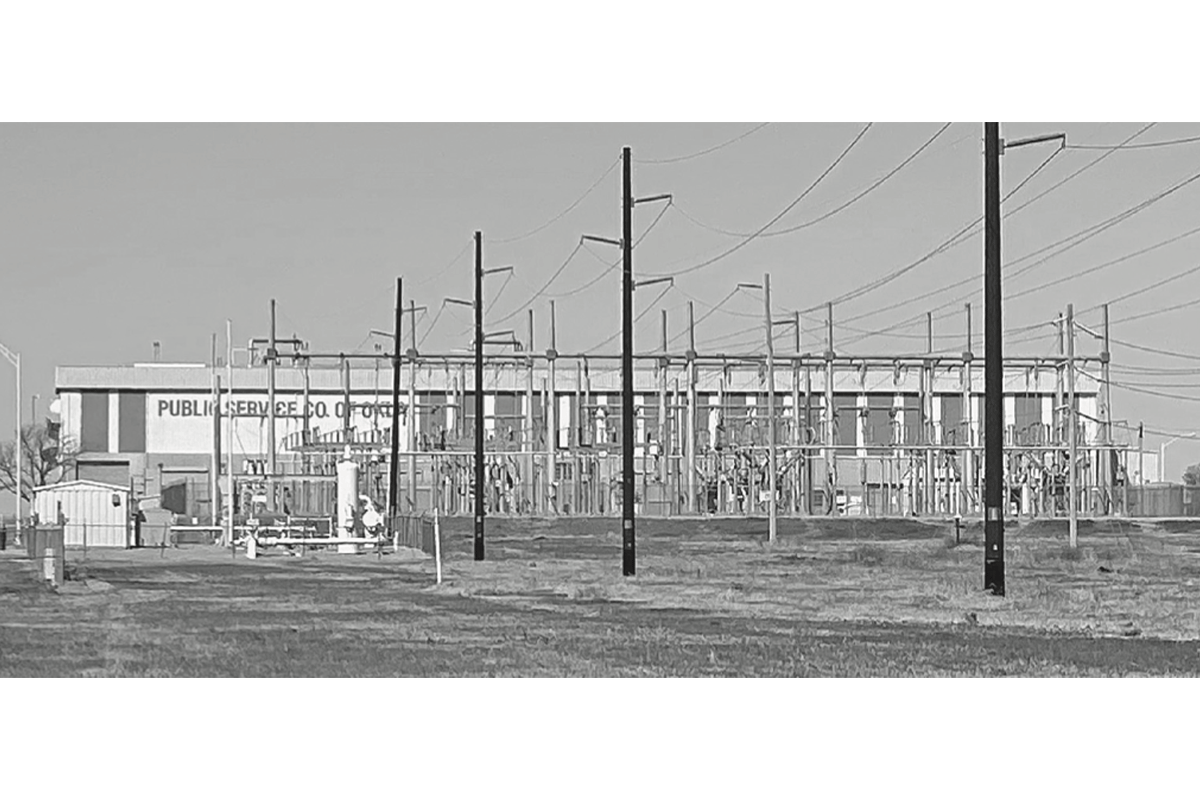
OKLAHOMA CITY – Public Service Co. of Oklahoma received permission Monday to bill its utility customers for construction of a $117.9 million emergency stand-alone electricity generation facility at Fort Sill Army post. But the level of expenses PSO can charge to its ratepayers prior to construction of the facility was scaled back considerably by the state Corporation Commission.
Commission Chairman Todd Hiett and Commissioner Dana Murphy endorsed the order, which was modified by Murphy. Commissioner Bob Anthony, a supporter of the project, refused to vote but filed a separate opinion.
The proposed Fort Sill Energy Center (FSEC) would feature construction of a reciprocating internal combustion engine (RICE) gas-fired generator capable of producing 36 megawatts of electricity, coupled with photovoltaic solar panels providing up to 10.9 megawatts of power.
The Energy Center would be constructed on 81 acres of Fort Sill property leased to PSO. The facility would be “islandable” – situated “behind Fort Sill’s defense perimeter” as a national security precaution, PSO executive Matt Horeled said.
The project would enable Fort Sill, home to the U.S. Army’s artillery school, to operate for 14 days without being connected to the standard electric grid in the event of an emergency and thereby “maintain mission readiness ... when it otherwise would potentially be offline awaiting normal grid operations to resume,” testified Michael McGhee, acting Deputy Assistant Secretary of the Army for Energy and Sustainability.
“Under normal circumstances, the energy produced by the RICE generator and solar panels would be fed onto the grid to serve PSO customers,” said Stan Whiteford, PSO region communications manager.
But if the power grid experienced an outage, the four 9-MW RICE engines and the photovoltaic solar panels could be disconnected from the grid to provide Fort Sill with 100% of the 33 MW of energy the post would need to sustain its operations. “That’s why it’s called an energy resilience project,” Whiteford said.
“This project meets the capacity needs of all PSO customers while helping to meet resiliency needs for Fort Sill,” PSO said in a statement re- leased Tuesday. “While the solar portion of the plan was approved, we are reviewing the Commission’s order and the conditions on cost recovery, particularly conditions placed on the natural gas generation proposal, to evaluate the financial viability of the project.”
PSO’s ability to construct, operate and make expenditures related to the FSEC is not at issue, the commission order states.
The Corporation Commission’s decision on PSO’s application “will not grant or deny permission to construct” the proposed power generation facility, the commission order continues. “PSO’s management already has the authority and discretion it needs to invest and build the FSEC regardless of the commission’s decision in this case. Should PSO proceed to build the FSEC without preapproval,” the utility could propose to include those expenditures in its rate base “in a future proceeding...”
If the commission had granted pre-approval of the project costs as envisioned by PSO, construction on the FSEC would begin this fall. Company officials said the solar facility would be operational in March 2022 and the gas-fired generation would come online19 months later, in October 2023.
If PSO proceeds with the Fort Sill Energy Center and construction goes as planned, the temporary Solar/RICE Asset “rider” the Corporation Commission approved Monday will begin appearing on utility bills in 2023. The rider would amount to less than $1 per month, commission Public Information Manager Matt Skinner said.
PSO SOLAR PLAN 'REASONABLE' BUT GAS-FIRED GENERATOR CAUSES HEARTBURN
Hiett and Murphy had no issues with the solar feature of the project. “The commission ... finds that PSO’s selection of the solar facility is reasonable and that the solar project imposes de minimis incremental cost to customers over the life of the facility,” the commission order states.
But the two commissioners, Administrative Law Judge Dustin R. Murer, and the state Attorney General’s staff all were critical of PSO’s projected costs of the RICE generation.
The RICE facility would impose “substantial incremental costs” on PSO customers “when compared with capacity alternatives available to PSO without regard to location, generation technology, or the service requirements of Fort Sill,” the order declares. “These additional incremental costs are not necessary to meet PSO’s capacity reserve margin ... and are unreasonable and unjust.”
While the PSO application was pending before the Corporation Commission, “several potential benefits of the RICE units were implied to provide value to the grid and PSO’s customers,” Mur- er wrote. Although the RICE technology may provide benefits beyond generation capacity, “any such benefits” are “not supported by evidence and cannot be considered an established need” in this case.
PSO calculated a 30-year “useful life” of the RICE facilities, and estimated operation and maintenance costs of the Fort Sill project at approximately $8.20 per megawatt hour based on 7,500 hours of run time.
“[I]t does not appear that pre-approving these facilities is fair to PSO’s ratepayers, as it provides everything Fort Sill needs and very little capacity to ratepayers in return,” Murer wrote.
During a previous discussion of the Fort Sill project, Anthony pointed to a PSO fact sheet which relates that the utility company has a total power production capability of 4,908 megawatts: 3,771 MW from natural-gas and coal-fired power plants and 1,137 MW from wind turbines under long-term contracts. The 46.9 MW of electricity that would be generated from the Fort Sill Energy Center would add a little less than 1% of generating capacity to PSO, Anthony said.
“That 1% is one of the highest costs we’ve ever seen,” Murphy responded.
PSO “did not present evidence of any other alternatives” for the Corporation Commission to consider, Murer wrote May 10 in his recommendation that the commission deny PSO’s re- quest for pre-approval of the costs of the Fort Sill Energy Center (FSEC). The utility “did not perform an economic analysis to demonstrate that the FSEC represents the lowest reasonable cost alternative to supply the needs of PSO’s system.”
PSO did consider alternatives but within the limits of the U.S. Army’s requirements, PSO attorney Joann Worthington said during one hearing on the application. She conceded that the FSEC “would cost more than something not behind Fort Sill’s fence line.”
GENERATOR TOO COSTLY, CRITICS SAY
Data supplied by PSO indicated the company’s retail revenue requirement for the 36 MW RICE unit would total almost $390 million over a 29-year period (2024-2052). The Attorney General’s staff calculated the revenue requirement for alternatives at slightly more than $240 million over the same period.
James B. Alexander, a regulatory analyst with the Attorney General’s Office, testified that the recommendation of the AG’s office would result in an average increase in a PSO residential customer’s bill of 43¢ versus the $1.27 monthly impact of PSO’s proposal.
Using U.S. Energy Information Administration (EIA) data for a combined-cycle natural gas generation facility as a proxy for 36MW of capacity, “the recalculated annual revenue requirement through 2052 is estimated to be $104.8 million less than PSO’s estimate for the RICE facilities on a net present value basis,” the commission order states.
If U.S. EIA data “as a proxy” for 36 megawatts of capacity were used, PSO residential customers “would face an increased bill of 54¢ per month rather than the $1.27 impact expected for the RICE facility” proposed by PSO, Murer wrote.
The commission decreed that PSO customers’ cost responsibility for the proposed FSEC “should be no greater than the revenue requirement for an equivalent amount of capacity located elsewhere on the grid, in order to ensure the interests of the public are fairly protected.”
The commission also asserted that “it is most reasonable to limit the cost responsibility of PSO’s customers for the proposed RICE facility” to no more than what the U.S. EIA calculated for 36 MW of generation capacity.
PSO proposed recovering the revenue requirement of the Fort Sill Energy Center through a “Solar and RICE Asset” pre-approval “rider.” The commission, though, decided that major variable operations and maintenance expenses should not be recouped through a rider. Instead, PSO would be allowed to request recovery “through normal means, such as in a general rate case.”
In a related matter, Commissioner Murphy previously noted that PSO has three cases pending before the Corporation Commission that potentially could have a financial impact of more than $1.1 billion on the company’s ratepayers: an estimated $825 million bill for electricity and natural-gas purchases from other entities in order to weather the February winter storm, a $172.4 million rate hike application, and the $117.9 million proposed Fort Sill Energy Center project.
POWER PLANTS NOT ARMY'S 'CORE COMPETENCY,' ATTORNEY SAYS
If the Fort Sill Energy Center were approved as requested by PSO, “the overall body of PSO’s customers would pay for the project, even though aspects of the project were intended to meet the special needs of Fort Sill,” ALJ Murer continued.
The Army has pledged more than $10 million for investment in equipment that would help make it possible for the solar and gas-fired facilities proposed for Fort Sill to be isolated from the PSO/Southwest Power Pool grid in the event of a terrorist attack such as 9/11/2001 or a catastrophic weather event such as a tornado, Worthington said. Two substations provide electricity to Fort Sill; the $10+ million “is a contribution we required from Fort Sill for the interconnection of the substations to our transmission system,” Whiteford said.
One citizen who wrote to the commission about the project suggested that Fort Sill should pay for construction of the Energy Center, since “it’s to their benefit”.
It’s highly unlikely that the Army could or would pay most or all of the cost of the proposed FSEC, said Army attorney John McNutt of the Office of the Judge Advocate General.
Because the U.S. Army has approximately 100 military installations, “It’s not eco- nomically feasible for the Defense Department to build its own electric power facilities at military installations. The Pentagon has not budgeted for these kinds of projects.” Additionally, building and maintaining power plants “is not our core competency,” McNutt said.
PSO SERVICE TO ARMY POST RATED 'VERY HIGH'
Public Service Co. and Fort Sill executed a 30-year lease on the 81-acre post property, with an option for an additional 10 years.
If PSO’s application had been approved as submitted, the utility would be contractually obligated to provide islandable power generation for at least three decades “even if the facilities were to become uneconomic,” testimony showed. The lease agreement “puts customers at too much risk and is against the public interest,” Murer contended.
Murer asserted that PSO has not proven that “there is a need of additional resilience and reliability for Fort Sill and the [electric] grid in general.” In fact, he wrote, the records show that PSO has historically provided very high electric service reliability to Fort Sill.”
Over the past decade, “there has not been a single service interruption to Fort Sill due to transmission forced outages, generation supply shortages, or regional electric grid emergency events,” energy consultant Scott Norwood testified in the case earlier this year.
ENERGY CENTER A 'PRIORITY', ARMY SAYS
However, Michael F. Mc- Ghee, testifying before the Corporation Commission on behalf of the U.S. Department of Defense, said the FSEC is “an important priority for Fort Sill and the greater surrounding Lawton community...”
The Army seeks to achieve “additional energy security and resilience on its installations by developing ‘islandable’ projects” which “contribute to the Army’s ability to provide access to necessary energy and water in the event of a disruption.”
Military installations that have secure electric power plants “inside the fence line” which can operate even if the regional electric grid is disrupted “have a tremendous, strategic advantage,” testified
McGhee, Deputy Assistant Secretary for the Army for Energy and Sustainability.
“For the last 10 years the Department of Defense has been trying to harden our installations,” Army attorney McNutt told the Corporation
Commission. “Electricity is critical for our installations.
We rely on the grid. We have to have reliable backup power.” The Attorney General’s staff said it agrees that it was proper to “consider the goals of Fort Sill.” However, “the appropriate issue” in the FSEC case is “how to allocate the costs of the project in proportion to the benefits received by PSO’s captive customer base.”
The commission order approved Monday urges PSO to file a rate case “at the earliest possible date” at which costs associated with the FSEC “can be included in an historic test year, or no later than Jan. 1, 2025.”