

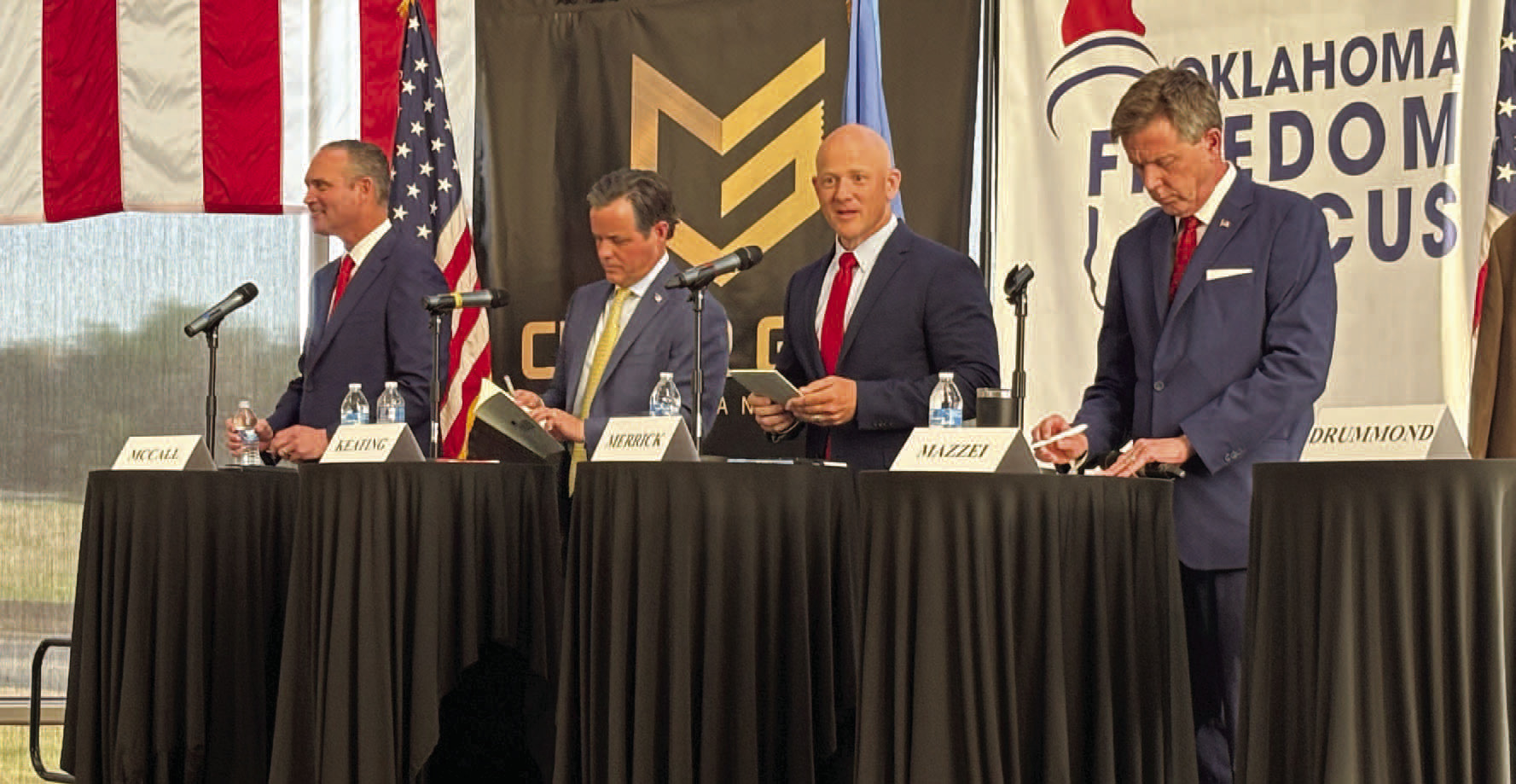

OKLAHOMA CITY – Several Republican gubernatorial candidates faced numerous questions about their policies during a debate hosted by the Oklahoma Freedom Caucus. One candidate, Attorney General Gentner Drummond, did not attend.
A statement from his campaign said Drummond had a scheduling conflict but also placed no confidence in the impartiality of the caucus’ moderator, Nathan Dahm. Drummond’s campaign also did not have a promotion table at the debate, which was held Monday night at the Oklahoma History Center in Oklahoma City.
“Our campaign is focused on results, not sideshows,” Matthew Parker, Drummond’s campaign chairman, said. “We won’t waste time engaging in political theater staged by Nathan Dahm.”
Dahm previously served as a Tulsa area state senator from 2012 to 2024 and former Oklahoma Republican Party chairman. Oklahoma Freedom Caucus is an ultraconservative organization and is affiliated with the State Freedom Caucus Network, whose members are kept secret.
On stage, a suit was suspended behind the lectern where Drummond would have appeared alongside fellow candidates Charles McCall, Chip Keating, Jake Merrick, and Mike Mazzei.
Caucus Chairman and State Sen. Shane Jett, R-Shawnee, joked that everyone should be respectful of the “empty suits in the room,” at which time the crowd erupted in laughter. Jett did not respond to Drummond’s accusation by press time. Dahm could not be reached for comment.
Jokes aside, the candidates faced a barrage of questions on subjects ranging from illegal immigration, gun control, abortion rights, education, and federal policy.
The candidates largely agreed on conservative issues but sometimes differed on how to achieve outcomes.
Privacy and Big Tech
Every candidate except Keating wanted to ban automatic license plate readers due to privacy concerns.
Keating, a former Oklahoma Highway Patrol trooper, said that last year a child abducted in Edmond was rescued because of the cameras used to capture license plate information.
“Obviously, the government has gotten out of control. Big tech, data, that’s the issue here,” Keating said. “Where is this data going?”
Everyone agreed the sale of license plate reader data should be stopped, but only
_________________ Keating wanted to regulate camera use solely for public safety purposes.
McCall, former Oklahoma House Speaker, said the cameras were nothing more than an extension of “the U.S. Patriot Act,” a federal law that broadened the government’s surveillance powers.
Merrick’s comment, “I want more cameras on the government, fewer cameras on the people,” drew a round of applause. He briefly served as District 22 State Senator to fill a vacancy in 2021 but lost to Kristen Thompson, R-Edmond, in 2022.
Federal Overreach and State Powers
Dahm asked candidates if they would refuse to allow state agencies to follow any federal mandate that “is unconstitutional,” and to provide an example.
Mazzei, who often spoke against Environmental Protection Agency regulation, said he would also fight overreach in education, energy, and religious freedom. Mazzei served as Bixby area state senator for District 25 from 2004 to 2016, and as Gov. Kevin Stitt’s budget secretary from 2019 to 2020.
McCall pointed to a bill he and other lawmakers passed that required the Attorney General to review all federal executive orders for federal overreach.
Mandates for the COVID-19 pandemic vaccine were a policy Keating said he would have opposed.
Merrick said his state Senate votes against certain “pro-life bills” were controversial, but his intent was entirely to abolish abortion.
“My stand for that was two-fold: to protect life and also push back against the federal government,” Merrick said. He also promised to resist federal overreach on gun control.
Tribal Relations
Candidates answered questions about tribal relations with the state, which have come under strain as negotiations for compact agreements, and the far-reaching consequences of the U.S. Supreme Court ruling on the McGirt case, erupted in lawsuits during Gov. Kevin Stitt’s term. Compact agreements regulate the state’s share of revenue, primarily for gaming. The McGirt ruling found that most of eastern Oklahoma remains an Indian reservation, and complicated criminal prosecution of tribal members.
Dahm asked if the candidates supported tribes as a partner or as a sovereign nation that “needed to be regulated.” Each answered they viewed the tribe as a strategic partner.
Mazzei said he would be a “tough negotiator” with tribes and would require financial disclosures as part of that negotiation process. Keating promised to “hit the reset button” on tribal relations. McCall said treaty agreements should be honored, and Oklahoma should work with tribes as it has for more than 100 years. Merrick said he was pleased to see a recent Oklahoma Supreme Court ruling to affirm tribal members’ rights to hunt on their own land, an issue that prompted three tribes to sue Stitt and the Oklahoma Department of Wildlife Conservation last year.
Candidates Agree on Abortion, Gun Rights
All the candidates vowed to support broad gun rights, including a push to allow them at the state Capitol and on university campuses. They said they would support further restrictions to abortion, and most explicitly agreed to hold women criminally responsible for an abortion.
McCall’s answer was less specific on whether to punish women for abortions.
“We should abolish abortion in the state of Oklahoma,” McCall said. “We should ... anyone who would have an abortion, it’s not the state laws of Oklahoma that you should be worried about. It’s about meeting your Maker.”
He added, “Not only do we need to have tough laws, but we also need to introduce people to Jesus.”
Education and Immigration
Education and illegal immigration questions also drew similar responses from candidates. Every candidate agreed that Oklahoma should not pay to educate illegal immigrants. They also agreed to deport illegal immigrants.
Keating and McCall sparred over claims that because the Oklahoma Highway Patrol is underfunded, its work to assist the deportation of immigrants has been limited.
“The Legislature has failed to fund the state patrol,” Keating said. “We are short 400 troopers today.”
McCall disagreed and said the Legislature had provided historic funding for public safety.
Last year, OHP attempted to remove troopers from the state’s seven largest cities to cover rural areas. The amount OHP receives is not clear because the agency falls under the Department of Public Safety, which received $120 million last year, Oklahoma Voice reported. OHP’s attempt to divert patrol from urban areas was unsuccessful.
Candidates also were asked how they planned to fix the state’s ever- worsening reading and academic scores. They also were asked if they believed education is adequately funded in Oklahoma.
Keating said he wanted to reform the per-pupil funding formula because it is “grotesquely broken.”
“We give school districts a blank check and then we don’t tell them how to spend the money,” he said.
Merrick said he believed streamlining school administration to one superintendent per county would reduce spending outside the classroom. He also added that Oklahoma needed to focus on recruiting high-quality teachers with high-quality wages.
Mazzei said schools “don’t have a money problem,” but a money management problem. He said he has a plan to make phonics mandatory, but McCall pointed out state law already requires it.
McCall also said he would appoint members to the Oklahoma Board of Education to “move these education outcomes up.”
Taxes
Candidates all promised to tackle the rising cost of living in the state.
McCall said he planned to eliminate personal income tax and freeze property taxes. Mazzei promised to abolish income taxes and property taxes for seniors. Keating said income tax should have been eliminated “long ago” and promised to freeze property tax. He also said the tax code should be reformed.
Merrick called for tax reform, but first the state needed to “limit the size of government” by reducing regulations.
The Legislature passed House Bill 2764 in 2025 to allow tax cuts if the state meets certain revenue expectations. It also cut the income tax by a quarter percent and streamlined six tax brackets to three.
None of the candidates Monday night presented a plan to replace revenue from income and property tax cuts.
The primary election is set for June 16 and, if needed, a primary runoff will be held on Aug. 25. The winner will face House Minority Leader Cyndi Munson, D-Oklahoma City, in the general election on Nov. 3.
Mindy Ragan Wood is an award-winning journalist with more than 20 years’ experience in city and county government and criminal justice. She can be reached at writermindyrwood@ gmail.com.