

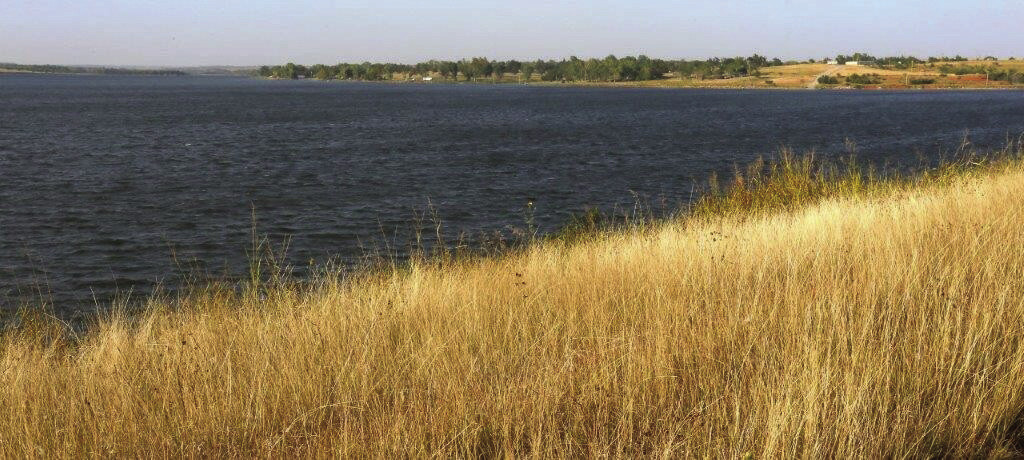
Existing annual lease agreements for camping sites at Lake Chickasha will not be renewed, and all current lake lease agreements will be terminated in six months. The City of Chickasha intends to raise the lake level by 10 feet in order to use the reservoir as an additional water source, City Manager Jim Crosby explained.
Nevertheless, city officials have no intention of “kicking anybody off their lease” in six months, Mayor Zach Grayson told Southwest Ledger. More likely the leases will be renewed month-to-month “until the need arises to clear the land,” he said.
“I think our water rights will be reduced” by the Fort Cobb Master Conservancy District, Crosby said during a City Council meeting Dec. 16. Consequently, “Our best and only [alternative] source is water from Lake Chickasha.”
Work will start next year on construction of a larger, modern water treatment plant for Chickasha. “As the city grows, we will not receive any more water rights from our present source, Fort Cobb Reservoir,” Crosby said.
FCMCD “wants us to find an alternative source of water” to supplement Chickasha’s withdrawals from Fort Cobb Lake, former mayor Chris Mosley told Southwest Ledger earlier this year.
Chickasha’s contract with the FCMCD allows the municipality to draw up to 5,125 acrefeet of water (almost 1.67 billion gallons) per year, Office Manager Ginger Abbott told the Ledger. The city’s water consumption totaled 1.09 billion gallons in calendar year 2022 and again in 2023, Chickasha Municipal Authority records reflect.
Outgoing City Manager Keith Johnson mailed letters last month to holders of lease agreements at the lake, informing them that City Hall “has determined that Lake Chickasha will become a supplemental source of drinking water for our community.” That will necessitate raising the water level in the lake.
“As part of this initiative … the City of Chickasha will not renew any of the existing lake lease agreements, and all current lake lease agreements shall terminate on June 30, 2025.”
The decision was made “to ensure the successful implementation of our water conservation goals and to ensure the long-term sustainability of our water supply,” the letter explained.
“The original intent for that lake was to be a source of drinking water,” Grayson said.
The City Council heard from a couple of concerned citizens who lease property at the lake.
Rodney Christian said he has “been out there for over 20 years, raised my kids and grandkids out there.” But now the city is “talking about running us off” next June “because they’re raising the water level,” he said.
Bryce Binyon said he’s been a lessee at the lake “for all of my life.” He wondered whether “people out there will be able to move back” after the lake level has risen.
As the water level rises, “areas out there that are leased, as well as some buildings, will be flooded,” Crosby said. “Not today, but over the years they will. So, we’re giving people plenty of opportunity to relocate.”
“While we acknowledge the challenges this may present, we believe that securing a reliable source of drinking water will benefit the entire community,” Johnson concluded.
The council also discussed the option, starting next summer, of authorizing leases for only two-week periods. “That’s standard practice for other areas, such as state parks,” Grayson said. However, no decision was reached on that issue.
“It will probably take several years,” perhaps a decade, to achieve the goal of elevating the lake level by 10 feet, Crosby said.
“Many things will have to be done” in preparation for the project, the city manager said.
“As we move forward, a lot of work has to be done to the dam,” he said. For example, the road atop the dam needs some attention, the earthen dam has some eroded areas, and more trees will have to be cleared from the vicinity of the emergency spillway. The north side of the dam in the vicinity of the spillway has been cleared “but not on the south side,” Crosby said. “It’ll be an easy fix but it will take time.”
“This is a long-term solution,” Crosby said. The Oklahoma Water Resources Board “has given us five to seven years to fix the dam.” OWRB records indicate the Lake Chickasha dam is 57 feet tall and 3,340 feet long.
Poor water quality in Lake Chickasha Lake Chickasha is located in Caddo County, near Verden, approximately nine miles west of Chickasha. The lake was impounded in 1958, OWRB records reflect. The reservoir is fed by Spring Creek on its western arm and by Stinking Creek on its eastern arm.
Lake Chickasha water has “a lot of gypsum,” Councilman Brian Gerdes noted.
“It’s something we’ll have to treat in the new water plant,” Crosby acknowledged. “All surface water contains various minerals.”
Research performed on Lake Chickasha 30 years ago by the state Conservation Commission detected “high sulfate concentrations originating from gypsum deposits in the geologic formations under the lake…” Water quality data collected as part of the state's lake assessment program also indicated high levels of dissolved solids and elevated levels of chlorophyll-a, which is a measure of algal biomass that is used to indicate or determine productivity in a lake. “The more chlorophyll- a is detected, the greater the level of algae,” said Robby Short, public information officer for the OWRB.
Consequently, “any utility for drinking water was abandoned” years ago. However, many advancements in water processing technology, such as reverse osmosis, have been made during the three decades since then.
In a related matter, Councilman Oscar Nelson wondered, “How much sediment has settled in that lake” over the past 66 years?
Chickasha’s existing water treatment plant, which is at least 60-plus and perhaps 70-plus years old, is incapable of adequately treating water from the lake.
The plant was designed to process 6 million gallons of potable water daily, but now its “functional capacity” is 4.2 million gallons per day to serve the 16,500 residents of Chickasha and the nearby community of Norge, Johnson said previously.
Chickasha currently receives all of its water from the Fort Cobb Lake approximately 35 miles northwest in Caddo County. The lake water is conveyed to Chickasha’s water treatment plant on Genevieve Street through a concrete asbestos pipeline.
The new treatment plant will be designed to produce 6 million gallons per day (mgd) of potable water and will be “expandable” to 8 mgd, Jason Cocklin of the Oklahoma City engineering company of Freese & Nichols told the Chickasha City Council in July. Production of 6 mgd “should get you out to the horizon, to about 2060-70,” Cocklin estimated.
After the contract is awarded, construction will take approximately 18 months to complete, from approximately May 2025 until December 2026, F&N predicted.
Crosby told the City Council that he will provide “a full report” in January on the status of the new water plant project and the acquisition of land on which it will be built.