

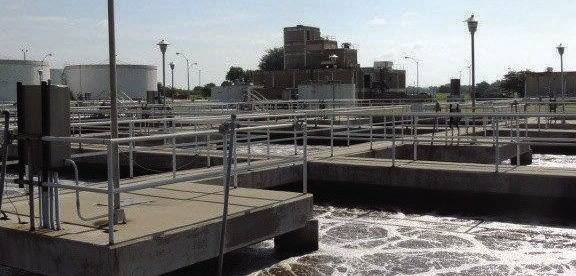
The Oklahoma Department of Environmental Quality has officially cleared the City of Lawton of responsibility for the fish kill that occurred in East Cache Creek at Sultan Park in Walters on July 7, municipal officials said.
The fish kill was initially blamed on the city’s wastewater treatment plant in an anonymous report submitted to the DEQ.
Sultan Park is “roughly 25 stream miles downstream” of the point where treated effluent from the WWTP enters Nine Mile Creek south of Lawton through a discharge pipe.
DEQ Environmental Programs Specialists Greg Ressel and Jeff Lawler said they counted 20 dead fish between Sultan Park and the confluence of Nine Mile Creek with East Cache Creek, which in turn empties into the Red River.
Ressel said he investigated “the complaint site” and measured ammonia and dissolved oxygen concentrations where the dead fish were discovered. Ressel also said he inspected the site two days earlier “and found that the water in [East Cache] Creek was black.” However, subsequent heavy rainfall “washed significant amounts of sediment downstream,” which changed the color of the water to “an opaque brown.”
The DEQ issued a notice of violation to Lawton on July 30 for the discharge of partially treated wastewater during upgrades to the WWTP.
The City of Lawton responded on Aug. 13, providing evidence to show that other environmental factors contributed to the fish kill.
• The WWTP’s discharge passed required toxicity tests in June 2024, indicating it was not harmful to aquatic life at the time.
• A DEQ review of the Lawton WWTP’s process control data from June 22 to July 8 showed that the effluent ammonia concentration was in a range “3-5 times the ammonia toxicity concentration for fish.”
However, at the time of the reported fish deaths, ammonia at the sample site tested by the DEQ was “within compliance of the WWTP effluent permit parameters,” wrote David Hastings, Lawton’s wastewater treatment plant superintendent.
• Hastings also noted that heavy rainfall occurred on July 4, causing East Cache Creek to flood and then recede, stranding larger fish. High temperatures exceeding 100 degrees further stressed the fish by reducing oxygen levels in the water, he wrote.
Prison lift station overflows frequently
• Additionally, the city received reports that GEO Group’s privately owned Lawton Correctional Facility east of the municipal wastewater treatment plant had ongoing sewage overflows.
The City of Lawton received reports of bypasses of raw, untreated sewage from the prison entering downstream of the Lawton WWTP’s discharge point into Nine Mile Creek.
More than 1,000 convicts are incarcerated in the private prison southeast of Lawton. Those overruns were reported Aug. 7 to the DEQ, which was advised the problem had been occurring for several months.
“They’ve had problems with their sewage lift station intermittently, on several occasions,” Rusty Whisenhunt, Lawton’s public utilities director, told Southwest Ledger. “We reported that to DEQ and they investigated.”
During a period of time when the prison’s sewage lift station was inoperable “it overflowed and made its way to Nine Mile Creek,” Whisenhunt said. “That’s the only place floatable solids could have come from. Solids did not come from our wastewater treatment plant. The problem is with the prison’s lift station and force main.”
DEQ District Engineer David Mercer called Whisenhunt on July 26 and informed him the city would have 15 days to “eliminate and prevent recurrence of the violations…” Lawton’sWWTP in ‘full compliance’ Hastings responded in an Aug. 13 letter to Shellie R. Chard, director of DEQ’s Water Quality Division, that the sewage treatment plant “reached full compliance” with its Oklahoma Pollutant Discharge Elimination System permit on July 27 – the day after Mercer called Whisenhunt and three days before the DEQ sent Lawton Mayor Stan Booker the notice of violation.
In a letter dated Sept. 23 and sent to Booker, Patrick Rosch of the DEQ wrote that “a review of DEQ records and the daily wastewater effluent and operational data” shared by Lawton’s WWTP staff “indicates that, as of the end of July, the WWTP treatment processes have been reestablished and are producing an effluent that is characteristic of properly treated wastewater.”
Rosch, an engineering manager with the Municipal Wastewater Group in the DEQ’s Water Quality Division, also wrote that “based upon the circumstances discussed in the city’s Aug. 13 NOV response, DEQ cannot conclude with certainty that the fish kill … was directly caused by the city’s WWTP discharge.”
Additional improvements are underway at Lawton’s sewage treatment plant, but the facility is “currently discharging effluent that meets all regulatory standards,” Hastings wrote. Also, the City of Lawton “remains committed to maintaining this level of compliance and ensuring theWWTP continues to operate effectively as the construction project continues.”
The City of Lawton also took proactive steps to mitigate the problem by releasing water from Lake Ellsworth into Nine Mile Creek, increasing the flow of fresh water to East Cache Creek in July.
“We are pleased with DEQ’s findings, which confirm that the fish kill was not the result of our wastewater treatment processes,” City Manager John Ratliff said. “I am also happy to report that the wastewater treatment plant has been in full compliance [with DEQ regulations] since July 26. We remain committed to continuing the rehabilitation of the WWTP and to ensuring full compliance with environmental standards moving forward.'
City officials have spent the last three years coping with myriad problems at the 47-year-old sewage treatment plant that have led to a series of health and environmental infractions.
Consequently, the city is renovating the WWTP – at a cost of approximately $100 million – “to improve the treatment process and ensure redundant operations are in place in the future,” city spokesperson Caitlin Gatlin said.