

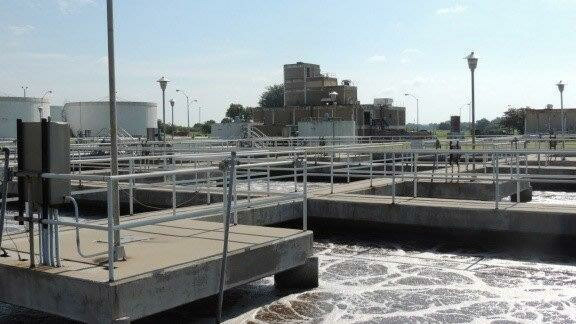
The City of Lawton received another notice of violation from the state Department of Environmental Quality last month because of unacceptable releases from its troubled sewage treatment plant.
The notice City Hall received July 30 cited “discharge without a permit” as the primary issue.
The NOV referred to a July 7 incident where eight fish were found dead in East Cache Creek near Sultan Park in Walters, 25 miles south of Lawton wastewater treatment plant.
Lawton’s sewage treatment plant discharges treated wastewater into Nine Mile Creek, which merges with East Cache Creek, which in turn empties into the Red River. The discharge rate from theWWTP is “anywhere from 14 million to 16 million gallons per day,” the city’s communications manager told Southwest Ledger.
Water samples were collected earlier this year from multiple sites on Nine Mile Creek and East Cache Creek, including at Thia Pai Park near Walters at 6:45 p.m. April 5, and it had an E. coli count of 1,050,000. East Cache Creek “runs right by there and it’s home to quite a few annual ceremonies for Kiowas in the area,” Lawton resident Kaysa Whitley told the Ledger.
What is emitted from the treatment plant is commonly referred to as “gray water:” wastewater from which bio-waste has been removed but is nevertheless unfit to drink. Treated effluent discharged into Nine Mile Creek is appropriately labeled as gray water.
The latest NOV also included data from June 22 to July 8 that indicated effluent ammonia concentrations that exceeded the ammonia toxicity threshold for fish.
The NOV received late last month was the second one issued this year by DEQ about Lawton’s sewage treatment plant.
The agency issued a notice against the City of Lawton on April 18 because of numerous “apparent violations” of the state Environmental Quality Code by the municipal WWTP.
In that NOV the city was cited for 19 infractions that occurred between December 2023 and February 2024. Those violations involved ammonia concentrations, carbonaceous biochemical oxygen demand, total suspended solids, and dissolved oxygen.
The notice informed municipal officials that the City of Lawton had been discharging pollutants “in excess of your Oklahoma Pollutant Discharge Elimination System permit limits…” Ammonia concentrations were three to five times allowable limits; CBOD, as much as five and seven times greater than permissible limits; total suspended solids, 9.8 times higher than acceptable limits.
From Feb. 26 to April 10, the DEQ received several complaints “regarding the ability of theWWTP to provide sufficient wastewater treatment and/or the adversely impacted state of Nine Mile Creek and/or East Cache Creek.” The complaints were made about locations in both Comanche and Cotton counties, wrote Shellie R. Chard, director of the DEQ’s Water Quality Division.
The City of Lawton “has been working diligently … over the past three years” to correct issues with the 47-year-old wastewater treatment plant, Public Utilities Director Rusty Whisenhunt wrote in a May 13 letter to DEQ’s Water Quality Division.
Those measures included an equipment replacement project that was completed in November 2022 and a construction project currently underway, Whisenhunt said. Those two projects have involved an investment of more than $100 million “dedicated to theWWTP.” Renovations continuing at sewage treatment plant Lawton officials met with the DEQ on June 10 to discuss the April 18 NOV, and the city “continues to make significant progress in improving its wastewater treatment plant,” said Caitlin Gatlin, the city’s communications manager.
“Staff has completed reseeding the activated sludge basins and biological activity is thriving on its own,” she wrote in a July 30 news release. “This process is essential for breaking down solids and ensuring effective nitrification, settling, and disinfection in downstream processes.
“Continuous maintenance is also being performed on upstream processes, including grit removal and hauling, primary clarifier repairs, and replacing the trickling filter tower rotating mechanisms, all crucial for sustaining the activated sludge’s food source.
“Further enhancements are underway, including installation of a new influent pump station with upgraded pumps, coarse and fine screens, vortex grit removal, to ensure complete solids removal. Aeration blowers will also be replaced with redundancy to ensure proper aeration of the activated sludge process,” Gatlin wrote.
“We will provide DEQ with a detailed written plan outlining our commitment and steps to correct the violation and ensure compliance with environmental regulations,” Gatlin said. “We are committed to keeping citizens informed about the status of theWWTP and our ongoing efforts to meet regulatory standards.”
Wastewater system troubled for years The City of Lawton has been under multiple “consent decrees” imposed by the DEQ for at least two decades because of shortcomings in the municipal wastewater collection and treatment system.
A consent order the DEQ issued to the City of Lawton in May 2021 is one of two that are still active. The 2021 mandate requires the city to “take steps to make improvements/ repairs to the WWTP to bring it into compliance with its Oklahoma Pollution Discharge Elimination System permit requirements.”
The city’s monthly wastewater discharge monitoring reports are to include effluent monitoring results for ammonia, biochemical oxygen demand, E. coli bacteria concentrations, total residual chlorine, and total suspended solids sampling.
The other active DEQ consent order against Lawton’s wastewater system was issued in January 2003, and a follow-up addendum was issued in October 2021. That order requires the City of Lawton to continue working on its sewage collection system to reduce infiltration and inflow.
The 2021 consent order compelled the City of Lawton to initiate an “immediate” corrective action plan by Feb. 1, 2022, and complete construction by November 1, 2024, on an “interim” corrective action plan.
The city is replacing more than 36 miles of deteriorated sanitary sewer lines throughout town. “We have multiple projects under construction and in design,” Whisenhunt confirmed for the Ledger on Aug. 2. The DEQ consent order requires 191,000 linear feet of failing sewer lines to be repaired or replaced to reduce infiltration and inflow.
Overhaul ofWWTP takes huge investment The City of Lawton is investing perhaps $180 million or more to renovate its malfunctioning wastewater treatment plant.
The first phase of the WWTP upgrade started in 2022 and those improvements are costing $85 million.
The renovations are being financed with a pair of Clean Water State Revolving Fund loans of $47 million and $72.9 million issued to the Lawton Water Authority, Whisenhunt informed the City Council.
City officials asked the state DEQ for an extension to complete the Phase I projects, which would result in a new completion date in August 2025.
Phase 2 of theWWTP rehabilitation project is in the design stage, Whisenhunt wrote in his May 13 letter to the DEQ. Phase 2 of the treatment plant overhaul will cost approximately $90 million and “aims to expand solids handling, UV (ultraviolet light) disinfection, and sludge digestion,” Whisenhunt said.
The Phase 2 design will take Garver engineers approximately 15 months to complete, Whisenhunt informed the Lawton Water Authority on May 14. The design work is being financed “in large part” from a $6 million Federal Communities Grant received last year, and remaining funds available through a CWSRF loan obtained in 2022, he said.
In a related matter, $5 million will be spent to replace water and sewer lines in “high-need areas” of town and to construct a “dewatering facility” at the sewage treatment plant.
Those projects will be financed with a $2 million American Rescue Plan Act grant from the Oklahoma Water Resources Board, coupled with $3 million in matching city funds, records reflect.
Lawton’s wastewater treatment plant, which is at 8104 SE 15th St. between Gooden Road and Tinney Road, went into service in 1977, records reflect.