

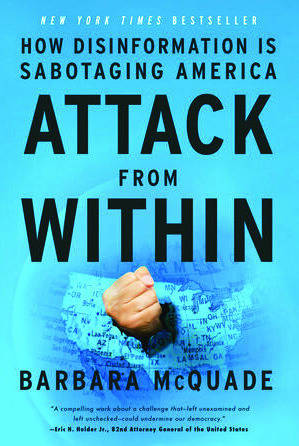
So, here’s the thing: If you’re a Donald Trump fan, you’re going to have to work really hard to read “Attack from Within: How Disinformation is Destroying America.”
There, I said it. I am risking you not reading this review, nor even considering reading this book, but let me tell you that reticence is a good reason to read it.
If you can agree with me that nobody is right about everything and everybody is right about something, then you can read anything and walk away with substance, however scant or voluminous, to ponder.
Despite far more criticism of GOP members than Democrats, it’s not a political book to turn the reader from one party to another. It is a strong plea to Americans to remember how vital the pursuit of truth is to hold leaders accountable. I think we can all agree politicians, more recently presidential candidates straining for the Oval Office, bend the truth.
Author Barbara McQuade, a University of Michigan law professor, legal analyst and former federal prosecutor, researched the history of tyrants and dictators who used disinformation to seize power. Her book explores the science of disinformation and misinformation, and why it works so well on our psyche, especially with today’s technology capabilities.
McQuade’s book also shows the tools of deception essentially work by an appeal to emotion, entrenched beliefs and the notion that one is right about practically everything. Bonus points if the target also loves a good conspiracy theory and does not believe that often outcomes are unintended and not diabolically orchestrated.
Plain old human nature can trip up any truth seeker – especially if we believe we are too smart to be duped.
The trouble is our brains are wired to gravitate to information that supports our opinions and silence anything that doesn’t – the well-worn path of confirmation bias.
With social media, penned by people or bots and populated by algorithms, we have a constant stream of affirming information to feed that bias even further, McQuade warns.
Tech concerns aside, she noted a criminal investigation wherein investigators had to retract their own findings because their first impression affirmed their suspicions and let high stakes pressure send them down the wrong path. No matter what the medium, the human brain is susceptible to seeing what we want to see.
McQuade used an even-handed example of confirmation bias in beliefs about climate change. When a disbeliever sees cold weather, they scoff at the notion that Earth’s atmosphere is heating up. When a believer sees record-setting temperatures they believe it’s climate change ramping up thanks to human causation, instead of other factors.
Entrenched beliefs like climate change are important tools for political candidates, but tyrants and dictators frequently and especially use idealizations of the past and foreboding about the future, McQuade notes.
We might say things like, “If only it could be like it was when we were kids,” or “If only president so-in-so were in office,” and “If only teachers and parents taught this or did that like they used to, then everything would be fine.” Well, how do we know that for sure? And can the past be transposed onto the present? Should it be? These are deep questions we all should ask ourselves, but power-grabbers know we don’t like to ask those questions. We just want things to be the way they were, and politicians promise to give it to us.
McQuade says purveyors of misinformation appeal to emotion so that “feelings over facts” rule a voter’s decision and if I’ve seen it once, I’ve seen it a million times during election season. Local, state and federal politicians appeal to fear, especially because nothing makes people angrier than the fear of losing one’s way of life, one’s income or rights. The angry vote; the apathetic stay home.
Tyrants “demonize” their opponent and claim their enemy will destroy the nation, meanwhile the tyrant professes he will save it. That’s pretty scary talk.
McQuade says tyrants use these feelings in their messaging, but with outright deception to win public trust above all other voices. After a while, it doesn’t matter how solid the facts may be to disprove their claims – if you want to believe it, you will.
The overarching question McQuade’s book asks is: Do you care who’s telling the truth or do you just want to hear what you believe is true? Once again, human nature besets our efforts to even ask this question, let alone answer it.
However much I side with her concerns about the lack of truth-seeking going on these days, that’s where I get a little frustrated with McQuade’s frequent one-sided examples of bad actors in the GOP. Trump is certainly her favorite example of a modern would-be tyrant or dictator, but members of both parties say the other side will take away your freedoms. Both sides lie about each other’s actions and policies via exaggeration and missing context.
McQuade does provide an example when Democrats used an altered image of GOP candidate for U.S. Senate in Pennsylvania, Dr. Mehmet Oz, in a campaign to defeat him. There are nonpolitical examples also, such as doctors and business professionals who use these tactics to fool and swindle customers or patients.
Published by Seven Stories Press, New York, 2024, Barbara McQuade’s “Attack from Within: How Disinformation is Destroying America” 384 p., is available on Amazon, Barnes & Noble, Target and Walmart.
Mindy Ragan Wood is an award-winning journalist with 18 years’ experience in city and county government and criminal justice. She can be reached at Mindy. Wood@Hilliary.com.