

“It makes sense for us to be in this neighborhood, because Fort Sill is the training base for the missile systems that Firehawk is developing design concepts for,” George Liddell, director of operations for the company, told the Lawton City Council recently.
Fort Sill is the home of the Air Defense Artillery School.
Firehawk Aerospace produces hybrid rocket engine propellant the U.S. needs to rebuild its stockpile of weapons because America has used so much of its arsenals to support its allies, Liddell said.
The small, private-sector business is “reshaping how solid-rocket motors are designed, built, and fielded, by using additive manufacturing and innovative production techniques,” said Richard Rogalski, executive director of the Lawton Economic Development Authority (LEDA).
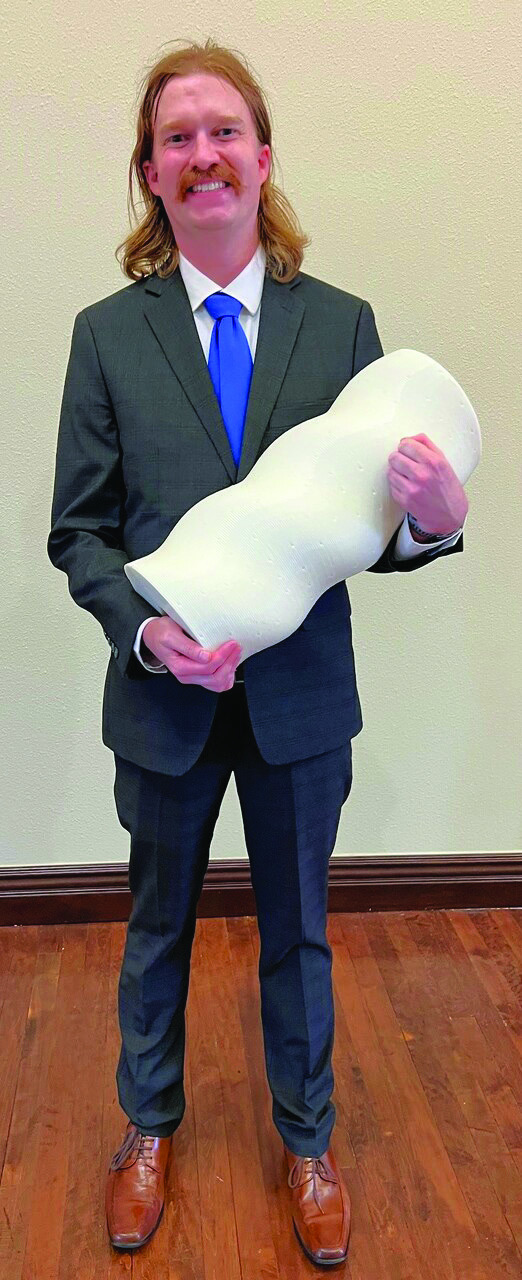
Firehawk Aerospace, which began operations in 2019, has an innovative approach to rocket propulsion: it utilizes 3D-printed solid rocket fuel to produce safer, more efficient, and cost-effective hybrid engines for various applications, including defense and commercial space exploration.
“These technologies will ensure a resilient, domestically controlled supply of critical missile systems and advanced missile technologies, supporting our country’s defense strategy and fortification of the nation’s supply chain for national security,” said Rogalski, Lawton’s former deputy city manager.
Firehawk has settled into FISTA in the Central Mall and is “looking to hire people here,” perhaps 100 or more initially, Liddell said.
The Addison, Texas-based company announced recently it will invest $45 million to build a state-of-the-art manufacturing facility in Lawton.
Firehawk Aerospace is tentatively eyeing 320 acres of undeveloped land owned by the Comanche County Industrial Authority and situated between 112th Street and Goodyear Boulevard, north of the railroad tracks, Rogalski said. The land is valued at approximately $9.6 million, records indicate.
The Firehawk initiative includes a $22 million state and federal funding package for construction of a 40,000 square-foot manufacturing facility, test infrastructure and specialized manufacturing equipment.
The company will invest in advanced machinery and other improvements to equip the $23 million manufacturing facility to be constructed by the Lawton Economic Development Authority (LEDA). This investment is expected to create approximately 100 high-tech jobs, marking a transformative milestone for the region’s aerospace and defense sectors.
The company’s contributions to the project will total more than $23 million over the next three and a half years and will include salaries, engine test equipment, propellant and production machinery and equipment, and leasehold improvements, records reflect.
Construction is set to begin later this year, with operations expected to start in 2026.
The company predicts production will reach 1,000 pounds per day of propellant, enough to power 15,000 rocket motors annually.
Firehawk’s expansion is anticipated to have a substantial economic impact on the region, fostering job creation, enhancing STEM education opportunities, and attracting further investments in the aerospace and defense industries.
The new facility in Lawton will serve as a hub for the design, production, and testing of these advanced propulsion systems, further solidifying the city’s position as a center for aerospace innovation.
Firehawk is “preparing for qualification and production capacity to support Programs of Record for multiple key Army weapon systems,” Chief Executive Officer Will Edwards said.
Mark Gibson, who lives in Pecan Valley, told the City Council of his reservations about “having a rocket fuel manufacturing plant in the neighborhood.”
“We understand national defense needs” but have “serious concerns about environmental and public health issues,” he said. “We are not anti-growth or anti-development,” he said. “But this material poses potential hazards.”
Nevertheless, the council voted 7-1 on June 10 to authorize city staff to initiate the process for rezoning the half-section of land from A-1 agricultural to I-4 heavy industrial. The lone nay vote was cast by Councilor Sherene Williams.
Mike W. Ray | Southwest Ledger Kevin Lapp, engineering infrastructure manager for Firehawk Aerospace, holds a 35-pound sample of the company’s hybrid rocket engine propellant made with a 3D printer. Nitrous oxide (commonly referred to as “laughing gas”) is inserted in the middle of this material and ignited, and it burns “from the inside out,” Lapp said.