

Why does Oklahoma have turnpikes? Because in many cases that was the only way a multi-lane, high-speed, divided highway between Points A and B could be financed.
Route 66 in Oklahoma was established in 1926, when this state was just 19 years old. It was designated as U.S. Highway 66 – also known as “the Mother Road” – and extended from Chicago, Illinois, to Santa Monica, California, becoming a significant east-west highway in the United States.
Route 66 was only two narrow paved lanes, each just 9 feet wide (compared to 12 feet today), Oklahoma Turnpike Authority Executive Director Joe Echelle told members of the Chickasha Rotary Club on Aug. 28.
Two decades later, major traffic wrecks were occurring along Route 66. Vehicles then had no seat belts, no lap belts, no padded dashboards, no airbags.
When Oklahoma’s first toll road – the 86-mile Turner Turnpike, a four-lane divided highway linking Oklahoma City and Tulsa – opened in 1953, only about one-third of Oklahoma’s highways were improved, Echelle said. “Most were still gravel or even dirt.”
In the wake of World War II, the State of Oklahoma “tried to sell bonds” to finance a turnpike but was unsuccessful “because the state’s credit rating wasn’t high enough.” So, the Legislature created the Turnpike Authority in 1947, authorizing it to sell bonds to finance turnpike construction and to repay the debt, with interest, from toll revenues.
Title 69 of the Oklahoma Statutes provides, “In order to facilitate vehicular traffic throughout the state and remove the present handicaps and hazards on the congested highways in the state, and to provide for the construction of modern express highways embodying reasonable safety devices including ample shoulder widths, long sight distances, the bypassing of cities and towns, and grade separations at intersecting highways and railroads, the Oklahoma Turnpike Authority … is hereby authorized and empowered to construct, maintain, repair, and operate turnpike projects … at such locations as shall be approved by the Transportation Commission, and to issue turnpike revenue bonds … payable solely from revenues to pay the cost of such projects.”
Today, Oklahoma has the nation’s fourth-lowest motor fuel tax of just 20 cents per gallon, which supports the tax-appropriated state highway system.
The 630-mile pay-as-you-go turnpike system has a dozen toll roads with 900 bridges and 104 interchanges.
The OTA has one of the lowest toll rates in the nation at an average of 7 cents per mile for passenger vehicles and an average of 25 cents per mile for commercial vehicles, Echelle said. Nationally the averages are 22 cents per mile for passenger vehicles and 79 cents per mile for commercial vehicles, he said.
The Turner was “the first four-lane, high-speed, divided highway west of the Mississippi River,” Echelle said. It opened to traffic three years before the federal National Interstate and Defense Highways Act created the Interstate Highway System. ‘Free roads’ not free The Turner Turnpike “sales pitch” to Oklahomans was that after the bonds were retired the toll road would become a “free road.” That was a misnomer, Echelle noted. “There are no ‘free’ roads.” All “free” roads, streets, highways and bridges are financed with taxes.
Legislation enacted in 1965 authorized “cross-pledging” of turnpike revenues, in which tolls from 11 turnpikes are deposited into one fund “to support the entirety of the system’s operations and maintenance.” The lone exception is the Gilcrease Expressway in Tulsa, which is on a separate trust indenture because of its funding structure, which includes a federal loan.
On Feb. 4, the OTA closed on delivery of $1.1 billion in Series 2025A Second Senior Revenue Bonds issued to finance a portion of the capital costs of certain Advancing and Connecting Communities and Economies Safely Statewide (ACCESS) Oklahoma projects and improvements.
Projects underway are widening the Turner to six lanes from mile marker 203 near Kellyville to mile marker 197 near Bristow; widening the turnpike in the vicinity of Stroud; and widening the toll road and a bridge in the vicinity of Wellston. This work is being done “in preparation for widening the Turner to six lanes for its entire length between Oklahoma City and Tulsa,” said Lisa Shearer-Salim, OTA’s communication manager.
The rest of the bond proceeds will be spent on improvement projects on the 105-mile Indian Nation Turnpike between Henryetta and Hugo; the 94-mile H.E. Bailey Turnpike between Newcastle and US-70 near Randlett and the Red River; and on the 88-mile Will Rogers Turnpike, which extends from Tulsa to the Oklahoma-Missouri state line.
More bonds will be issued in coming years to pay for the 15-year ACCESS Oklahoma program, which will cost an estimated $8.2 billion total, Shearer-Salim said.
Anyone who drives on the
Turn to TURNPIKE, p4 Turner knows it carries a lot of heavy truck traffic; 16% of the toll transactions in June on that highway (Interstate 44) were incurred by medium- to largesize trucks, Shearer- Salim told Southwest Ledger.
In comparison, trucks accounted for 24% of the toll transactions in June on the Will Rogers Turnpike, which extends 88 miles from Tulsa to the Oklahoma- Missouri state line, she said.
Turnpike Authority self-funded via tolls The OTA is self-funded via toll revenue “without any state appropriations,” Echelle emphasized. Furthermore, approximately 40% of its revenue is paid by out-of-state motorists, research shows.
“Oklahoma taxpayers are not on the hook for turnpikes,” Echelle said. “Bondholders are the ones ‘holding the bag.’ We are not a debt of the state.”
The OTA expects to collect almost $489 million this year. Nearly 93% of that was generated from tolls and the balance from interest income, concessions (revenue from McDonalds restaurants), and from miscellaneous sources (such as late fees).
Of that money, Echelle said: $220.6 million will be spent on asset preservation (cable barriers and pavement rehabilitation), $98.3 million will be devoted to operations (routine maintenance), and $32.9 million will be spent on 120 Department of Public Safety personnel employed by the OTA, including 99 Oklahoma Highway Patrol troopers. “Since 2016 we have funded all OHP trooper academies,” Echelle added.
The OTA also made its required bond payments of principal and interest of $137.2 million on Jan. 2, “in full and on time,” he said. The Oklahoma Turnpike Authority “has never been in default, nor has it been late on its debt service payments in the 72 years since the Turner Turnpike opened to traffic.”
In contrast, the Oklahoma Department of Transportation, which maintains highways and bridges on the state’s highway network, “has a $30 billion backlog” of needed improvements, Echelle said.
While the OTA is paying on new bonds, “we’re also closing out old bonds,” he said. As an illustration, bonds sold in 1998 to f inance construction on the Kilpatrick and Creek turnpikes will be retired in 2028, he said. OTA’s bond ratings are among the highest of any tolling entity in the nation. They include Moody’s, Aa3; Fitch, AA-; and S&P Global, Aa-.
In July, 81.7% of the OTA’s toll revenue was derived from the PikePass, 7.4% from inter-operational agreements with other states (Texas, Kansas, Colorado and Florida), and 10.87% from Plate-Pay, which replaced the cash rate. Oklahoma has no cash tollbooths remaining on its system.
PIKEPASS stickers adhere to the windshield and cost about 75 cents apiece, compared to approximately $25 for the original “soap dish style” plastic transponders, Echelle said. The OTA has 3.6 million active PIKEPASS toll tags and 1.2 million PIKEPASS accounts, ledgers reflect.
Safety a key reason for cashless tolling Late last year the OTA completed a four-year effort to create nonstop travel on Oklahoma’s turnpike system. “We were the first in the nation to go to ‘open road’ tolling,” Echelle said. “Going cashless was the most significant overnight improvement we have made.”
Safety was the primary reason for that.
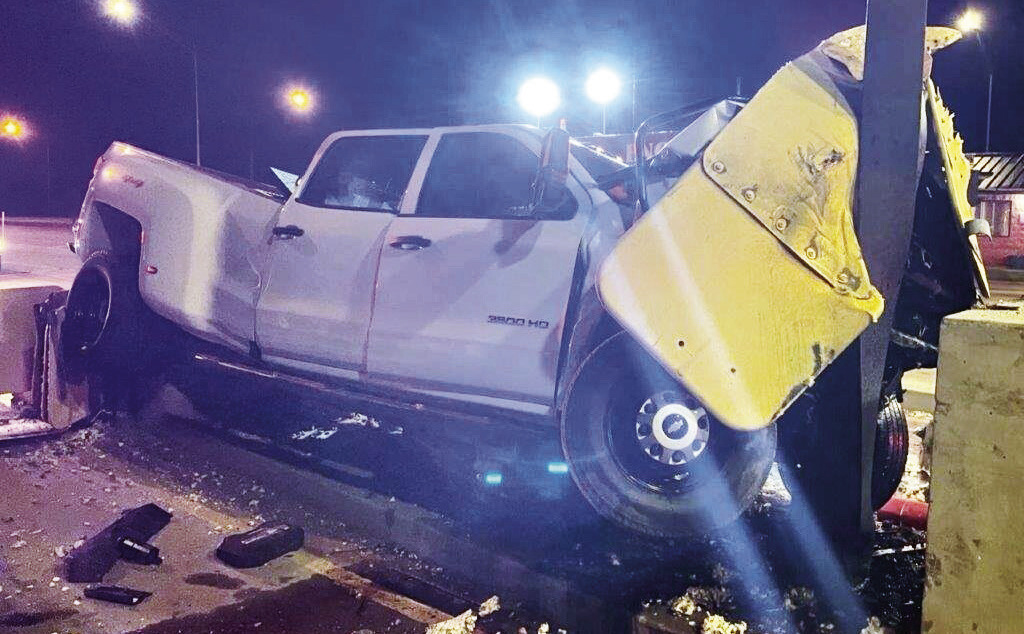
In June 2020, a Jackson County Medical Services ambulance traveling from the Altus area to Oklahoma City on the H.E. Bailey Turnpike smashed into the tollbooth at Newcastle at about 3 a.m., knocking it into the opposing lane of traffic. Four people were injured: a patient, two paramedics and the toll attendant, who miraculously survived the mishap.
Two years later, a pickup approaching the Newcastle gate while on cruise control plowed into the crash attenuator and “narrowly missed the tollbooth,” Echelle reported.
Cashless tolling in Oklahoma began in 2021 with PlatePay, in which motorists drive through toll plazas without stopping to pay a toll; instead, cameras at the toll plazas take a photo of the vehicle’s license plate as the vehicle passes through. If the driver has a PIKEPASS, the account is charged as usual; if the driver does not have a PIKEPASS, OTA mails an invoice to the registered owner of the vehicle.
Rotarian Tim Elliott asked whether the OTA has reached an agreement with any of the state’s 39 Native American tribes about paying turnpike tolls.
“We’ve been struggling with that,” Echelle said. “There’s a lot of misinformation getting tossed around.”
The State of Oklahoma has “compacts” with the Chickasaw, Choctaw and Cherokee nations, and the OTA has agreements with the Miami Tribe, Sac and Fox Nation and the Shawnee Tribe for access to those tribes’ motor vehicle registration information, Shearer- Salim said. OTA also has a Phase 1 agreement with the Seminole Nation “and negotiations are ongoing,” she told the Ledger.
Vehicles bearing license plates from tribes that don’t share their owners’ information with the OTA have amassed $17 million in unpaid tolls, Echelle said.
Meanwhile, Oklahoma’s cashless tolling system “will soon be tied in with Canada,” he said.