

Southwest Ledger
LAWTON – Westwin Elements is constructing a “state-of-the-art nickel/cobalt refinery” in southwest Lawton that “marks a significant step toward reducing America’s reliance on foreign countries for its raw material supply chain…” The pilot project will generate nearly 1,500 direct and indirect jobs, according to Richard Rogalski, executive director of the Lawton Economic Development Authority and Lawton’s former deputy city manager.
Additionally, chemists and engineers contend Westwin’s facility would be safe.
Nevertheless, critics are skeptical and expressed their distrust during back-to-back City Council meetings recently.
Westwin’s project “has taken several twists and turns over the past two years,” Brad Cooksey, president of the Lawton/ Fort Sill Economic Development Corporation, told the City Council on April 22.
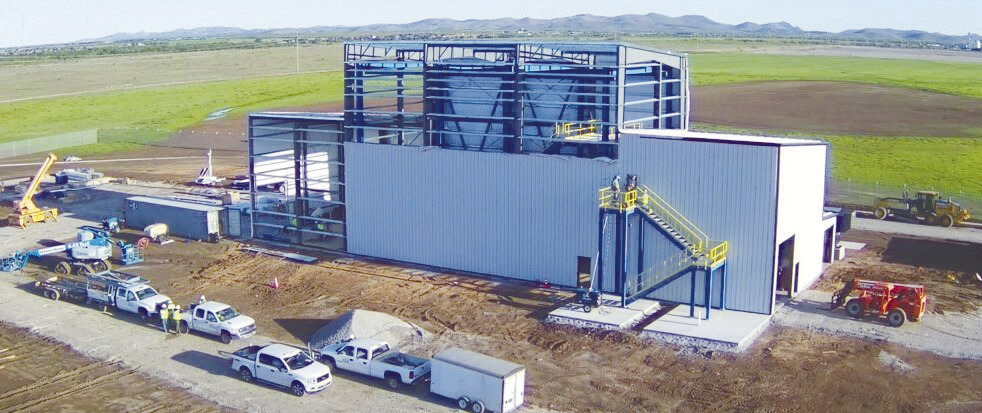
Construction on the pilot facility for refining nickel on 40 acres owned by the LEDA began Nov. 30, 2023, at the corner of Southwest 112th Street and Bishop Road, and reportedly is on schedule for completion this summer.
Officials emphasized that the pilot plant “would be developed as a precursor to a large-scale commercial facility” that’s also contemplated.
A year ago, KaLeigh Long, founder and chief executive officer of Westwin Elements, said company officials were in talks with several aerospace companies, such as Lockheed Martin and Boeing, to supply them with refined rare minerals and projects that would “eventually produce slightly near $2.6 billion in annual revenue and hundreds of jobs.”
Rogalski told the City Council that Westwin will create 735 jobs with an average salary of $100,000 per year, for a payroll of $73.5 million annually. The project also is expected to create 500 other direct jobs and 245 indirect jobs, and generate $8 million in new taxes for the City of Lawton, he said.
The tax revenue that Westwin could produce is needed to help finance the many capital improvements that are needed in Lawton on its streets, water and sewer lines, the wastewater treatment plant, and parks, Councilman Kelly Harris said.
Westwin Elements, based in Oklahoma City, describes itself as “the pioneering force behind the first major nickel, cobalt, and manganese refinery to solve America’s critical minerals crisis…” The “full-scale production facility” will refine nickel “through the carbonyl process and will utilize the feed residue for the recovery of other critical metals, including cobalt and manganese, which will be processed through an additional hydrometallurgy circuit.” The plant will use nickel power as feedstock.
The carbonyl process utilized by Westwin has been in use f or more than a century “and is a proven, clean process to yield high-purity nickel products. By inputting mixed hydroxide precipitate as our preferred feed, we refine high-purity nickel metal and extract cobalt and manganese from carbonyl residues.”
Rogalski pointed to a nickel plant in Wales – Vale Europe Clydach Refinery, also known as “The Mond 1902” – that has operated for a century. The town “was built around the refinery,” he said.
The future refinery in Lawton would supply raw materials needed to produce items such as aerospace alloys and lithium-ion batteries, company representatives said.
Westwin officials say their company adheres “to the highest ethical and environmental standards” and “ensures the responsible sourcing of cobalt and nickel…” The company’s refining processes “boast over 200 years of combined expertise, resulting in products of highest quality, environmental neutrality, and unmatched purity, all while maintaining competitive pricing relative to foreign sources.”
Air emissions analyzed There has been “a considerable amount of concern regarding the environmental impact” of the Westwin project,” Lawton officials noted.
Consequently, Blackshare Environmental Solutions performed a third-party review of the air quality permit application that Westwin submitted to the Oklahoma Department of Environmental Quality for emissions from their pilot facility. The study was commissioned by the LEDC, Cooksey said.
The federal government has established criteria for various pollutants that require permits, “to prevent degradation of health and the environment,” said Derek Blackshare, president and chief executive officer of Blackshare Environmental Solutions, which is based in Tulsa. Also, states such as Oklahoma may require some permits beyond those required by federal agencies.
Last October, Westwin estimated the emissions from its pilot plant, primarily particulate matter – dust, in layman’s terms, “from bagging and loading,” Derek Blackshare said. “That was their main source of emissions.” Those emission levels were below the maximum permissible by the DEQ, he said.
In January of this year Westwin applied for a special permit for a 578-horsepower emergency generator at the production site. Those emissions, from CO (carbon monoxide) and NOx (nitrogen oxides), are “the primary pollutants” from the generator and are products of combustion, Blackshare explained.
Those pollutants, too, are below permissible levels, he said: NOx, 4.9 tons/year and CO 1.8 tons/year (equivalent to emissions from 36 gasoline- powered cars).
Westwin “was permitted properly and its emissions are relatively low,” Blackshare said.
Blackshare’s company has more than 35 years of environmental engineering experience and has provided environmental compliance and permitting for more than 300 industrial facilities in Oklahoma, City Hall and LEDC officials said.
Derek Blackshare is a certified hazardous materials manager. He instructs a graduate-level college course on hazardous materials and environmental compliance and is on the Environmental Programs Advisory Board for Oklahoma State University. He earned a Bachelor of Science degree in mechanical engineering, and a master’s degree in industrial engineering and management.
City ‘gaslighting’ public Kaysa Whitley accused the City Council of “ignoring the people” and “gaslighting” the public about Westwin’s potential hazards, such as air emissions. In addition, the city did not perform “due diligence on protection of tribal sites” near the Westwin project.
Cooksey, though, showed the City Council that Garver Engineering of Norman performed a “cultural resources study within the Westwin project site and a one-mile buffer around it. Garver used local, state and national databases that included current listings of the National Register of Historic Places, the Oklahoma Landmarks Inventory, and the State Historic Preservation Office.
The Archaeological Survey at the University of Oklahoma reviewed the Westwin project “in order to identify areas that may potentially contain prehistoric or historic archeological materials.” The location was crosschecked with state site files “containing approximately 26,000 archaeological sites, which are currently recorded for the State of Oklahoma.” No sites were listed as occurring within the project area.
Historic topographic and General Land Office maps also were used to “identify historic sites and cemeteries,” Garver reported.
“There are no National Register of Historic Places” or State Historic Preservation Office sites within a mile of the Westwin project, Garver was informed.
“I don’t feel like we have had a voice” in the Westwin issue, one critic said. “We haven’t heard from the other side. Where’s the research from that side?” Lawton City Council meetings “are held in the afternoon,” she noted. “I work and can’t come to those meetings.” She also complained that “I didn’t get to vote on whether we wanted a cobalt refinery.”
Another critic said the City of Lawton “has had discussions where only professionals were consulted.” The City Council “has not sought input from the public. The citizenry has been shut out of the discussions.”
Westwin was topic of several meetings Councilwoman Mary Ann Hankins disagreed. “We have had a lot of opportunities for people to get their questions about this project answered,” she said. “We’ve had forums.”
The LEDC “has met with several small groups,” Mayor Stan Booker said. “We’ve had more meetings about this than anything else I can remember.”
“We’ve had several meetings about this. I think the process has been transparent,” said Councilman George Gill, a lifelong resident of Lawton. “We’ve had chemists talk about it, and now we’ve had an engineer.” Gill said most of the telephone calls he receives from constituents “are, ‘What are we going to do for the citizens of Lawton and for the kids of Lawton?’ We have to have industry to make this town grow.” And virtually every industry requires weighing “risk versus results,” he said.
Robert Ratcliffe, a retired serviceman, said cobalt is mined in the Congo and diseases have been attributed to cobalt mining.
The Westwin project has “more dangers than are being addressed,” he said. Cobalt mining in an Idaho mountain range ceased in 1992 after federal regulators confirmed that pollution from an open pit mine contaminated nearby watersheds, he related.
“Can you reassure this community that we will never have health issues because of the facility?” Ratcliffe asked.
Councilman Randy Warren said the Blackshare engineering review of the Westwin project “affirms for me information we have been provided from the beginning.” What is proposed is “a new process,” he said. “Any industry has inherent dangers to prepare for and train for.” City of Lawton employees, for example, “handle different chemicals and we train our employees for them.”
Great Plains Technology Center in Lawton provides training for industries, Hankins noted, adding, “Goodyear has risks. Bar S Foods has risks.”
Citizens have advised us “to be cautious,” Councilman Allan Hampton said. “I don’t think we’ve rushed into this. I, for one, don’t want to put my family in danger.”
Kerri Shelton, from Bethany, noted that Oklahoma winds routinely “come sweeping down the Plains” and will blow dust particles from the Westwin production site. Similarly, Becky Lekey said, “We need to be worried about particulate matter, stuff that’s floating around in the air.”
Councilman Harris owns Oklahoma Mobile X-ray Inc., which provides medical services to homebound and nursing home patients throughout southwest Oklahoma.
Cobalt is used to treat cancer, he noted. “People have fears” about Westwin. “I understand those fears. We have tried to assuage those fears.” No one on the City Council “wants to bring a company to town that injures people,” Harris said. “I’ve come to the conclusion that this is safe.”
Councilman Bob Weger said he has been contacted by several of his constituents about the Westwin plant. “Some have been against it, many have been for it. They want accountability.” As for Weger himself, “I’m very much on board.”
“We have to move forward. We have to have hope,” Hankins said. “We don’t want to stand still.”