

Marija Fine was an infant in March 1944 when Nazi soldiers wrestled her from her mother’s arms and shipped the baby to orphanages in Latvia and Germany. She would never see her biological mother again.
Fine, now 77, was one of thousands of children separated from parents who were sent to German concentration camps because of their opposition to the war and the Nazi regime. Five years later, as part of the U.S. and British rebuilding efforts in Europe, some orphans, including Fine, were flown to the United States and adopted by American families.
In Fine’s case, she was adopted by John and Selma Futches who lived in Boulder, Colo. Fine’s fortunes turned from bad to good with the adoption as she enjoyed her childhood in a loving home and later became a well-educated woman with multiple college degrees.
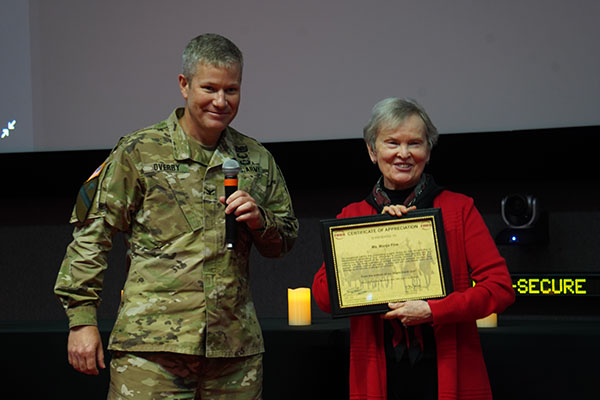
That’s part of the story Fine told Fort Sill officers and soldiers April 15 as part of the post’s annual Days of Remembrance event at Reimer Conference Room in Snow Hall.
Fine is the author of “Wide Eyes: A War Orphan Unlocks the Mystery of Her Latvian Roots After Seventy Years.” But Fine didn’t know the details of her biological family or heritage until 2014 when a family detective in Riga, Latvia, unraveled the mystery about her parents. For seven decades, Fine’s humble beginnings were unknown because of the Soviet occupation of her native Latvia, which became an independent country once again in 1991. Since then, Latvia has established itself as a democratic, unitary parliamentary republic.
The detective’s efforts enabled Fine to be reunited with the one surviving member of her father’s family – her aunt Leonora. The discovery opened Fine’s eyes to her identity and allowed her to understand her origin and her family name Platacs, which means wide eyes.
Her father Bronislavs Platacs and his wife, Solomeja, married other people after World War II and began new lives in separate countries, Fine learned. She later discovered many of the orphans who came from the Baltic states did not enjoy the life she had in the U.S. Their experiences were far from enjoyable, she said during an interview after her Fort Sill speech.
Yet, they all feared for their lives at the German and Latvia orphanages.
“Many children were shot as we were transported from place to place,” she recalled. “We had to live in basements for two weeks.”
Malnourishment was not uncommon for the war orphans.
“I couldn’t walk until I was 24 months old,” she said.
About 1.5 million children – mostly Jewish – died and lost families as part of the Holocaust, Fine said.
Fortunately for Fine, she has no recollections of her time at the war orphanages. But her investigation into her family since 2014 has provided a plethora of information about her entire life. During her research for the book, Fine was able to interview her babysitter, her aunt and discover “what life was like when I was born.”
Although the research for the book helped fill a specific void in her life, Fine said she is happy that she was brought to the U.S. and adopted by the Futches.
“I landed in a wonderful place,” she said of her adoption. “I was fortunate on how things worked out for me.”
For years, she had questions about her parents and what happened to them. She learned that a Soviet newspaper had printed the names of all the children at orphanages, but she conceded her parents were not educated and likely would not have read the newspaper.
“It probably would have been an unhappy life,” she said. “It would have been a tough time with the Soviet occupation. I was spared the post-war problems.”
Fine became a U.S. citizen in 1955. In 1965, she received a degree in history from Midland University in Fremont, Neb. Five years later, she earned a master’s degree in International Studies from The American University in Washington, D.C.
Fine also earned educational certificates for teaching English as a Second Language and computer programming. She later put the certificates to good use. She has 20 years of experience as a teacher and director of ESL. From 1986 to 1994, she trained youth in life skills and trained adults in computer literacy at WAVE, a national youth agency.