

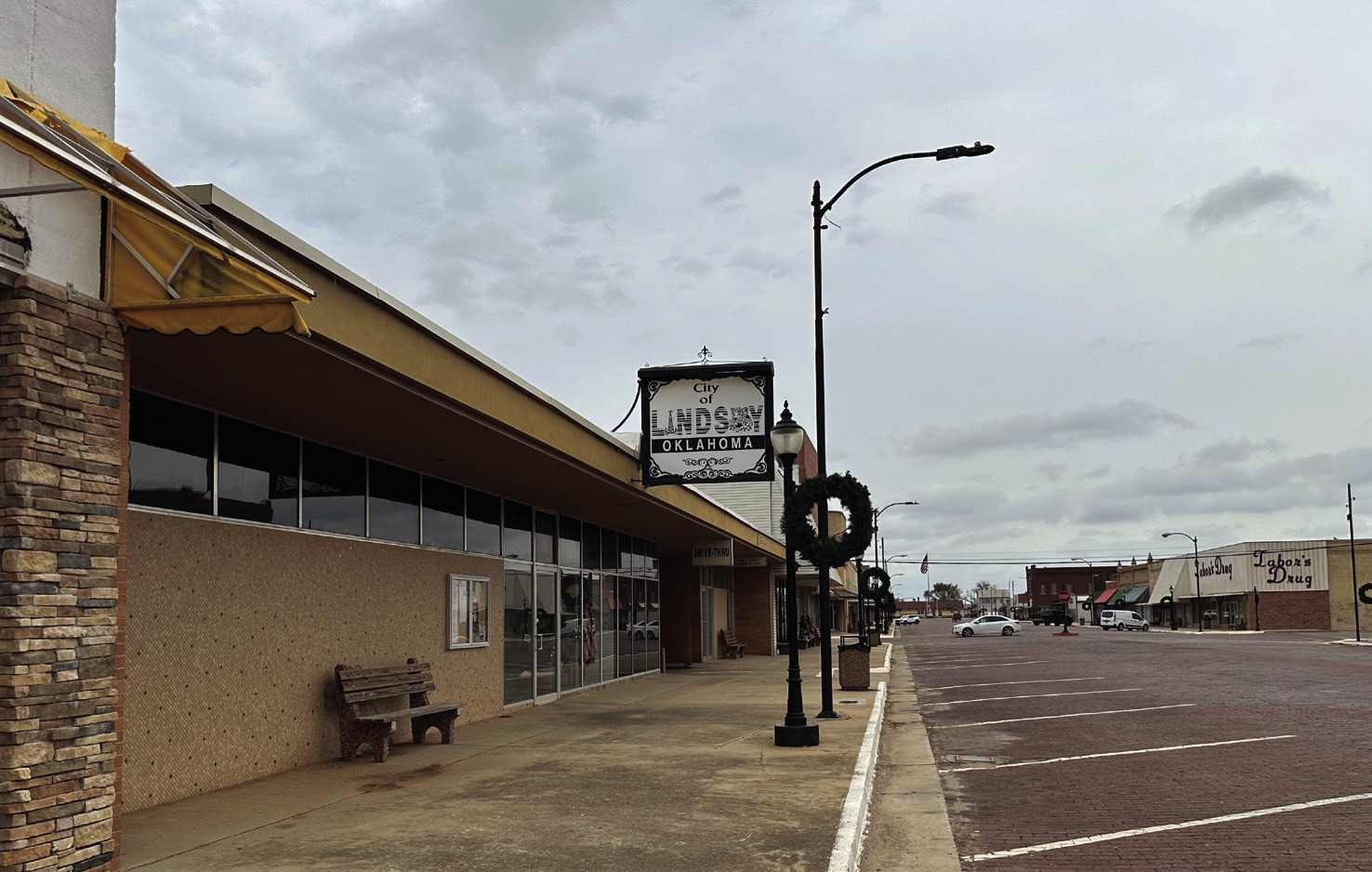
OKLAHOMA CITY – A forensic audit of the financial records of the City of Lindsay over a three-year period revealed “countless examples of a lack in oversight, gross mismanagement, and poor decision making” that “shortchanged” local taxpayers “by hundreds of thousands of dollars,” State Auditor and Inspector Cindy Byrd reported. However, she added, there was “very little evidence of fraudulent behavior.”
The audit was performed at the request of Garvin County District Attorney Greg Mashburn, Byrd related, and was delivered on Nov. 12.
The results of the city audit were announced less than a month after The First National Bank of Lindsay was closed by federal regulators who uncovered “false and deceptive bank records suggesting fraud.” The Federal Deposit Insurance Corp. was named receiver on Oct. 18 and the bank’s insured deposits were transferred to First Bank & Trust Co. in Duncan.
Lindsay “experienced substantial financial difficulties” during the audit period of July 1, 2019, through June 30, 2022, “primarily caused by the City Council’s failure to provide adequate oversight along with poor financial decisions made by city management,” Byrd wrote. “Obvious warning signs … went unnoticed.”
The effect of the “lack of oversight” was increased by “ineffectual city leadership that failed to properly maintain records and oversee city functions,” Byrd related. An “inability to obtain timely audits potentially cost the city more than $1 million in grant funds, and failure to maintain a properly functioning utility program almost the cost over $1 million.”
On a positive note, the City of Lindsay is “working diligently to resolve the issues” pointed out in the state audit “and appears to have ‘turned the corner’ financially,” Byrd said. City and Lindsay Public Works Authority accounts contained $5.78 million on June 30, 2024, ledgers showed.
“Public audits are being performed again and the city has caught up and is fully eligible to apply for grant money.”
The audit uncovered a variety of issues in seven areas.
• Utility revenue. City Hall estimated that it underbilled commercial customers by approximately $1.5 million as of June 2024, although city officials said they expect to recover approximately $676,000 (45%) of that amount.
Underbillings began as early as 2010 and didn’t cease until May 2024, state auditors discovered. In July the city began efforts to collect 18 months’ worth of underpayments.
Electric meters were installed but not entered into the billing system. Some meters were installed incorrectly, so some customers were underbilled. And internal settings in the billing software were set incorrectly, resulting in underbilled accounts.
The council approved a 1-cent rate hike on residential and commercial electric rates effective Jan. 1, 2019, but it wasn’t implemented until five months later, “resulting in the loss of approximately $88,460 in utility revenue.”
Failure to process rate increases, collect late fees, and bill for current usage resulted in $152,460 in lost revenue. Late fees that were not properly assessed during the eight months of utility billings reviewed by state auditors resulted in the loss of an estimated $64,000 in revenue.
The city failed to bill for all utility usage, resulting in a backlog of billed utility revenue of up to $170,00.
By June 30, 2022, unpaid utility billings had soared to $930,982.
Additionally, state auditors examined 53 accounts (29 council members and key city employees plus 24 other customers) to determine whether any of them received “preferential treatment.” Three key employees, three council members, and four citizens had “significant overdue” utility billings. Two city employees and two City Council members continued to receive utility services despite not having made any payments for periods ranging from four to eight months.
Turn to AUDIT, p8 The maximum amounts in arrears among the key employees and the council members ranged from $1,145 to $3,470, auditors found.
• Sales taxes. Lindsay voters approved a 4% sales tax rate, of which 2% was unrestricted, 1% was designated for Emergency Medical Service, and 1% was designated for the Lindsay Public Works Authority for buying water and making capital improvements to the utility system.
Nearly half a million dollars of restricted sales taxes earmarked for the LPWA was “improperly retained” in the city’s General Fund bank account. City officials “should transfer this amount to the LPWA when possible,” Byrd advised.
• Expenditures. Eight invoices from the Grand River Dam Authority (four each in 2021 and 2022) were paid late, “some due to insufficient funds being available,” resulting in $16,319 in late fees.
In an evaluation of 26 expenditures, state auditors found one purchase order greater than $35,000 that was not properly approved by the City Council; eight purchase orders for amounts that exceeded $10,000 “were not properly approved;” invoices on four purchases were missing; 10 purchase orders were not properly encumbered; and four purchases had invoices that were not dated.
Minutes of the council meeting Aug. 13, 2018, related that bids were obtained and approved for the purchase of an ambulance for $159,343. However, supporting documentation of the bid process and award “could not be provided,” state auditors reported.
Similarly, a ladder truck bought in 2018 for $729,073 was approved by the council “but was purchased using a Texas BuyBoard contract.” No evidence could be found indicating that the company on the BuyBoard contract was “a properly bid vendor for the State of Oklahoma.” The City of Lindsay financed the ladder truck for $780,000 over a seven-year period, records reflect.
State auditors reviewed P-card expenditures from July 2018 through June 2022 for the City of Lindsay and for the Lindsay Public Works Authority. (A P-card is a purchasing card or a credit card used for buying goods and services.)
During that four-year period there were 16 city P-card users and 15 LPWA P-card users. City P-card expenditures averaged more than $128,000 per year, and LPWA P-card expenditures averaged more than $94,000 per year. Total P-card expenditures during that period came to $892,786.
Testing of P-card expenditures were narrowed to purchases made by six employees. The findings “indicated that the City and the LPWA did not maintain adequate records to support” P-card expenditures; records for several months were missing.
One employee “consistently failed to submit his P-card transaction log with any accompanying receipts.” Further, a review of $117,068 in expenditures found that records were lacking for 29.5% of those purchases.
A “disproportionate amount” of the missing P-card records was attributed to two individuals: former City Manager Rebecca Niernberger and former City Clerk Kathy Hammans.
No records could be found to support $10,651 in P-card expenditures by Niernberger, she made $1,789 in “questionable” food purchases, and she “improperly” charged $727 in fuel at Webb Oil by filling her personal vehicle – even though she received a $500 per month car allowance from the city.
Similarly, no records could be found to support $20,156 in P-card expenditures by Hammans.
• Payroll. The City Council voted during a special meeting in January 2022 to approve COVID-19 hazard pay to all city employees. A resolution specified that payments were to be $1,300 per person; payments were to be prorated for the time the individual was employed by the city in calendar year 2021; and total costs were not to exceed $85,000.
The program, administered by Niernberger, “resulted in overpayments totaling $26,065 – all 59 employees who were awarded the onetime hazard payment received $1,550 instead of $1,300, auditors found. In addition, the total payout climbed to $91,450, or $6,450 more than the council authorized.
State auditors also evaluated 43 pay raises for “appropriateness and proper approval” per Lindsay’s City Charter.
Two dozen of those pay raises, ranging from 24.2% to 64.8%, were approved “solely by the city manager between Nov. 3 and 8, 2021 – and they cost the city $281,994 per year, “not counting additional retirement contribution costs,” auditors reported.
The documentation for six of the 43 raises (14%) was “either missing, not properly filled out, or not properly approved.” The City Council “did not specifically approve any of these pay raises” with the exception of one for an acting city manager.
According to the charter, any officer approving unauthorized payments “shall be liable to said city individually” for the amount of the transaction.
In a related matter, four contracts involving former city managers were not properly approved by the council.
• Donations. During the three-year audit period, $167,268 was deposited or transferred into the city’s Donation Fund bank account. No logs or records were maintained on cash donations, “so the cash that was deposited could not be allocated to a particular department,” auditors reported. Donation checks totaling more than $53,000 were made out to the General Fund “without any indication as to which specific department was to receive the funds.”
Failure to accurately track donations resulted in an inability to credit $92,000 in donations to designated departments, auditors reported.
• Audits. The city’s financial audits were not completed in “the statutorily required timeframe.” State statute requires municipal audits to be completed and filed with the State Auditor and Inspector within six months after the close of each fiscal year, i.e., by Dec. 31 of that particular year.
In the three-year period covered by the state audit, one audit was five months late, the Fiscal Year 2021 audit was 19 months late, and the FY 2022 audit was 16 months late. Both audits that were filed more than a year late were delayed “primarily due to the city’s disorganized and incomplete financial records.”
The lack of timely audits “hindered the City Council’s assessment of the city’s financial status” and prevented the city from applying for grants.
Consequently, according to the current city manager, if the audits had been maintained in a timely manner the city could have applied for grants worth up to 50% of the $2.3 million cost of new “smart” meters the City Council approved for purchase in December 2021.
• Open Records requests. On “several occasions,” local citizens claimed that the city “failed to adequately comply” with Open Records requests.
City Hall received 470 Open Records requests during the three-year audit period. Of those, 31 had no completion date cited in the city’s Open Records request ledger; three requested nonexistent records and 28 of them (6%) were not completed. During the audit period, 19.4% of completed requests – almost one of every five – required two weeks or longer to fulfill.
During the second half of 2023, City Hall received 83 Open Records requests and all were completed. The average number of days to complete a request was 3.3 days, but one wasn’t fulfilled until 71 days had passed. Only three of the 83 requests required two weeks or longer to complete.
• Auditors’ final thoughts. “The city has made great strides since the end of the audit period” on June 30, 2022. Revenue in city and LPWA accounts stood at $5.78 million on June 30, 2024, public audits “are being performed again and the city has caught up…” Also, the Open Records response process “appears to be operating smoothly and efficiently.”
Expenditures “have been brought under control.” P-card expenditures are now subject to City Council review and have been reduced from more than $223,000 per year to less than an average of $50,000 per year in FY 2022 and FY 2023.
Unbudgeted pay raises have been “partially reversed” and current pay raises are “within budget.”
Utility billing errors “have been identified and corrected” and collection of “a portion of the amount owed” has begun.